AI CV Makers: A Guide to Resume Design and Job Applications
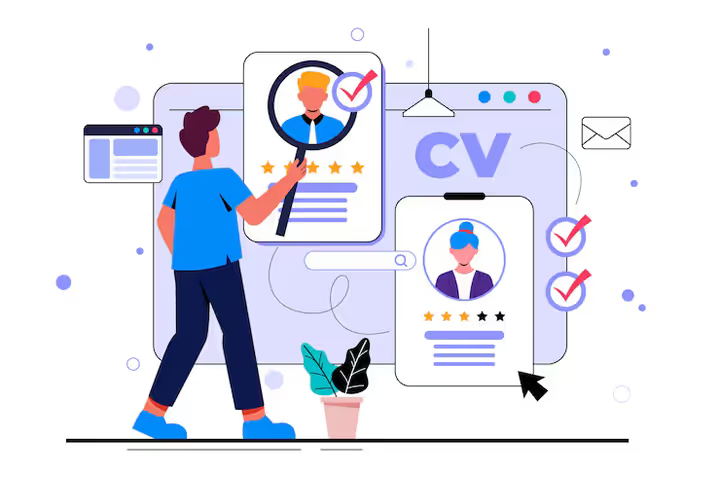
AI CV makers are digital tools that use artificial intelligence to help people prepare curriculum vitae (CVs) and resumes.
They can assist with writing professional summaries, organizing education and work history, describing skills, and adapting documents to different types of employment opportunities. These tools combine document templates, language-processing technology, and structured forms to simplify the process of creating a professional profile.
A CV traditionally presents a person's education, qualifications, work experience, achievements, and relevant skills. In some countries, including India, the terms CV and resume are often used interchangeably. In other regions, a CV may be a longer academic or professional record, while a resume is usually a shorter document tailored to a particular position.
How AI CV makers developed
Earlier resume tools primarily focused on templates, fonts, page layouts, and formatting. Users entered their information manually and arranged it within a selected design. Later tools introduced spelling checks, prewritten phrases, and guided forms that helped users organize their professional details.
Modern AI CV makers can interpret written information and generate suggested descriptions in natural language. Some can identify repeated words, reorganize sections, suggest skills based on a user's stated experience, and adapt the tone of a professional summary. Their capabilities vary by platform, and the output still requires human review.
How artificial intelligence helps create a CV
Many AI CV makers rely on natural language processing, a branch of artificial intelligence that helps computer systems interpret and generate human language. More recent systems may use large language models to produce summaries, rewrite sentences, or respond to instructions about a document.
A typical process involves four stages:
Information entry: The user enters education, experience, skills, qualifications, and other relevant details.
Content generation: The tool drafts summaries, experience descriptions, or skills sections using the information supplied.
Document organization: The platform places the content into a selected layout and arranges the sections.
Review and export: The user checks the document, corrects errors, and saves it in a suitable format, such as PDF or DOCX, when supported.
The technology can help with wording and presentation, but it cannot independently verify every statement about a person's qualifications or experience.
Why AI CV Makers Matter Today
Preparing a CV can be difficult for students, recent graduates, career changers, and experienced professionals. Some people understand their abilities but struggle to describe them clearly. Others may have substantial experience but find it difficult to organize several years of work into a concise document.
AI CV makers address these challenges by providing structured guidance and language suggestions. They can help users move from unorganized notes to a readable document without requiring advanced writing or design skills.
Different users and their needs
The usefulness of an AI CV maker depends on the user's background and the purpose of the document.
Students and recent graduates: These users can organize academic projects, internships, certifications, volunteer activities, and relevant coursework.
Experienced professionals: AI writing tools can help summarize responsibilities and explain achievements in a clear, consistent style.
Career changers: Users can highlight transferable skills, such as communication, planning, research, or technical knowledge.
Freelancers and independent professionals: A CV can present project experience, client work, qualifications, and specialized abilities.
Academic applicants: Some tools can organize research experience, publications, conference participation, and academic qualifications.
AI-generated wording should reflect the user's actual background. A tool may suggest that a person highlight project management, for example, but that suggestion does not establish that the person has managed projects.
Applicant tracking systems and readable documents
Many organizations use applicant tracking systems (ATS) to collect applications and help organize candidate information. Depending on the system, these platforms may extract details such as names, employment history, education, and skills from submitted documents.
AI CV makers may include templates designed for easier text extraction. Simple headings, consistent formatting, and recognizable section names can help both automated systems and human readers interpret a document.
However, no particular layout or keyword arrangement guarantees that a CV will pass an ATS or lead to an interview. Systems differ in their capabilities, and selection decisions may involve many factors beyond document formatting.
Recent Developments in AI CV Technology
AI writing and document tools have become more flexible, with an increasing emphasis on personalized content, automated feedback, and connections between different stages of application preparation. Developments across 2024–2026 reflect a broader shift from template-based editing toward tools that can interpret instructions and work with longer pieces of text.
Personalized writing and role-specific content
Some AI CV makers can adapt a professional summary or experience section to a particular field. For example, a person applying for a software development position may emphasize programming languages and completed projects, while an applicant for an administrative role may focus on scheduling, record management, and communication.
This process usually works by comparing the user's existing information with the language and requirements of a target position. The tool can suggest which relevant details deserve greater attention, but users should confirm that every statement is accurate.
AI feedback and document analysis
Newer tools may assess a CV for readability, section completeness, repeated phrases, and alignment with a supplied position description. Some platforms also identify vague statements and suggest more specific wording.
For example, a sentence such as “Worked on customer records” might be revised to explain the type of records maintained and the tasks performed. Any numerical results or claims about performance should come from the user's actual experience rather than being invented by the AI system.
Integration with broader career tools
AI CV makers increasingly appear alongside interview preparation, cover letter writing, profile editing, and career planning features. Some platforms allow users to reuse information across several documents, reducing repeated data entry.
These integrations introduce practical considerations. Personal information may be stored across multiple tools, and generated content may become inconsistent when different versions of a CV are edited separately. Maintaining one accurate record of qualifications and employment history can help reduce these problems.
Comparison of common AI CV features
Feature | Main purpose | Important limitation |
|---|---|---|
AI writing assistant | Drafts summaries and experience descriptions | May generate inaccurate claims |
CV templates | Organizes information into a document layout | Some layouts may be difficult to parse |
Keyword suggestions | Identifies relevant terms from a position description | Excessive repetition can reduce readability |
Grammar checker | Detects language and punctuation issues | May miss contextual errors |
ATS-oriented analysis | Reviews document structure and terminology | Cannot predict every employer's screening process |
Document export | Produces a shareable file | Formatting may change between applications |
The availability of these features varies by platform, subscription level, and document format.
Laws and Policies Relevant to AI CV Makers in India
AI CV makers operate within a broader legal environment involving personal information, digital platforms, employment practices, and intellectual property. The applicable rules depend on how a platform collects data, where it operates, and how employers use the information provided by applicants.
Personal data protection
India's Digital Personal Data Protection Act, 2023 establishes a framework for processing digital personal data. Its implementation includes rules and commencement arrangements that may take effect in stages, so the provisions applicable to a particular situation depend on the relevant date and legal requirements.
CVs can contain personal details such as names, contact information, education records, employment history, and professional identifiers. Users should review a platform's privacy notice, understand how submitted information may be used, and check whether documents or prompts may be retained for further processing.
It is also sensible to avoid entering unnecessary sensitive information into an AI tool. A CV generally does not need bank details, account passwords, or unrelated personal records.
Employment and non-discrimination considerations
Employers may have legal obligations under applicable Indian laws and workplace policies when making recruitment decisions. AI-generated CVs do not remove those obligations, and an AI system should not be treated as an independent authority on a person's suitability.
Applicants should ensure that qualifications, dates, certifications, and employment details are accurate. Employers using automated screening systems should consider whether their processes introduce unfair barriers or rely on irrelevant information.
Intellectual property and originality
A CV normally presents personal facts and experience, but the language used to describe them may be generated or revised by an AI system. Users should check the terms of the platform they use and review any restrictions concerning submitted material, generated content, or document ownership.
A person's actual experience should remain the foundation of the CV. Copying another applicant's achievements or claiming qualifications that have not been earned can create serious problems during verification.
Tools and Resources for Creating an AI-Assisted CV
AI CV makers differ in their writing capabilities, formatting options, privacy practices, and document export features. Comparing these characteristics helps users understand what a platform can and cannot do.
Commonly used platforms
The following tools illustrate different approaches to CV preparation. Their individual features and access arrangements may change over time.
Canva: Provides visual document templates and design tools for creating structured professional documents.
Kickresume: Focuses on CV and cover letter creation, with AI-assisted writing features.
Teal: Combines resume editing with tools for organizing application materials and tracking applications.
Rezi: Concentrates on resume structure, keyword alignment, and features intended to support ATS readability.
Microsoft Word: Supports conventional CV creation through document templates, formatting tools, and writing assistance where available.
Google Docs: Provides document templates, collaborative editing, and standard formatting options.
These platforms differ in their available features, data handling practices, supported languages, and export formats. A platform's inclusion here is descriptive and does not imply that it is suitable for every user.
Information to prepare before using a tool
AI CV makers generally produce more relevant drafts when the user supplies clear and accurate source information. Useful material includes:
Education history, including institutions, qualifications, and completion dates.
Employment history, including roles, responsibilities, and verified achievements.
Technical and interpersonal skills supported by actual experience.
Certifications, academic projects, publications, or relevant training.
A target role or field, when the document is intended for a particular application.
Before sharing the document, review spelling, dates, contact information, section order, and any claims generated by the system. Check the exported file on a separate device or document viewer to confirm that the layout remains readable.
Frequently Asked Questions
What is an AI CV maker?
An AI CV maker is a digital tool that uses artificial intelligence to help draft, organize, edit, or format a curriculum vitae. It may suggest professional summaries, revise experience descriptions, and identify relevant skills based on information supplied by the user.
How do AI CV makers help with ATS readability?
Some AI CV makers suggest conventional headings, relevant terminology, and simpler layouts that can help software extract document information. Results vary across applicant tracking systems, so no format can guarantee that an application will pass automated screening.
Can students use AI CV makers without work experience?
Yes. Students can use them to organize education, academic projects, internships, extracurricular activities, certifications, and relevant skills. The document should clearly distinguish completed experience from coursework, practice projects, or future goals.
Is it safe to upload a CV to an AI platform?
Safety depends on the platform's privacy practices, security measures, and data retention policies. Users should review those policies and avoid submitting personal information that is unnecessary for creating the document.
Should an AI-generated CV be checked before submission?
Yes. AI-generated text can contain incorrect details, vague descriptions, or claims that do not reflect the user's experience. A careful review helps ensure that the final document is accurate, relevant, and easy to read.
Final Thoughts
AI CV makers combine writing assistance, document formatting, and language analysis to help people organize professional information. Their features can support students, experienced professionals, and career changers, although the quality of the result depends on the information provided and the review process. Privacy, accuracy, document readability, and truthful descriptions remain important considerations. AI can assist with preparing a CV, but the final document should represent the person's actual qualifications and experience.