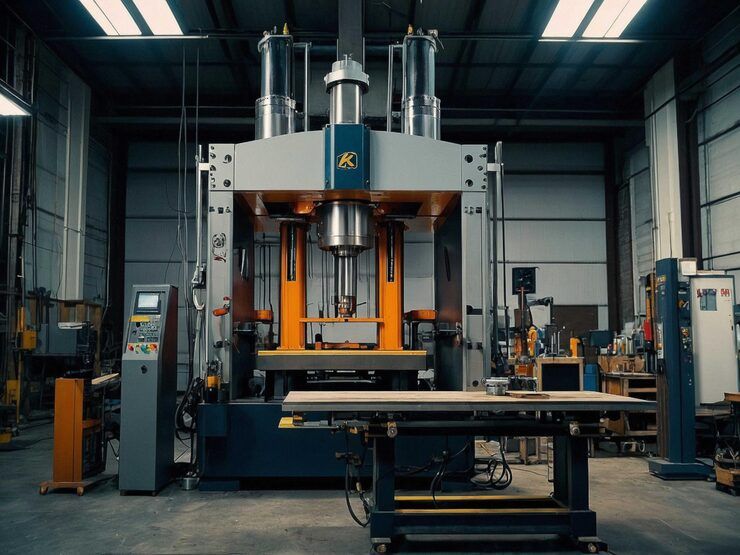
Hydraulic press machines are industrial devices that use fluid pressure to generate compressive force for shaping, forming, assembling, or testing materials. They operate based on the principle that pressure applied to a confined fluid is transmitted equally in all directions, allowing a relatively small input force to produce a much larger output force.
These machines exist because many manufacturing processes require controlled, high-force application that cannot be achieved efficiently with manual tools or purely mechanical systems. Hydraulic presses provide consistent force, smooth operation, and precise control, making them suitable for handling metals, plastics, composites, and other materials.
From metal forming and forging to component assembly and material testing, hydraulic press machines are widely used in industries where strength, accuracy, and repeatability are essential.
Why Hydraulic Press Machines Matter Today
Hydraulic press machines are fundamental to modern manufacturing due to their ability to deliver controlled force and support diverse industrial applications.
Why this topic matters today:
-
High-force capability: Enables shaping and forming of strong materials
-
Precision control: Maintains consistent pressure and movement
-
Versatility: Suitable for multiple processes such as pressing, punching, and forming
-
Industrial scalability: Supports both small-scale and large-scale production
-
Material efficiency: Reduces waste through controlled deformation
These machines affect manufacturers, production engineers, quality inspectors, and industrial designers. They solve problems related to uneven force application, inconsistent shaping, and limited production efficiency.
Industries such as automotive, aerospace, construction, electronics, metal fabrication, and packaging rely heavily on hydraulic press systems for accurate and reliable operations.Working Principles of Hydraulic Press Machines
Hydraulic presses operate based on fluid mechanics principles, commonly referred to as Pascal’s principle.
Basic working process explained:
-
A hydraulic fluid is stored in a reservoir
-
A pump moves the fluid into a cylinder
-
Pressure is applied through a piston
-
The piston transfers force to the material
-
The material is shaped or compressed under controlled pressure
Key components include:
-
Hydraulic cylinder
-
Pump and motor system
-
Control valves
-
Pressure gauges
-
Frame and pressing plates
The ability to control pressure, speed, and stroke length makes hydraulic presses highly adaptable for different applications.
Types of Hydraulic Press Machines
Hydraulic press machines are designed in various configurations depending on industrial requirements.
| Type | Key Feature | Typical Application |
|---|---|---|
| H-frame press | Open structure for accessibility | General fabrication |
| C-frame press | Compact design | Light-duty operations |
| Four-column press | High stability and precision | Heavy forming processes |
| Bench press | Smaller size | Laboratory and small components |
| Hydraulic forging press | High-force output | Metal forging |
Each type is selected based on force capacity, workspace, and precision requirements.
Recent Updates: Industry Trends and Developments (2024–2025)
Hydraulic press technology has evolved significantly in recent years, focusing on efficiency, control, and environmental considerations.
| Year | Development or Trend | Industrial Impact |
|---|---|---|
| 2024 | Energy-efficient hydraulic systems | Reduced power consumption |
| 2024 | Improved servo-controlled presses | Better motion control and accuracy |
| 2025 | Smart monitoring integration | Real-time pressure and performance tracking |
| 2025 | Noise and vibration reduction designs | Improved workplace conditions |
Recent developments also include advanced sealing systems to reduce fluid leakage, improved hydraulic fluid formulations, and better automation integration for repetitive processes.
Laws, Regulations, and Policy Influence
Hydraulic press machines are subject to industrial safety and environmental regulations to ensure safe operation and compliance.
Common regulatory frameworks include:
-
Workplace safety regulations: Cover machine guarding, emergency stops, and operator protection
-
ISO machinery safety standards: Define safe design and operation requirements
-
Environmental regulations: Address hydraulic fluid handling and waste management
-
Industrial inspection guidelines: Require periodic maintenance and performance checks
In many countries, manufacturing facilities must follow strict guidelines to ensure worker safety and environmental protection when operating hydraulic systems.
Tools and Resources for Better Understanding
Learning about hydraulic press machines is supported by a range of technical and educational resources.
Helpful resources include:
-
Mechanical engineering textbooks on fluid mechanics
-
Industrial manufacturing handbooks
-
Hydraulic system design guides
-
Safety training manuals
-
Engineering research publications
Reference tools commonly used:
-
Pressure calculation charts
-
Force conversion tables
-
Hydraulic circuit diagrams
-
Preventive maintenance checklists
These resources help engineers, technicians, and learners understand system behavior and optimize performance.
Industrial Applications of Hydraulic Press Machines
Hydraulic press machines are used across many sectors due to their flexibility and strength.
Common application areas include:
-
Metal forming and stamping
-
Sheet metal bending and shaping
-
Component assembly and fitting
-
Plastic molding and compression
-
Material testing and quality control
| Industry | Application |
|---|---|
| Automotive | Body panel forming |
| Aerospace | Structural component shaping |
| Construction | Metal structure fabrication |
| Electronics | Component assembly |
| Manufacturing | General forming processes |
These applications demonstrate the wide range of uses supported by hydraulic press systems.
Frequently Asked Questions
What is the main advantage of a hydraulic press machine?
It provides high force with precise control, allowing accurate shaping and forming of materials.
How does a hydraulic press differ from a mechanical press?
Hydraulic presses use fluid pressure for force generation, while mechanical presses rely on mechanical linkages.
What materials can be processed using hydraulic presses?
Metals, plastics, composites, and various industrial materials.
Why is pressure control important?
Controlled pressure ensures consistent results and prevents material damage.
Are hydraulic presses suitable for heavy-duty applications?
Yes, many designs are specifically built for high-force industrial operations.
Conclusion
Hydraulic press machines are a cornerstone of modern manufacturing, enabling controlled force application for a wide range of industrial processes. Their ability to deliver precision, consistency, and adaptability makes them essential in industries that require high-quality forming and assembly.
As technology advances, hydraulic presses continue to improve through better control systems, enhanced efficiency, and safer operation. Understanding their working principles, types, and applications provides valuable insight into how modern manufacturing achieves accuracy and reliability at scale.