Industrial Antifreeze & Coolants: How Thermal Fluids Protect Equipment and Processes
Industrial antifreeze and coolants are fluids used to control temperature, prevent freezing, and protect equipment in industrial processes. Industrial antifreeze is commonly used in cooling circuits, heat-transfer systems, engines, refrigeration equipment, and process machinery, while industrial cooling fluids help move unwanted heat away from operating components.
Industrial coolant suppliers, industrial antifreeze suppliers, and industrial coolant manufacturers may provide formulations based on equipment requirements, operating temperatures, materials, and environmental conditions.
Context
What Are Industrial Antifreeze and Coolants?
Industrial antifreeze and coolants are formulated liquids designed to transfer heat and maintain appropriate temperatures within equipment or process systems. Water has good heat-transfer properties, but it can freeze at low temperatures and may contribute to corrosion or mineral deposits. Adding suitable chemical components can change these characteristics.
Many formulations contain a base fluid such as water, ethylene glycol, propylene glycol, or another heat-transfer medium. Additional ingredients may include corrosion inhibitors, stabilizers, defoamers, and other additives selected for a particular application.
Industrial antifreeze generally has two related functions: lowering the freezing point of a fluid mixture and helping protect equipment from corrosion or other fluid-related problems. Coolants can also be designed primarily for heat removal where freezing protection is not the main requirement.
How Industrial Coolants Work
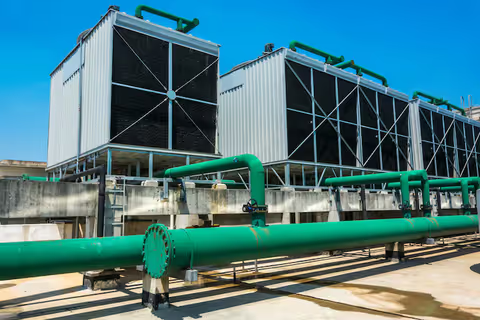
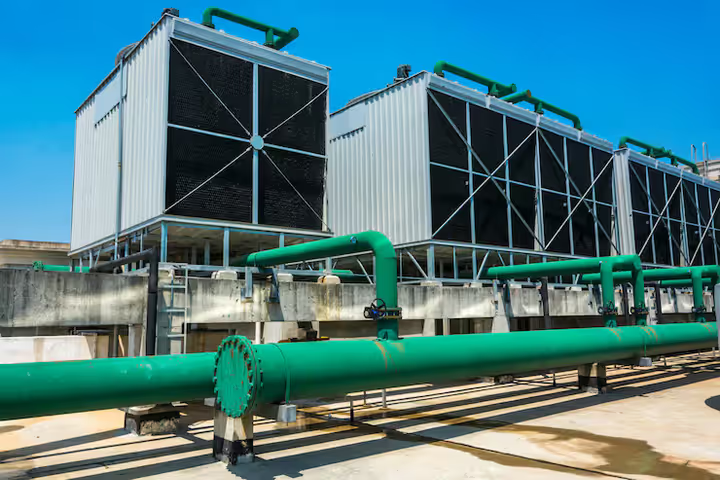
A cooling system circulates fluid through areas where heat is generated. The fluid absorbs heat and transports it toward a radiator, heat exchanger, cooling tower, chiller, or another heat-dissipation component.
The basic process can be described as:
- Heat absorption occurs as the fluid passes through warm equipment.
- Fluid circulation transfers the absorbed heat to another part of the system.
- Heat rejection occurs through a heat exchanger, radiator, cooling tower, or chiller.
- The cooled fluid returns to the equipment and repeats the cycle.
The correct fluid depends on temperature range, pressure, flow rate, system materials, concentration, and operating conditions.
Common Types of Industrial Cooling Fluids
Different applications require different fluid properties. Some systems use water-based mixtures, while others require concentrated glycol formulations or specialty heat-transfer fluids.
| Coolant type | Common characteristics | Typical applications |
|---|---|---|
| Water-based coolant | Efficient heat transfer | General process cooling |
| Ethylene glycol mixture | Low-temperature protection | Industrial cooling loops |
| Propylene glycol mixture | Low-temperature protection with different handling considerations | Food-related facilities and process systems |
| Specialty heat-transfer fluid | Designed for specific temperature ranges | Specialized industrial equipment |
| Chiller coolant | Formulated for circulating cooling systems | HVAC and industrial chillers |
Concentration is also important. Increasing the proportion of antifreeze does not always improve heat transfer. The appropriate mixture must be determined according to the equipment and operating environment.
Importance
Why Temperature Control Matters
Industrial equipment often generates significant heat during normal operation. If heat is not removed effectively, components can experience thermal expansion, accelerated wear, fluid degradation, or interruption of normal operation.
Industrial cooling systems are therefore used across manufacturing, food processing, chemical production, power generation, refrigeration, plastics processing, metalworking, and other sectors.
A suitable coolant can also help maintain a stable operating temperature. Consistent temperature control is particularly relevant when manufacturing processes depend on controlled thermal conditions.
Protection Against Freezing and Corrosion
Freezing can expand a fluid and create pressure inside pipes, heat exchangers, or other enclosed components. This can create mechanical problems in systems exposed to low temperatures or seasonal conditions.
Corrosion is another consideration. Water and certain dissolved substances can interact with metals used in cooling systems. Industrial antifreeze formulations may contain inhibitors intended to reduce corrosion of materials such as steel, aluminum, copper, and brass.
The actual level of protection depends on formulation, concentration, system design, fluid age, and operating conditions.
Where Industrial Coolants Are Used
Industrial antifreeze and cooling fluids can be found in systems such as:
- Industrial chillers and refrigeration equipment
- Engine and generator cooling circuits
- Manufacturing process cooling loops
- Heat exchangers
- Injection molding equipment
- Laser and electrical equipment cooling systems
- HVAC and building cooling systems
- Cold-storage installations
- Certain renewable-energy and energy-storage systems
Industrial chiller coolant is commonly selected according to the chiller design, temperature range, pump requirements, and materials in contact with the fluid.
Recent Updates
Developments in Coolant Formulation
From 2024 through 2026, industrial cooling has increasingly focused on energy efficiency, equipment monitoring, fluid longevity, and environmental considerations. Manufacturers and system operators are examining formulations that can work within specific temperature ranges while supporting efficient heat transfer.
There is also greater attention to monitoring coolant condition. Temperature sensors, flow meters, conductivity measurements, and fluid-analysis programs can provide information about system performance and fluid condition.
Greater Use of Monitoring and Automation
Modern cooling installations may combine chemical formulations with electronic controls. Sensors can track temperature, pressure, flow, and other operating variables, while control systems can adjust pumps, fans, valves, or refrigeration equipment.
This trend connects coolant management with broader industrial automation. Data from cooling systems can also become part of plant monitoring platforms, allowing operators to identify changes in operating conditions.
Environmental Considerations
Environmental considerations are also influencing coolant selection. Industrial facilities are examining fluid composition, handling requirements, biodegradability characteristics, and disposal procedures when evaluating cooling fluids.
Propylene glycol-based formulations are used in some applications where their particular handling characteristics are appropriate. However, no coolant should be assumed to be suitable for every environment. Compatibility, safety information, and system requirements remain important factors.
Laws or Policies
Industrial Chemical Rules in India
In India, industrial antifreeze and coolants can be subject to several layers of environmental, workplace, transport, and chemical-management requirements. The applicable rules depend on the chemical composition, quantity handled, facility type, and method of use.
The Environment (Protection) Act, 1986 provides a major framework for environmental regulation in India. Facilities handling chemicals may also need to consider rules concerning hazardous chemicals, storage, emergency planning, waste management, and environmental releases.
Workplace and Chemical Handling Requirements
Chemical handling in industrial facilities is generally associated with workplace safety practices. Safety Data Sheets, container labeling, appropriate storage, personal protective equipment, and employee training are important parts of chemical management.
Some antifreeze formulations contain substances that require controlled handling. Ethylene glycol, for example, should not be treated as an ordinary household liquid simply because it is used as a coolant. Its hazards and handling requirements should be assessed using the relevant Safety Data Sheet.
Environmental and Waste Management
Used coolant can contain degraded additives, corrosion products, dissolved metals, and other contaminants. It should therefore be managed according to applicable waste-handling requirements rather than being discharged into drains or natural waterways.
Indian facilities may need to consider Central Pollution Control Board and State Pollution Control Board requirements depending on the nature of their operations and waste streams. Specific regulatory obligations vary by facility and chemical composition.
Tools and Resources
Coolant Selection and System Calculations
Several technical resources can help explain or evaluate cooling systems. These include manufacturer technical data sheets, Safety Data Sheets, coolant concentration charts, heat-load calculations, and equipment manuals.
Useful calculations may include:
- Heat-load estimation
- Required fluid flow rate
- Freeze-point determination
- Coolant concentration
- Heat-exchanger capacity
- Pumping requirements
- Expansion volume
A basic heat-transfer relationship is often expressed as Q = m × Cp × ΔT, where Q represents heat transfer, m represents mass flow, Cp represents specific heat capacity, and ΔT represents the temperature difference.
Fluid Monitoring Resources
Industrial operators may use refractometers or other concentration-measurement instruments to check glycol mixtures. pH meters, conductivity meters, laboratory analysis, and visual inspections can also help identify changes in coolant condition.
The appropriate measurement method depends on the formulation. A concentration instrument designed for one fluid may not accurately measure another formulation.
Technical Documentation
Equipment manuals and technical documentation from industrial coolant manufacturers can provide information about recommended concentration ranges, material compatibility, operating temperatures, and replacement intervals.
Information from industrial coolant suppliers may also include product specifications and Safety Data Sheets. For bulk industrial antifreeze suppliers, documentation is particularly relevant because larger quantities require appropriate storage, handling, and transport arrangements.
FAQs
What is industrial antifreeze used for?
Industrial antifreeze is used in cooling systems where freezing protection and temperature control are required. It may also contain corrosion inhibitors and other additives intended to protect system components.
How is industrial chiller coolant different from regular coolant?
Industrial chiller coolant is formulated for circulating systems that operate under specific temperature, flow, and material conditions. Its suitability depends on the chiller design and the required operating range.
What do industrial coolant manufacturers consider when developing formulations?
Industrial coolant manufacturers may consider freezing point, boiling behavior, heat-transfer characteristics, corrosion protection, material compatibility, fluid stability, and operating temperature. The formulation also depends on the equipment and process.
What are custom industrial coolant formulations?
Custom industrial coolant formulations are fluids developed or adjusted for particular system requirements, such as unusual temperature ranges, specific metals, specialized equipment, or particular environmental conditions. Technical testing and compatibility assessment are generally needed before use.
How should industrial antifreeze be stored?
Industrial antifreeze should be stored according to its Safety Data Sheet and applicable chemical-handling requirements. Containers should be clearly identified and protected from unsuitable temperatures, incompatible materials, spills, and unauthorized access.
Conclusion
Industrial antifreeze and coolants help manage temperature, freezing risk, corrosion, and heat transfer across many industrial systems. Their formulations can differ according to operating temperature, equipment materials, concentration requirements, and application type. Recent developments have increased attention to fluid monitoring, automated temperature control, energy efficiency, and environmental considerations. In India, chemical handling and disposal are influenced by environmental and workplace regulations that vary according to the substance and industrial activity.