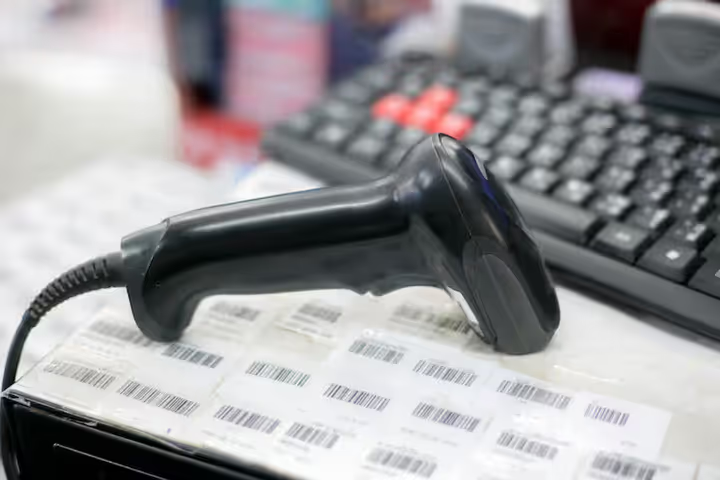
Industrial Barcode Scanning Systems: A Guide to Automated Identification
Industrial barcode readers are electronic devices that identify information encoded in printed or digitally displayed barcodes. They use optical sensors, cameras, lighting, and image-processing software to capture a barcode and convert its pattern into data that a computer, controller, or manufacturing system can understand.
Barcodes were developed to make identification and tracking more consistent than manual data entry. Early systems were primarily associated with retail checkout operations, but barcode technology gradually expanded into warehouses, factories, transportation, healthcare, electronics, automotive production, and other industrial environments.
Industrial barcode readers are designed for conditions that can be more demanding than ordinary indoor scanning. They may need to operate around dust, vibration, changing temperatures, reflective surfaces, fast-moving products, or continuous production lines.
How Industrial Barcode Readers Work
A barcode contains information through a specific arrangement of lines, spaces, squares, dots, or other visual patterns. One-dimensional barcodes use bars and spaces, while two-dimensional codes such as QR codes and Data Matrix codes store information across a larger visual area.
A typical reader uses a light source or camera to capture the code. Processing software analyzes the captured image or reflected light and translates the pattern into characters or other data.
The resulting information can then be transmitted to equipment such as:
- Programmable logic controllers.
- Warehouse management systems.
- Manufacturing execution systems.
- Enterprise resource planning platforms.
- Inventory databases.
- Conveyor-control systems.
Common Barcode Formats
Different applications use different barcode formats. The choice depends on the amount of information required, available printing space, industry standards, and the operating environment.
| Barcode type | General characteristic | Common applications |
|---|---|---|
| Code 128 | One-dimensional format with relatively high data density | Logistics and industrial identification |
| Code 39 | One-dimensional format used for alphanumeric data | Manufacturing and equipment identification |
| EAN/UPC | Retail-oriented one-dimensional formats | Consumer products |
| QR Code | Two-dimensional matrix format | Product information and general identification |
| Data Matrix | Compact two-dimensional format | Parts and component tracking |
| PDF417 | Stacked two-dimensional format | Documents and identification applications |
Importance
Why Industrial Barcode Readers Matter
Industrial operations often involve large numbers of components, packages, raw materials, and finished products. Keeping track of these items manually can introduce data-entry errors and make it difficult to identify where an item is within a production or distribution process.
Industrial barcode readers provide a way to capture identification information automatically. When integrated with other systems, a scan can trigger an inventory update, production record, routing instruction, or inspection event.
This technology is particularly relevant where products move rapidly through a production line. A reader positioned beside a conveyor can capture codes without requiring an operator to handle each item individually.
Applications Across Industries
Industrial barcode readers are used in many environments because the underlying principle is adaptable. Common applications include:
- Manufacturing: identifying components, work orders, assemblies, and finished products.
- Warehousing: recording incoming materials, storage locations, and outgoing shipments.
- Automotive production: tracking parts and assemblies throughout production stages.
- Electronics: identifying circuit boards and small components.
- Food processing: tracking packages, batches, and production information.
- Pharmaceuticals: supporting identification and traceability requirements where applicable.
- Logistics: recording packages and shipment movements.
- Printing and packaging: checking labels and verifying product identification.
Fixed-Mount and Handheld Readers
Two broad configurations are fixed-mount and handheld readers. Fixed-mount devices remain in a specific position and are commonly installed beside conveyors, production machines, sorting equipment, or inspection stations.
Handheld devices are moved by an operator toward the barcode. They can be useful when products are stored in different locations or when scanning occurs away from a fixed production line.
The choice depends on workflow, product movement, scanning distance, available space, and integration requirements.
Factors That Affect Reading Performance
Barcode reading depends on more than the reader itself. The quality and position of the barcode can have a significant effect on successful identification.
Important factors include:
- Print quality and contrast.
- Barcode size.
- Scanning distance.
- Product movement.
- Surface reflectivity.
- Lighting conditions.
- Camera resolution.
- Barcode orientation.
- Presence of dirt, damage, or distortion.
For example, a highly reflective metal surface may create glare that interferes with image capture. A code printed on a curved object can also require different positioning or imaging techniques.
Recent Updates
Greater Use of Camera-Based Reading
From 2024 through 2026, industrial barcode reading has continued shifting toward camera-based systems capable of handling one-dimensional and two-dimensional codes. Image-based readers can analyze a larger visual area than traditional laser-based approaches and can support applications involving different code formats.
This trend is particularly relevant as manufacturers use more Data Matrix and QR-based identification systems. Camera-based technology can also support image capture for verification tasks when configured for that purpose.
Machine Vision Integration
Barcode readers are increasingly being integrated with machine vision platforms. A single inspection station may combine code reading with checks involving shape, position, label presence, or other visual characteristics.
This integration can reduce the need for separate inspection stages, although the actual capabilities depend on the hardware, software, lighting, and application configuration.
Industrial Connectivity
Modern industrial barcode readers commonly support digital and network-based communication methods. Depending on the model, connections may include Ethernet-based industrial protocols, serial communication, USB, or input/output signals.
Connectivity allows barcode information to move directly into manufacturing or warehouse systems. It also makes it possible to configure readers remotely in some industrial installations.
Two-Dimensional Identification
Two-dimensional codes are receiving greater attention because they can contain more information in a relatively compact area. Data Matrix codes are commonly associated with component identification, while QR codes are used across a broader range of applications.
The shift toward two-dimensional identification also places greater importance on camera resolution, lighting, decoding software, and code quality.
Laws or Policies
Industrial Requirements in India
Industrial barcode readers in India are generally regulated indirectly through requirements covering electrical equipment, workplace safety, electromagnetic compatibility, radio communication where applicable, and sector-specific traceability rules.
The exact requirements depend on how and where a reader is installed. A fixed device connected to industrial machinery may be subject to different considerations from a handheld wireless device.
Electronic and Electrical Compliance
The Bureau of Indian Standards develops standards covering many categories of electrical and electronic equipment. Depending on the particular device and applicable regulatory framework, manufacturers and organizations may need to consider relevant Indian standards and conformity requirements.
Wireless barcode readers can involve additional considerations because radio-frequency equipment may fall under applicable telecommunications and wireless regulations.
Data and Privacy Considerations
Barcode data can sometimes contain information related to products, shipments, employees, patients, or other identifiable records. Organizations should therefore consider applicable data-protection and information-security requirements when barcode systems are connected to databases or cloud platforms.
India's Digital Personal Data Protection framework is relevant when systems process personal data within its scope. A barcode itself does not necessarily contain personal information, so the legal implications depend on what information is associated with the scanned identifier.
Tools and Resources
Barcode Verification Tools
Barcode verification equipment can assess whether a printed code meets applicable quality requirements. These tools can examine characteristics such as contrast, symbol structure, dimensions, and decoding reliability.
Simple barcode-generation and decoding software can also help during system development and testing. However, a software-based scan may not reproduce the conditions of a production environment.
Integration Resources
Industrial barcode projects may involve several technical resources, including:
- Barcode-generation software.
- Barcode verification equipment.
- Reader configuration utilities.
- PLC programming environments.
- Machine vision software.
- Industrial communication documentation.
- Warehouse or manufacturing database tools.
These resources help organizations evaluate how identification data moves from the physical product into an operational information system.
Standards and Industry Resources
The International Organization for Standardization publishes standards covering barcode symbologies and quality requirements. GS1 provides widely used identification and data standards for supply chains and product identification.
For Indian organizations, the Bureau of Indian Standards and relevant government departments can provide information about applicable standards and regulatory requirements.
FAQs
What are industrial barcode readers used for?
Industrial barcode readers are used to identify products, components, packages, and other objects in manufacturing, warehousing, logistics, and processing environments. They convert barcode information into digital data that can be transferred to connected systems.
What is the difference between industrial barcode readers and regular scanners?
Industrial barcode readers are generally designed for more demanding operating environments. Depending on their configuration, they may provide greater resistance to vibration, dust, temperature changes, continuous operation, or high-speed scanning than equipment intended for ordinary office or retail use.
Can industrial barcode readers scan QR codes?
Yes. Many modern industrial barcode readers use camera-based imaging and can decode QR codes and other two-dimensional formats. The exact formats supported depend on the reader and its decoding software.
How are industrial barcode readers connected to factory systems?
Industrial barcode readers can communicate through methods such as Ethernet, serial connections, USB, digital inputs and outputs, and industrial communication protocols. The appropriate connection depends on the reader, controller, and software architecture.
What factors affect industrial barcode reader accuracy?
Code quality, lighting, scanning distance, surface reflectivity, movement speed, barcode orientation, camera resolution, and physical damage can all affect reading performance. Proper positioning and application-specific configuration are important parts of system design.
Conclusion
Industrial barcode readers convert visual identification codes into digital information that can be used across manufacturing, warehousing, logistics, and other industrial processes. Their capabilities range from basic one-dimensional scanning to camera-based reading of two-dimensional codes and integration with machine vision systems. Recent developments have emphasized network connectivity, automated identification, and broader use of compact two-dimensional codes. Regulatory considerations in India depend on the equipment, installation environment, wireless capabilities, and the type of information processed.