Industrial Rotary Kiln Systems: A Guide to Thermal Processing and Material Handling
Industrial rotary kilns are large thermal processing machines used to heat, dry, calcine, or chemically transform bulk materials. Industrial rotary kilns are widely associated with cement production, minerals processing, lime production, and other high-temperature industries.
A typical system consists of a rotating cylindrical vessel, heating arrangement, material feeding equipment, discharge equipment, temperature controls, and exhaust handling components.
Rotary kiln manufacturers design systems around factors such as material type, processing temperature, throughput, residence time, and atmosphere. Modern rotary kiln systems can also incorporate sensors, automated controls, and monitoring equipment to regulate operating conditions. This article explains how these machines work, where they are used, how industrial rotary kiln equipment has developed, and which rules commonly apply to their operation.
Context
What Is an Industrial Rotary Kiln?
An industrial rotary kiln is a long, cylindrical chamber that rotates around its longitudinal axis while material moves through it. The cylinder is normally installed at a slight angle, allowing gravity and rotation to gradually move material from the feed end toward the discharge end.
Inside the kiln, material is exposed to controlled heat. Depending on the process, the objective may be drying, heating, calcination, chemical conversion, or thermal treatment. Industrial rotary kiln equipment can operate with direct or indirect heating arrangements.
Direct-fired systems place the heat source and process material within the same general chamber. Indirect systems transfer heat through the kiln wall or another heat-transfer surface, which can be useful when the material must remain separated from combustion gases.
Main Components
A rotary kiln system is more than the rotating cylinder itself. Supporting equipment coordinates material movement, heating, temperature control, and exhaust handling.
Common components include:
- Feed hopper and feeding mechanism
- Rotating kiln shell
- Refractory lining
- Drive motor and gearbox
- Support rollers and riding rings
- Burner or heating system
- Temperature sensors
- Discharge equipment
- Exhaust and gas-handling equipment
- Control and monitoring system
The refractory lining protects the kiln shell from high temperatures and helps maintain thermal conditions inside the chamber. Its composition depends on the process temperature and the materials being processed.
How Rotary Kilns Work
Material enters through the feed section and moves through the rotating chamber. Rotation continually exposes the material to heat while internal movement helps distribute the material through the processing zone.
The operating conditions depend on the application. Important variables include temperature, rotational speed, feed rate, material characteristics, gas flow, and residence time.
| Operating factor | Role in rotary kiln processing |
|---|---|
| Temperature | Controls heating or thermal reaction conditions |
| Rotation speed | Influences material movement and residence time |
| Feed rate | Determines the quantity entering the kiln |
| Residence time | Determines how long material remains in the heated zone |
| Gas flow | Affects heat transfer and atmosphere |
| Material size | Influences heating and movement characteristics |
Importance
Industrial Applications
Rotary kilns are used when materials require controlled thermal treatment at industrial scale. One well-known application is a rotary kiln for cement production, where raw materials undergo chemical and physical changes at elevated temperatures before forming clinker.
Other applications include:
- Lime production
- Mineral processing
- Calcination of selected materials
- Processing of certain industrial minerals
- Thermal treatment of bulk solids
- Production of some specialty materials
- Selected waste and resource recovery processes
The exact kiln configuration depends on the chemistry and physical properties of the material.
Why Process Control Matters
Thermal processing requires control over several conditions at the same time. A change in feed composition can affect heat requirements, while changes in rotation speed can influence residence time.
Industrial rotary kiln equipment therefore commonly incorporates measurement and control systems. Temperature sensors, pressure measurements, gas analyzers, motor controls, and automated feed controls can work together to maintain defined operating conditions.
Industrial rotary kiln systems can also be integrated with upstream and downstream equipment. For example, material preparation may occur before the kiln, while cooling, screening, grinding, or storage may follow the thermal process.
Safety and Environmental Considerations
Rotary kilns involve high temperatures, moving machinery, combustion equipment, and potentially dusty or chemically active materials. Appropriate guarding, insulation, ventilation, monitoring, and operating procedures are therefore important parts of system design.
Exhaust gases can contain particulate matter and process-related gases. Depending on the material and fuel, emissions may require filtration, gas treatment, monitoring, or other controls before exhaust is released.
Recent Updates
Automation and Monitoring
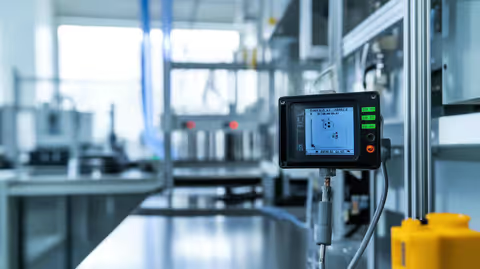
Recent developments in rotary kiln thermal processing systems have increasingly focused on digital monitoring and automated control. Sensors can continuously collect information about temperature, pressure, motor operation, material movement, and combustion conditions.
Automated rotary kiln systems may use programmable logic controllers and supervisory control platforms to coordinate equipment. Operators can view process information from centralized interfaces and adjust defined operating parameters.
The degree of automation varies considerably. Some installations use basic control loops, while larger systems may integrate multiple sensors and advanced process-control software.
Energy and Heat Recovery
Energy management has become an important area of development in industrial thermal processing. Heat leaving a kiln can represent significant thermal energy, depending on the process and operating conditions.
Advanced systems may incorporate heat recovery arrangements in which useful heat from exhaust gases or hot processed material is transferred to another part of the plant. Such arrangements can reduce the amount of externally supplied thermal energy required for associated processes, although their suitability depends on plant configuration.
Equipment Integration
Modern rotary kiln processing equipment is increasingly considered as part of a connected production line rather than as an isolated machine. Feeding, heating, cooling, exhaust treatment, material handling, and control equipment can be coordinated through a common automation structure.
This approach can provide operators with a more complete view of process conditions. It also creates greater reliance on sensors, control software, electrical systems, and communication networks.
Laws or Policies
Environmental Requirements
The rules governing rotary kiln operations depend on the country, industry, fuel, material being processed, and emissions profile. Industrial facilities may be subject to requirements covering air emissions, particulate matter, combustion gases, hazardous substances, waste handling, and environmental monitoring.
In the United States, facilities can be subject to requirements administered under federal environmental legislation, including the Clean Air Act. Specific requirements depend on the facility category and applicable federal, state, or local rules.
Other countries use their own environmental permitting systems and emissions standards. Operators generally need to determine which rules apply to the particular installation rather than relying on a single international requirement.
Workplace and Equipment Safety
Industrial rotary kilns also involve occupational safety requirements. Regulations may address machine guarding, electrical systems, hot surfaces, confined areas, lockout procedures, lifting equipment, and worker exposure to dust or process gases.
International standards can also influence equipment design. Depending on the location and application, manufacturers and plant operators may consider standards from organizations such as ISO, IEC, NFPA, or other national standards bodies.
Permits and Documentation
A thermal processing facility may need documentation covering equipment specifications, emissions characteristics, operating procedures, inspections, and maintenance activities. Environmental permits can establish limits or monitoring requirements specific to the installation.
Because regulations differ by jurisdiction, the applicable authority and current regulatory documents should be checked for each project.
Tools and Resources
Design and Process Tools
Engineers working with rotary kiln systems can use several categories of technical resources. Thermal calculations help estimate heat requirements, while material-balance calculations help track feed, product, gases, and other process streams.
Common resources include:
- Thermal balance worksheets
- Material-balance templates
- Residence-time calculations
- Temperature monitoring instruments
- Gas analysis equipment
- Vibration monitoring tools
- Process-control software
- Equipment maintenance records
These resources help organize operational information and support engineering analysis.
Industry Standards and Technical References
Technical information can be obtained from standards organizations, environmental agencies, occupational safety authorities, and engineering institutions. Manufacturer documentation can also provide information about equipment configuration, operating limits, instrumentation, and maintenance requirements.
For industrial calcination equipment, process-specific technical literature is particularly relevant because material chemistry can influence temperature requirements, residence time, atmosphere, and equipment configuration.
FAQs
What are industrial rotary kilns used for?
Industrial rotary kilns are used for controlled thermal processing of bulk materials. Applications include cement clinker production, lime processing, mineral calcination, drying, and selected thermal treatment processes.
How does a rotary kiln for cement production work?
In cement production, prepared raw materials pass through a rotary kiln where they undergo chemical and physical changes at high temperatures. The resulting clinker is subsequently cooled and processed into cement.
What are automated rotary kiln systems?
Automated rotary kiln systems use sensors, controllers, drives, and software to monitor and regulate process conditions. Automation can include temperature control, feed regulation, burner management, motor control, and alarm monitoring.
What do rotary kiln manufacturers consider during system design?
Design considerations include material characteristics, required processing temperature, feed rate, residence time, kiln dimensions, heating method, refractory materials, exhaust conditions, and downstream equipment.
What is industrial calcination equipment?
Industrial calcination equipment is used to heat materials to a controlled temperature to cause decomposition, removal of volatile components, or other chemical changes. Rotary kilns are one type of equipment used for calcination.
Conclusion
Industrial rotary kilns provide controlled thermal processing for materials used in cement, minerals, lime, and other industrial applications. Their operation depends on coordinated control of temperature, material movement, residence time, gas flow, and equipment condition. Recent systems increasingly incorporate automation, digital monitoring, and heat-recovery concepts. Environmental and workplace requirements also play an important role in the design and operation of rotary kiln processing equipment.