Battery Manufacturing Lines: A Beginner’s Guide to Modern Battery Production
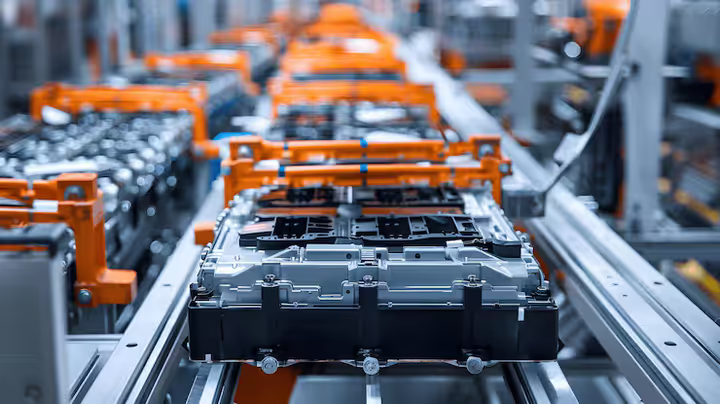
A battery manufacturing line is an integrated production system that combines multiple machines and process stages to manufacture rechargeable battery cells. Modern production facilities use a lithium ion battery manufacturing line to produce cells that are later assembled into battery modules and battery packs for electric vehicles, energy storage systems, consumer electronics, industrial equipment, and other applications.
Battery technology has advanced significantly over the past several decades. Early manufacturing processes involved a greater degree of manual work, while modern facilities increasingly rely on automation, digital monitoring, and precision equipment. Today, an EV battery manufacturing line integrates material preparation, electrode production, cell assembly, electrolyte filling, formation, testing, and inspection into a coordinated workflow.
Battery production line equipment is designed to maintain consistent manufacturing conditions because even small variations in moisture, coating thickness, or material composition can affect battery performance. As battery demand continues to grow, manufacturing systems have become increasingly sophisticated while maintaining strict quality control throughout production.
How a Battery Manufacturing Line Works
A typical battery cell manufacturing line begins with preparing active materials that will form the battery electrodes. These materials are blended into a slurry using battery slurry mixing systems before being coated onto thin metal foils.
The coated electrodes are dried, compressed, and cut into precise dimensions. Depending on the battery design, the electrodes are wound or stacked with separators before being placed into cell housings.
Battery electrolyte filling equipment introduces electrolyte into each cell under carefully controlled conditions. The cells then undergo sealing, formation charging, inspection, and testing before moving to module or pack assembly.
Each production stage contributes to maintaining consistent battery quality throughout manufacturing.
Main Equipment Used in Battery Production
A modern battery manufacturing line commonly includes:
- Battery slurry mixing systems
- Electrode coating machines
- Drying ovens
- Calendering equipment
- Slitting machines
- Electrode stacking or winding machines
- Battery electrolyte filling equipment
- Cell sealing machines
- Formation charging equipment
- Battery quality inspection systems
- Automated material handling systems
- Production monitoring software
These machines work together to create a continuous manufacturing process.
Importance
Supporting Electric Transportation
The growing use of electric vehicles has increased global demand for battery manufacturing capacity.
An EV battery manufacturing line produces battery cells that become part of electric cars, buses, trucks, construction equipment, and other electrically powered vehicles.
Supporting Energy Storage
Battery cells manufactured in modern facilities are also used in stationary energy storage systems connected to renewable electricity sources.
These systems help balance electricity supply and demand while supporting grid stability.
Improving Manufacturing Consistency
Battery production requires precise control over material composition, coating thickness, temperature, humidity, and assembly accuracy.
Automated battery manufacturing systems monitor these variables throughout production to maintain consistent manufacturing conditions.
Reducing Manual Handling
Modern production facilities use robotic handling equipment and automated transport systems to move materials between manufacturing stages.
Automation reduces unnecessary manual handling while supporting continuous production.
Supporting Advanced Manufacturing
Battery manufacturing has become one of the fastest-growing advanced manufacturing sectors.
Modern facilities integrate robotics, digital monitoring, artificial intelligence, and automated inspection technologies throughout production.
Main Stages of a Battery Manufacturing Line
Raw Material Preparation
The manufacturing process begins by preparing cathode and anode materials.
Battery slurry mixing systems blend active materials, conductive additives, binders, and solvents into uniform mixtures suitable for electrode coating.
Electrode Manufacturing
The prepared slurry is coated onto thin metal foils.
After coating, electrodes move through drying ovens before passing through compression equipment that produces uniform thickness.
Electrodes are then cut into required dimensions.
Cell Assembly
Battery cells are assembled by stacking or winding electrodes together with separator materials.
Assembly methods vary depending on whether the battery design uses cylindrical, prismatic, or pouch cells.
Electrolyte Filling
Battery electrolyte filling equipment introduces electrolyte into sealed battery cells under carefully controlled environmental conditions.
This stage plays an important role in battery operation.
Formation and Aging
Completed cells undergo controlled charging and discharging cycles.
Formation allows electrochemical reactions inside the battery to stabilize before final testing.
Inspection and Testing
Finished cells pass through multiple quality inspections that verify electrical performance, dimensional accuracy, and overall manufacturing consistency.
Modern production facilities increasingly automate these inspection processes.
Typical Battery Manufacturing Process
| Manufacturing Stage | Main Purpose |
|---|---|
| Material preparation | Prepare active materials |
| Slurry mixing | Blend electrode materials |
| Electrode coating | Apply active materials |
| Drying and calendering | Remove solvent and compress electrodes |
| Cell assembly | Build battery cell structure |
| Electrolyte filling | Introduce electrolyte |
| Formation | Stabilize electrochemical performance |
| Inspection | Verify manufacturing quality |
Each stage supports the production of finished battery cells.
Recent Updates
Expanded Automation
Between 2024 and 2026, manufacturers have continued increasing automation across battery production facilities.
Automated battery manufacturing systems now perform many repetitive production activities while maintaining precise manufacturing conditions.
AI-Based Production Monitoring
Artificial intelligence is becoming increasingly integrated into battery manufacturing.
AI systems analyze production information collected from sensors throughout the battery manufacturing line to identify process variations and assist manufacturing engineers.
These technologies support quality monitoring rather than replacing human supervision.
Digital Manufacturing Platforms
Many battery factories now operate using connected manufacturing platforms that integrate production planning, equipment monitoring, maintenance scheduling, and quality management.
These systems improve visibility across manufacturing operations.
Improved Inspection Technologies
Battery quality inspection systems increasingly use machine vision, laser measurement, and automated electrical testing to evaluate finished cells.
Advanced inspection improves consistency throughout production.
Sustainable Manufacturing Practices
Manufacturers continue improving energy management, material recovery, water utilization, and waste reduction throughout battery production facilities.
These improvements contribute to broader sustainability initiatives within manufacturing.
Laws or Policies
Battery manufacturing operates within national and international regulatory frameworks covering industrial production, environmental protection, and product safety.
Common regulatory areas include:
- Workplace safety regulations
- Electrical equipment standards
- Environmental protection regulations
- Chemical handling requirements
- Hazardous waste management
- Fire protection standards
- Transportation regulations for battery products
- Product safety certification requirements
Many countries also support battery manufacturing through industrial development strategies and clean energy programs.
Regulatory requirements differ among regions.
Tools and Resources
Engineers, researchers, students, and manufacturing professionals use numerous technical resources related to battery production.
Useful resources include:
- Battery engineering textbooks
- Manufacturing execution systems
- Process simulation software
- Production scheduling software
- Industrial automation platforms
- Machine vision inspection software
- Statistical process control software
- Technical journals
- Engineering conference publications
- Battery safety standards
These materials explain battery manufacturing processes, production technologies, and quality management methods.
FAQs
What is a battery manufacturing line?
A battery manufacturing line is an integrated production system that combines multiple machines to manufacture rechargeable battery cells from raw materials through final inspection.
What equipment is included in a lithium ion battery manufacturing line?
A lithium ion battery manufacturing line commonly includes battery slurry mixing systems, coating machines, drying equipment, assembly machines, battery electrolyte filling equipment, formation systems, and inspection equipment.
What is the purpose of battery slurry mixing systems?
Battery slurry mixing systems prepare uniform mixtures of active materials, binders, conductive additives, and solvents before electrode coating begins.
Why is battery electrolyte filling equipment important?
Battery electrolyte filling equipment introduces electrolyte into battery cells under controlled conditions, allowing the electrochemical processes inside the cell to function properly.
How do automated battery manufacturing systems improve production?
Automated battery manufacturing systems coordinate equipment, monitor production conditions, reduce manual handling, and assist quality control throughout the manufacturing process.
Conclusion
A battery manufacturing line combines multiple production technologies into an organized workflow that transforms raw materials into finished battery cells. Modern lithium ion battery manufacturing line facilities use battery production line equipment, battery slurry mixing systems, battery electrolyte filling equipment, and automated battery manufacturing systems to maintain consistent manufacturing conditions. Continued advances in automation, artificial intelligence, and digital production monitoring are shaping the future of battery manufacturing. These developments support growing demand for batteries used across transportation, energy storage, and industrial applications.