Collaborative Robots: Complete Guide to Safe and Smart Industrial Automation
Collaborative robots, often called cobots, are changing modern manufacturing and industrial automation.
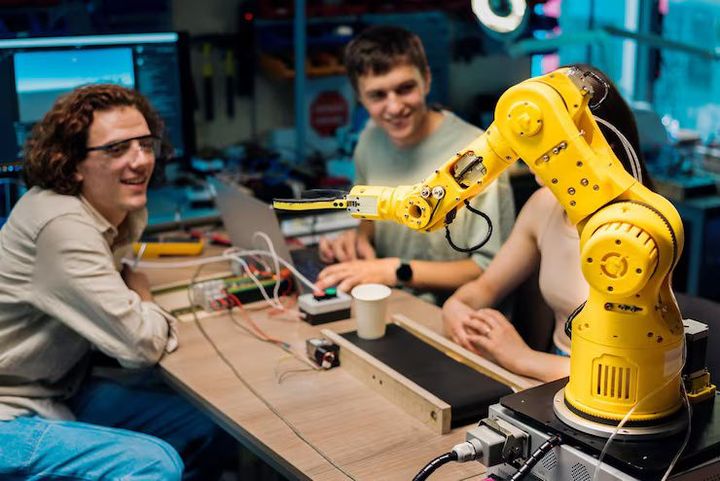
Unlike traditional industrial robots that work inside safety cages, collaborative robots are designed to operate alongside human workers in shared workspaces.
These intelligent robotic systems help improve productivity, workplace safety, and operational efficiency while handling repetitive or physically demanding tasks. Industries such as automotive manufacturing, electronics assembly, healthcare, logistics, packaging, and food processing increasingly use collaborative robots to support daily operations.
This guide explains collaborative robots, how they work, their main types, benefits, applications, and future developments in simple language.
Understanding the Concept
A collaborative robot is an industrial robot designed to safely interact with people during production activities. It uses advanced sensors, cameras, force detection, and intelligent control systems to detect nearby workers and adjust its movement when necessary.
Unlike conventional industrial robots that usually operate in isolated areas, collaborative robots share workspaces with people while performing repetitive and precision-based tasks.
Collaborative robots are commonly used for:
- Material handling
- Machine tending
- Pick and place operations
- Assembly processes
- Quality inspection
- Packaging automation
- Palletizing
- Laboratory automation
These robots support workers rather than replacing them, allowing employees to focus on tasks requiring creativity, decision-making, and problem-solving.
Key Types or Categories
Power and Force Limited Robots
These robots continuously monitor the amount of force applied during movement. If unexpected contact occurs, the robot immediately slows down or stops.
This type is commonly used in electronics assembly and light manufacturing.
Safety Monitored Stop Robots
These collaborative robots automatically stop moving whenever a person enters the designated work area.
Once the workspace becomes clear, the robot resumes operation.
Hand Guiding Robots
Workers can physically guide the robot arm to teach movement paths without complex programming.
This simplifies setup for repetitive production tasks.
Speed and Separation Monitoring Robots
These robots use vision systems, laser scanners, and sensors to monitor the distance between people and the robot.
The robot automatically reduces speed as a worker approaches.
Mobile Collaborative Robots
Mobile cobots combine robotic arms with autonomous mobile platforms.
They transport materials between workstations while performing handling or inspection tasks.
Important Subsections
Robot Arm
The robotic arm performs physical movements required for production activities.
Different arm designs provide various reach distances and payload capacities.
End Effectors
An end effector is the tool attached to the robot arm.
Examples include:
- Vacuum grippers
- Mechanical grippers
- Welding tools
- Screwdrivers
- Inspection cameras
- Polishing tools
The selected tool depends on the production task.
Vision Systems
Integrated cameras help collaborative robots identify products, measure positions, inspect components, and guide movement accurately.
Vision technology improves flexibility in changing production environments.
Safety Sensors
Safety sensors continuously monitor:
- Human movement
- Distance
- Force
- Speed
- Workspace boundaries
These systems help maintain safe human-robot collaboration.
Robot Controller
The controller manages robot movement, task execution, sensor input, and communication with other industrial equipment.
Modern controllers also support artificial intelligence and machine learning capabilities.
How It Works
Collaborative robots follow a structured operating process.
Step 1: Program the Task
Operators define the required movement or guide the robot through the desired path.
Many collaborative robots support intuitive programming methods.
Step 2: Monitor the Environment
Built-in sensors continuously observe the surrounding workspace.
The robot identifies nearby workers, objects, and equipment.
Step 3: Execute the Task
The robot performs operations such as:
- Picking components
- Positioning materials
- Tightening screws
- Loading machines
- Packaging products
- Inspecting finished items
Step 4: Respond to Human Interaction
If a worker enters the robot's operating area, the robot may:
- Slow down
- Stop moving
- Adjust its path
- Resume operation after the area becomes safe
Step 5: Repeat with Consistent Accuracy
The robot repeats programmed tasks while maintaining high precision throughout production.
Benefits and Advantages
Collaborative robots provide several important advantages.
Improved Workplace Safety
Advanced sensors and intelligent safety functions help reduce the risk of workplace accidents during human-robot interaction.
Higher Productivity
Cobots perform repetitive tasks consistently, allowing workers to focus on more complex activities.
Better Product Quality
Precise and repeatable movements improve manufacturing consistency.
Flexible Manufacturing
Collaborative robots can perform multiple production tasks with different end effectors and programming methods.
Space Efficiency
Since many collaborative robots work without large protective cages, they fit well in compact production areas.
Reduced Worker Fatigue
Repetitive lifting, positioning, and assembly activities can be assigned to collaborative robots, reducing physical strain on employees.
Real-World Examples or Applications
Collaborative robots are used in many industries.
Automotive Manufacturing
Cobots assist with:
- Component assembly
- Screw fastening
- Quality inspection
- Material handling
Electronics Manufacturing
Electronics production uses collaborative robots for:
- Circuit board assembly
- Precision inspection
- Small component handling
- Product testing
Food Processing
Collaborative robots support:
- Packaging
- Sorting
- Labeling
- Palletizing
Healthcare
Healthcare facilities use collaborative robotic technology for:
- Laboratory sample handling
- Pharmacy automation
- Medical equipment preparation
Warehousing and Logistics
Logistics operations use cobots for:
- Order picking
- Box handling
- Inventory movement
- Packaging support
Important Factors to Understand
Several factors influence successful collaborative robot implementation.
Task Selection
Collaborative robots perform best with repetitive, structured, and precision-based activities.
Payload Capacity
Each robot has a maximum weight it can safely handle.
Selecting the appropriate payload improves efficiency.
Reach Distance
The robot arm must provide enough movement to complete assigned tasks.
Safety Assessment
Every workplace should conduct a detailed safety assessment before introducing collaborative robots into shared workspaces.
Employee Training
Workers should understand:
- Safe interaction
- Robot operating procedures
- Emergency stop functions
- Basic maintenance practices
Proper training supports safe and efficient operation.
Future Trends and Industry Insights
Collaborative robots continue evolving with new technologies.
Artificial Intelligence Integration
Artificial intelligence enables collaborative robots to recognize objects, optimize movement, and adapt to changing production conditions.
Machine Vision Improvements
Advanced vision systems improve inspection accuracy and object recognition.
Internet of Things Connectivity
Connected robots exchange production data with industrial equipment, enabling smarter manufacturing environments.
Predictive Maintenance
Modern monitoring systems analyze robot performance to identify maintenance needs before unexpected downtime occurs.
Human-Centered Automation
Future collaborative robots will become easier to program, more flexible, and better at supporting workers across different industries.
Conclusion
Collaborative robots have become an important part of modern industrial automation by combining intelligent technology with safe human interaction. Their ability to perform repetitive tasks, improve workplace safety, increase production efficiency, and support consistent quality makes them valuable across manufacturing, logistics, healthcare, food processing, and many other industries.
As artificial intelligence, machine vision, industrial sensors, and connected manufacturing technologies continue to advance, collaborative robots will play an even greater role in creating smarter, safer, and more flexible workplaces.