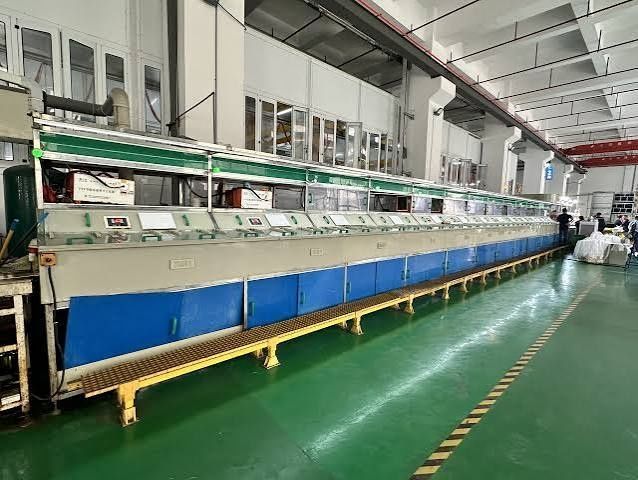
Electroplating Line Equipment Explained: How Automated Plating Systems Work
Electroplating line equipment is used to apply a controlled metallic coating to the surface of a component through an electrochemical process. Industrial electroplating equipment commonly combines preparation tanks, plating tanks, rectifiers, pumps, filtration units, rinsing stations, material-handling systems, and control equipment.
Modern automatic electroplating lines and automated plating systems can coordinate several stages of production while monitoring selected operating conditions.
Electroplating is used across industries such as automotive manufacturing, electronics, hardware, electrical equipment, aerospace components, and general engineering. The coating can improve characteristics such as corrosion resistance, electrical conductivity, surface appearance, hardness, or wear resistance, depending on the metal and process used.
Context
What Is Electroplating?
Electroplating is an electrochemical process in which a metal layer is deposited onto a conductive surface. The component being coated acts as the cathode, while a suitable anode and electrolyte are used to support the movement of metal ions.
When electrical current passes through the plating bath, metal ions are reduced and deposited onto the component surface. The thickness and characteristics of the coating depend on factors such as current density, bath chemistry, temperature, plating duration, agitation, and the condition of the component.
Electroplating developed from early electrochemical experiments and became increasingly important as industrial manufacturing expanded. Today, it is integrated into controlled production lines that can handle large quantities of components.
Main Stages of an Electroplating Line
An electroplating line normally contains several stages before and after the actual plating operation. Surface preparation is particularly important because oil, oxidation, dirt, and other contaminants can interfere with coating adhesion.
A typical sequence may include:
- Cleaning and degreasing
- Rinsing
- Acid activation or surface treatment
- Electroplating
- Intermediate rinsing
- Post-treatment
- Drying
- Inspection and handling
The exact sequence depends on the base material, coating metal, product specifications, and intended application.
Components of Electroplating Machinery
Electroplating machinery consists of interconnected equipment designed to control chemical, electrical, mechanical, and material-handling functions. Common components include plating tanks, rectifiers, pumps, filters, heating systems, exhaust systems, control panels, and lifting mechanisms.
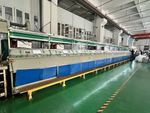
Industrial plating equipment may be arranged as manual, semi-automatic, or fully automated systems. The physical layout can be linear, circular, or customized according to factory space and production requirements.
| Equipment | Main Function | Typical Consideration |
|---|---|---|
| Plating tanks | Hold electrolyte and components | Chemical compatibility |
| Rectifiers | Supply controlled electrical current | Current and voltage range |
| Rinsing tanks | Remove residual chemicals | Water management |
| Pumps | Circulate process liquids | Flow rate and chemical resistance |
| Filters | Remove suspended particles | Filtration capacity |
| Heating systems | Maintain bath temperature | Temperature control |
| Hoists or conveyors | Move components between stages | Load and movement pattern |
| Control panels | Manage equipment functions | Automation and monitoring |
Types of Electroplating Lines
Electroplating lines can be classified according to their operating method and level of automation. Manual systems require operators to move components between stages, while automatic electroplating lines use programmed material-handling systems.
Automated electroplating systems may use programmable controllers, sensors, motorized hoists, conveyors, and monitoring equipment to coordinate different stages. Precision electroplating equipment may incorporate more detailed controls when coating thickness and process conditions require close regulation.
Importance
Protecting Component Surfaces
Electroplating can change the surface characteristics of a component. Depending on the selected coating, it may provide protection against corrosion, improve wear resistance, or modify electrical and mechanical properties.
For example, zinc coatings are commonly associated with corrosion protection for steel components, while nickel and chromium coatings may be used for particular functional or decorative purposes. Copper coatings can also be used where electrical conductivity or specific surface characteristics are required.
Supporting Manufacturing Quality
Coating thickness and uniformity are important considerations in many electroplating applications. Uneven deposition can affect dimensions, appearance, electrical properties, or the performance of a component.
Industrial electroplating equipment therefore needs to control factors such as current distribution, bath temperature, chemical concentration, and processing time. Monitoring these conditions helps maintain consistency between production cycles.
Automation and Workplace Organization
Electroplating involves chemicals, electrical equipment, heated liquids, and moving components. Automation can reduce direct handling during selected stages and can create a more structured production sequence.
Automated plating systems can coordinate tank transfers, immersion times, rinsing sequences, and other machine functions. Operators still have important responsibilities involving process supervision, inspection, chemical management, and workplace safety.
Supporting Different Industries
Electroplating is used for many types of components and materials. Applications can include:
- Automotive fasteners and components
- Electrical contacts and connectors
- Electronic hardware
- Industrial fittings
- Plumbing components
- Machine parts
- Consumer hardware
- Precision engineering components
The appropriate plating process depends on the base material and the functional requirements of the finished component.
Recent Updates
Greater Use of Automation
Recent developments in electroplating have focused on greater automation and process monitoring. Automatic material handling, programmable controls, sensors, and digital interfaces can coordinate multiple stages of a plating line.
Automated systems may record information such as bath temperature, current, voltage, processing time, and equipment status. This information can help production personnel monitor operating conditions.
Improved Process Monitoring
Modern control systems increasingly connect electrical measurements with chemical and mechanical information. Sensors can monitor selected parameters continuously, while control software can display operating conditions to personnel.
This approach is particularly relevant to precision electroplating equipment, where small changes in process conditions can influence coating characteristics.
Resource Management
Water and chemical management are important considerations in electroplating facilities. Recent equipment designs increasingly incorporate improved rinsing arrangements, filtration, process-liquid circulation, and monitoring systems.
Closed-loop or partially recirculating systems may reduce the amount of process water required in certain applications. Actual resource requirements depend on the process chemistry, production volume, and facility design.
Digital Factory Integration
Electroplating lines are also becoming more connected with wider factory control systems. Production data can be collected from programmable logic controllers, sensors, rectifiers, and other equipment.
This can allow operators to review production conditions and identify changes in machine behavior. Digital monitoring does not replace laboratory testing or physical inspection where those activities are required.
Laws or Policies
Environmental Requirements in India
In India, electroplating facilities are subject to environmental and industrial regulations because the process can involve chemicals, wastewater, air emissions, hazardous materials, and industrial waste.
The Central Pollution Control Board and State Pollution Control Boards play important roles in environmental regulation. Depending on the facility and its activities, permissions and compliance requirements may relate to wastewater discharge, air emissions, hazardous waste, and chemical handling.
Wastewater and Chemical Management
Electroplating wastewater can contain metals, acids, alkalis, and other substances associated with surface-treatment processes. Treatment systems may therefore be required before wastewater is discharged or otherwise managed.
Facilities can use wastewater treatment systems, neutralization processes, filtration, precipitation, and other treatment methods depending on the contaminants involved.
Workplace Safety
Electroplating facilities also need to address risks associated with chemicals, electricity, machinery, heat, and material movement. Applicable occupational safety requirements may include provisions for ventilation, chemical handling, protective equipment, machine guarding, emergency arrangements, and worker training.
The exact requirements depend on the facility, location, chemicals used, workforce, and applicable central and state regulations. Current requirements should be checked with the relevant authorities rather than assumed to be identical across all facilities.
Tools and Resources
Process Monitoring Instruments
Digital meters, temperature sensors, pH meters, conductivity meters, current monitors, and other instruments can help operators observe electroplating conditions. The appropriate instrument depends on the chemical process and parameter being measured.
Plating Calculations
Electroplating calculations can be used to estimate theoretical metal deposition based on electrical current, processing time, electrochemical characteristics, and other variables. These calculations are commonly associated with Faraday's law of electrolysis.
Actual deposition can differ from theoretical calculations because of current efficiency, bath conditions, geometry, agitation, and other factors.
Equipment Documentation
Technical drawings, electrical diagrams, tank specifications, operating manuals, chemical compatibility information, and maintenance records are useful resources when evaluating an electroplating line.
Electroplating line manufacturers may provide technical documentation describing tank dimensions, rectifier ratings, lifting arrangements, automation architecture, and process sequences.
Government and Standards Resources
Government environmental portals, pollution-control authorities, industrial safety resources, and standards organizations can provide information about regulatory requirements and technical practices.
OEM electroplating equipment manufacturers may also provide equipment specifications and system documentation for customized industrial installations. Such information should be evaluated alongside applicable regulations and the technical requirements of the specific plating process.
FAQs
What is electroplating line equipment?
Electroplating line equipment is a group of machines and systems used to prepare components, apply metallic coatings, rinse and treat plated surfaces, and move components through different stages. It can include tanks, rectifiers, pumps, filters, heaters, control panels, and material-handling equipment.
How do automatic electroplating lines work?
Automatic electroplating lines use programmed controls and mechanical handling systems to move components through defined processing stages. Sensors and control systems can monitor selected parameters such as temperature, current, voltage, and processing time.
What is included in industrial electroplating equipment?
Industrial electroplating equipment can include plating tanks, cleaning tanks, rinsing stations, rectifiers, pumps, filtration systems, heating equipment, ventilation systems, hoists, conveyors, and control panels. The configuration varies according to the plating process and component requirements.
What are automated electroplating systems used for?
Automated electroplating systems are used to coordinate repeated plating operations with programmed movement and process controls. They can be applied to components used in automotive, electronics, electrical, engineering, hardware, and other manufacturing sectors.
What do electroplating line manufacturers produce?
Electroplating line manufacturers can produce individual plating machines as well as integrated production lines. Their equipment ranges may include automated plating systems, industrial plating equipment, rectifiers, tanks, material-handling systems, control panels, and customized production configurations.
Conclusion
Electroplating line equipment combines chemical-processing, electrical, mechanical, and control technologies to apply metallic coatings to manufactured components. Modern automated electroplating systems can coordinate material movement, processing stages, monitoring, and selected control functions. Developments from 2024 through 2026 have emphasized automation, digital monitoring, resource management, and improved process control. In India, electroplating facilities must also consider applicable environmental, wastewater, chemical-handling, industrial-safety, and waste-management requirements.