Expert Guide to AI Edge Devices: Analysis, Research, and Emerging Edge AI Technology Trends
AI edge devices are computing systems that process artificial intelligence workloads close to where data is generated rather than sending every piece of information to a distant cloud server.
They can include cameras, industrial controllers, embedded computers, gateways, robots, vehicles, sensors, and specialized computing units.
The concept combines edge computing with artificial intelligence. Traditional cloud-based AI sends data to centralized computing infrastructure for processing. Edge AI moves some or all of that processing closer to the physical source, which can reduce dependence on continuous communication with remote servers.
AI edge devices can analyze information locally and produce an output without transferring all raw data elsewhere. For example, an industrial camera can process an image locally and identify a particular object or condition before sending selected information to another system.
How Edge AI Devices Work
An edge AI device generally contains several hardware and software components that work together. The processor runs the operating system and applications, while an AI accelerator or specialized processor can handle computationally intensive machine-learning tasks.
A typical system may include:
- Sensors or cameras for collecting information
- A central processor for general computing
- AI edge processors for machine-learning workloads
- Memory for storing applications and temporary data
- Communication interfaces
- Local storage
- Operating software and AI frameworks
- Security components
The exact configuration depends on the application. A small sensor node may have limited computing resources, while an industrial computer can contain considerably more processing capability.
AI Edge Hardware Components
AI edge computing hardware can use several types of processors. Central processing units handle general-purpose tasks, graphics processing units can process parallel workloads, and neural processing units are designed for specific AI calculations.
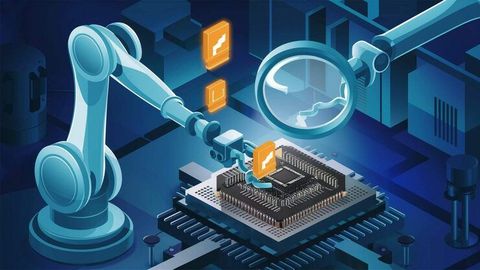
An edge AI accelerator can perform operations such as neural-network inference with lower computational overhead than a general-purpose processor in certain workloads.
| Component | Main function | Typical application |
|---|---|---|
| CPU | General computing | Embedded computers and gateways |
| GPU | Parallel processing | Vision and complex AI workloads |
| NPU | Neural-network processing | AI-enabled embedded devices |
| AI accelerator | Specialized inference | Industrial vision and automation |
| Memory | Temporary data storage | Model execution and applications |
| Storage | Local data retention | Logs, models, and system software |
These components can be combined in different ways depending on power requirements, physical size, operating environment, and AI workload.
Importance
Reducing Dependence on Remote Processing
One reason organizations use edge AI devices is to process information near the source. A system that needs an immediate response may not be suitable for sending every input to a remote cloud environment and waiting for a response.
Local processing can allow an AI application to analyze information directly on the device. This can be relevant to machine monitoring, robotics, transportation, security systems, and industrial automation.
Supporting Faster Responses
The physical distance between a device and a cloud server can introduce communication delays. Although network connections can be fast, applications with strict response requirements may benefit from local computation.
For example, an autonomous machine may need to detect an obstacle and adjust its movement immediately. An autonomous edge AI system can process sensor information locally and provide a response without depending entirely on a remote computing platform.
Managing Large Data Volumes
Modern cameras and sensors can generate substantial quantities of information. Transferring all raw data to centralized infrastructure can place additional demands on networks and storage systems.
Edge computing devices can filter, summarize, classify, or analyze information locally. Instead of transmitting every raw image or sensor reading, the system may transmit selected events, measurements, or results.
Industrial Applications
Industrial edge AI devices are increasingly associated with manufacturing, logistics, energy, transportation, and infrastructure monitoring.
Examples include:
- Machine condition monitoring
- Automated visual inspection
- Production-line monitoring
- Predictive equipment analysis
- Robot navigation
- Warehouse automation
- Energy system monitoring
- Worker and equipment zone detection
In these applications, AI processing can be connected to existing industrial control and information systems.
Data Privacy and Security Considerations
Local processing can reduce the amount of raw information that needs to leave a physical location. This can be useful when an organization wants to limit the transfer of sensitive images, operational information, or other data.
However, local processing does not automatically make a system secure. Devices still require appropriate authentication, software updates, encryption, access controls, physical protection, and network security.
Recent Updates
Growth of Specialized Edge Processors
From 2024 through 2026, edge computing development has increasingly focused on processors designed specifically for AI inference. AI edge chips and integrated neural-processing units are appearing in embedded computers, industrial systems, cameras, vehicles, and consumer electronics.
These processors are intended to perform machine-learning calculations within relatively constrained power and physical environments.
Smaller AI Models
AI applications at the edge increasingly use models designed to operate with limited memory and processing capacity. Techniques such as quantization, pruning, model compression, and optimized neural-network architectures can reduce computational requirements.
Smaller models can be deployed on devices that would not have enough resources to run large cloud-oriented models locally.
Multimodal Edge Processing
Some edge systems are beginning to process multiple types of information, such as video, audio, temperature, motion, and other sensor measurements.
Combining several data sources can provide a broader understanding of an environment. Industrial AI edge computing can therefore involve several sensors connected to a single local computing platform.
Greater Use in Industrial Automation
Factories and industrial facilities are increasingly connecting sensors and machines to local computing systems. AI can be applied to equipment monitoring, quality analysis, anomaly detection, and process observation.
The growth of connected industrial equipment also increases the importance of interoperability. Edge systems may need to communicate with programmable logic controllers, industrial networks, databases, and supervisory systems.
Distributed AI Architectures
AI processing is increasingly divided between devices, local gateways, data centers, and cloud platforms. Rather than treating edge and cloud computing as separate alternatives, organizations can use a distributed architecture.
For example, an edge device can identify an event locally, a nearby gateway can aggregate information from multiple devices, and a central platform can analyze long-term trends.
Laws or Policies
Indian Regulatory Environment
In India, AI edge systems can be affected by rules covering information technology, cybersecurity, data protection, telecommunications, electronic equipment, and sector-specific requirements.
The Digital Personal Data Protection Act, 2023 establishes a framework for processing digital personal data in India. Where edge devices collect information that qualifies as personal data, organizations may need to consider applicable requirements concerning data processing and protection.
Data Protection
Edge devices can process images, audio, location information, biometric information, and other forms of data depending on their application. Organizations therefore need to determine what information is being collected and whether it falls under applicable data-protection requirements.
Local processing may reduce data transmission, but it does not remove obligations that may apply to the underlying data.
Electronic Equipment Requirements
AI edge hardware can fall within India's broader framework for electronic products, electrical safety, electromagnetic compatibility, and electronic waste management.
Equipment placed into particular markets or used in regulated sectors may be subject to additional technical requirements. The applicable standards depend on the equipment type and intended use.
Industrial and Sector Regulations
Edge AI used in factories, vehicles, healthcare facilities, energy infrastructure, or telecommunications may also be affected by sector-specific regulations.
Organizations deploying these systems need to evaluate the applicable rules for the specific application, location, type of data, and connected infrastructure.
Tools and Resources
AI Model Development Frameworks
AI developers use machine-learning frameworks to create and optimize models before deploying them to edge hardware. Frameworks can support model training, inference, quantization, hardware acceleration, and deployment.
Model compatibility is important because different AI edge processors support different model formats and computational operations.
Hardware Benchmarking Tools
Benchmarking tools can measure processor performance, memory usage, inference speed, energy consumption, and other characteristics.
Useful measurements can include:
- Inference latency
- Frames processed per second
- Memory utilization
- Processor utilization
- Power consumption
- Model size
- Thermal behavior
These measurements help describe how an AI application behaves on a particular hardware platform.
Edge Management Platforms
Organizations operating many devices may use device-management platforms to monitor hardware status, deploy software updates, manage configurations, and collect system information.
Enterprise edge AI solutions can combine device management with AI model deployment and monitoring. Such platforms are particularly relevant when hundreds or thousands of devices operate across multiple locations.
Security Resources
Security assessment tools can examine device configurations, network connections, authentication mechanisms, software versions, and access permissions.
Organizations may also use security frameworks and technical guidance covering embedded systems, industrial networks, cloud infrastructure, and connected devices.
FAQs
What are AI edge devices used for?
AI edge devices are used to process AI workloads near the location where data is generated. Common applications include industrial monitoring, robotics, computer vision, transportation, smart infrastructure, and automated equipment.
What is the difference between edge AI devices and cloud AI?
Edge AI devices process some AI workloads locally, while cloud AI generally performs processing in centralized computing infrastructure. A system can also use both approaches by processing immediate information locally and sending selected data to the cloud.
What are AI edge processors and edge AI chips?
AI edge processors and edge AI chips are computing components designed to handle AI workloads on or near the edge. They may include neural processing units, GPUs, specialized accelerators, or other architectures designed for machine-learning inference.
How are industrial edge AI devices used in factories?
Industrial edge AI devices can analyze information from cameras, machines, and sensors to support visual inspection, equipment monitoring, anomaly detection, robotics, and process observation.
What do enterprise edge AI solutions include?
Enterprise edge AI solutions can include computing hardware, AI accelerators, sensors, software, device management, model deployment tools, networking components, and security controls. The configuration depends on the organization and application.
Conclusion
AI edge devices combine local computing with artificial intelligence to process data closer to where it is generated. Their applications include industrial automation, robotics, machine monitoring, transportation, computer vision, and connected infrastructure. Recent developments have focused on specialized AI processors, smaller models, multimodal processing, distributed architectures, and centralized device management. The design of an edge AI system depends on processing requirements, data characteristics, power limitations, security needs, connectivity, and applicable regulations.