Explore Industrial 3D Printers: Complete Guide & Key Facts
Industrial 3D printers are changing the way modern manufacturing works. Instead of cutting or shaping material from a larger block, these advanced machines create objects layer by layer using digital designs. This process, known as additive manufacturing, helps industries develop complex parts with greater precision and less material waste.
Today, industrial 3D printing is used across sectors such as aerospace, automotive, healthcare, construction, energy, and engineering. As digital manufacturing continues to grow, businesses and researchers are exploring new ways to improve productivity, reduce production delays, and support innovation.
What Are Industrial 3D Printers?
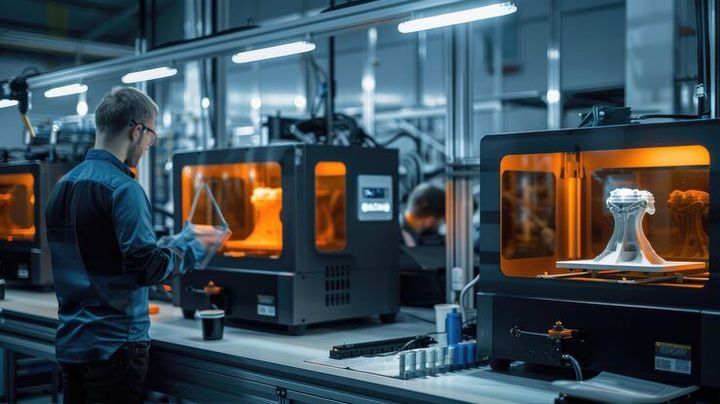
Industrial 3D printers are high-performance machines designed for professional manufacturing and engineering applications. Unlike consumer desktop printers, these systems work with advanced materials such as metals, industrial polymers, composites, ceramics, and high-strength resins.
The process starts with a Computer-Aided Design (CAD) model. The software divides the model into thin layers, and the printer builds the object one layer at a time until the final product is complete.
This technology supports rapid prototyping, precision engineering, digital manufacturing, and advanced production workflows.
Common Industrial 3D Printing Technologies
Several printing methods are widely used in industrial environments.
Fused Deposition Modeling (FDM)
FDM printers melt thermoplastic materials and deposit them layer by layer. This method is commonly used for functional prototypes and engineering models.
Selective Laser Sintering (SLS)
SLS uses a laser to fuse powdered materials into solid objects. It produces durable components with complex geometries and is suitable for industrial manufacturing.
Stereolithography (SLA)
SLA technology uses a laser to cure liquid resin into hardened layers. It is valued for producing highly detailed and accurate parts.
Direct Metal Laser Sintering (DMLS)
DMLS creates metal components by melting fine metal powder with a high-powered laser. This process is widely used for aerospace and medical applications where precision is critical.
Why Industrial 3D Printers Matter
Modern industries face constant pressure to improve efficiency while maintaining quality. Industrial 3D printers help address these challenges by enabling faster product development and greater design flexibility.
Some of the major advantages include:
- Reduced material waste
- Faster prototype development
- Ability to create complex designs
- Improved production flexibility
- Enhanced engineering accuracy
- Support for digital manufacturing strategies
Many organizations also use additive manufacturing to strengthen supply chain resilience by producing components closer to where they are needed.
Industries Using Industrial 3D Printing
The adoption of industrial 3D printers continues to expand worldwide.
Aerospace
Aircraft manufacturers use additive manufacturing to produce lightweight components that improve fuel efficiency and overall performance.
Automotive
The automotive sector relies on industrial 3D printing for prototype development, custom tooling, and specialized production parts.
Healthcare
Medical researchers and manufacturers create surgical models, dental products, orthopedic devices, and customized medical solutions using advanced printing technologies.
Construction
Large-scale 3D printing systems are helping engineers explore innovative building methods and modern infrastructure solutions.
Energy and Industrial Equipment
Power generation and industrial machinery sectors use additive manufacturing to create durable components that can operate under demanding conditions.
Materials Used in Industrial 3D Printing
One of the biggest strengths of industrial 3D printers is material versatility.
Popular materials include:
- Stainless steel
- Titanium
- Aluminum alloys
- Nylon polymers
- Carbon fiber composites
- High-performance engineering plastics
- Industrial resins
- Ceramic materials
The choice of material depends on the required strength, heat resistance, durability, and application.
Key Trends Shaping the Industry
Industrial 3D printing continues to evolve rapidly. Several trends are influencing the future of additive manufacturing.
Artificial intelligence is improving print optimization and quality control. Machine learning systems can identify potential defects before production is completed.
Automation is also becoming more common. Smart factories are integrating industrial 3D printers into connected manufacturing systems to improve operational efficiency.
Sustainable manufacturing practices are another important trend. Additive manufacturing often generates less waste compared to traditional production methods, supporting environmental goals.
According to industry research, the global additive manufacturing market continues to expand as more sectors recognize its value for innovation and advanced engineering.
Challenges to Consider
Although industrial 3D printers provide many advantages, they also come with certain limitations.
Some advanced materials require specialized handling and controlled environments. Large-scale industrial systems may also need skilled operators and detailed design planning.
Production speed can vary depending on the complexity of the part, and post-processing may be required to achieve the desired finish or performance characteristics.
Understanding these factors helps organizations make informed decisions about additive manufacturing strategies.
The Future of Industrial 3D Printers
The future of industrial 3D printing looks promising. Researchers are developing new materials, faster printing methods, and larger production systems capable of manufacturing increasingly complex products.
Digital manufacturing, smart factories, and Industry 4.0 technologies are expected to drive further adoption across global markets. As innovation continues, industrial 3D printers will likely play an even greater role in engineering, infrastructure, healthcare, and advanced manufacturing.
Final Thoughts
Industrial 3D printers have become an important part of modern manufacturing. Their ability to create complex designs, support rapid prototyping, and improve production efficiency makes them valuable across many industries.
As additive manufacturing technology advances, businesses and professionals will continue exploring new possibilities for innovation and sustainable production. Understanding how industrial 3D printers work and where they are used provides valuable insight into one of the most significant manufacturing technologies of the modern era.