Augmented Reality, commonly referred to as AR, is a digital technology that overlays computer-generated information onto the physical world. In the automotive industry, AR is used to enhance how information is displayed, understood, and interacted with during vehicle design, manufacturing, operation, and maintenance. AR exists in this sector because vehicles and automotive systems have become increasingly complex, requiring clearer ways to visualize data and processes.
Traditionally, automotive information was communicated through physical manuals, dashboards, and training diagrams. As vehicles integrated advanced electronics, sensors, and software, these traditional methods became less efficient. AR emerged as a solution by allowing digital instructions, visual cues, and contextual data to appear directly within the user’s field of view.
In automotive contexts, AR can appear through head-up displays, tablets, smart glasses, or in-vehicle screens. Its purpose is to bridge the gap between digital data and real-world components, making complex information easier to interpret without removing attention from the task or environment.
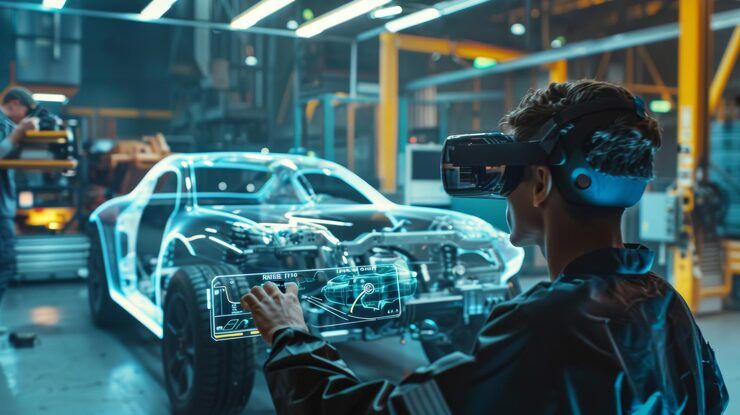
Importance: Why AR Matters in the Automotive Industry Today
AR matters in the automotive industry today because it supports clarity, safety, and efficiency across multiple stages of a vehicle’s lifecycle. From design and production to driving and maintenance, AR helps users understand systems that would otherwise be difficult to visualize.
This topic matters because AR in automotive settings:
-
Improves visualization of complex vehicle systems
-
Supports safer driver awareness through contextual information
-
Enhances accuracy in manufacturing and assembly processes
-
Assists learning and skill development for technical tasks
AR affects a wide range of stakeholders, including automotive engineers, factory operators, drivers, trainers, and researchers. For drivers, AR-based displays can present navigation or vehicle alerts in a way that reduces the need to look away from the road. For manufacturing teams, AR supports precision by overlaying instructions directly onto physical components.
By addressing challenges related to information overload and system complexity, AR contributes to clearer communication and better decision-making in automotive environments.
Recent Updates: AR Developments in the Past Year
During 2024 and early 2025, AR adoption in the automotive industry continued to expand, driven by advances in display technology and computing power. In early 2024, several automotive discussions highlighted improvements in AR head-up displays. These systems began offering wider fields of view and more accurate alignment with real-world objects.
In mid-2024, AR gained increased attention in automotive manufacturing and training. Reports focused on the use of AR-guided assembly and inspection processes, where digital overlays help reduce errors and improve consistency. Training programs also used AR simulations to help technicians understand vehicle systems without physical disassembly.
By late 2024 and into 2025, integration between AR and advanced driver assistance systems became a key topic. AR was discussed as a way to visually represent sensor data, such as lane boundaries or hazard zones, in a more intuitive manner. At the same time, automotive research emphasized careful design to avoid distraction and ensure clarity.
Another notable update involved collaboration between automotive and technology firms to standardize AR interfaces, reflecting the industry’s move toward more consistent user experiences.
Laws and Policies: Regulations Influencing Automotive AR
AR applications in the automotive industry are influenced by vehicle safety regulations, human–machine interface guidelines, and data protection policies. These frameworks aim to ensure that new technologies enhance safety rather than introduce risk.
International vehicle safety guidelines developed under the United Nations Economic Commission for Europe influence how in-vehicle displays and driver information systems are designed. These regulations focus on minimizing distraction and maintaining driver attention.
Standards related to usability, ergonomics, and system safety published by the International Organization for Standardization also affect AR implementation. These standards help guide how visual information is presented and evaluated in automotive contexts.
Data protection and privacy policies play a role when AR systems process sensor data, location information, or user behavior. Automotive AR systems must align with national and regional data protection frameworks to ensure responsible handling of digital information.
Tools and Resources: Learning and Understanding AR in Automotive Use
A range of educational and technical resources help explain how AR is applied in the automotive industry. These tools support learning, experimentation, and system planning.
Helpful tools and references include:
-
AR visualization software used for vehicle design
-
Simulation platforms for driver assistance visualization
-
Training modules using AR for technical education
-
Automotive human–machine interface design guidelines
-
Research publications on AR and mobility technology
The table below outlines common automotive AR use cases and their general focus:
| AR Application Area | Primary Purpose | Typical Context |
|---|---|---|
| Head-up displays | Driver information visualization | Navigation and alerts |
| Manufacturing AR | Assembly and inspection guidance | Factory environments |
| Maintenance AR | Component identification and instructions | Technical learning |
| Design visualization | Virtual prototyping and review | Vehicle development |
| Training simulation | Skill development and system understanding | Education and onboarding |
These resources help clarify how AR supports different automotive functions without replacing human judgment.
Frequently Asked Questions About AR in the Automotive Industry
What does AR mean in automotive contexts?
AR refers to displaying digital information over real-world vehicle environments to improve understanding and interaction.
Is AR the same as virtual reality in cars?
No, AR overlays information onto the real world, while virtual reality creates a fully digital environment.
Does AR improve driving safety?
When designed carefully, AR can support awareness by presenting information within the driver’s line of sight.
Is AR used only inside vehicles?
No, AR is also used in manufacturing, training, and maintenance environments within the automotive industry.
Are there regulations for automotive AR systems?
Yes, safety and usability guidelines influence how AR displays are designed and implemented in vehicles.
Conclusion: AR as a Supportive Technology in Automotive Evolution
Augmented Reality has become an important supportive technology in the automotive industry, helping bridge the gap between complex digital systems and real-world interaction. By enhancing visualization, improving clarity, and supporting learning, AR addresses many challenges created by increasingly advanced vehicles.
Understanding the context, importance, recent developments, regulatory influences, and learning resources related to AR in the automotive industry provides a balanced view of its role. Rather than replacing existing processes, AR complements them, offering clearer ways to access information and interact with modern automotive systems. As technology continues to evolve, AR is likely to remain a key tool in shaping how people design, build, and use vehicles in an informed and responsible way.