Factory Automation: Explore Robotics, PLC Systems, Industrial Control and Smart Manufacturing
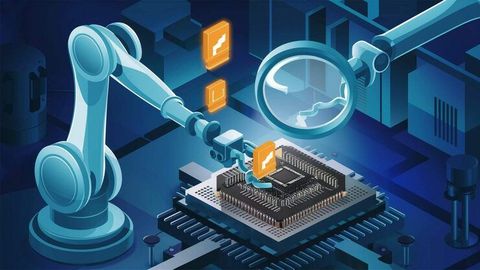
Factory automation refers to the use of control systems, machines, software, sensors, and robotics to perform or coordinate manufacturing activities with limited direct manual intervention. It can be applied to individual production steps or to connected processes across an entire factory.
The concept developed from the broader industrial movement toward mechanization and process control. Early factories used mechanical equipment to repeat physical tasks, while later systems introduced electrical controls, programmable logic controllers, sensors, and computerized monitoring. Modern factory automation combines these technologies with industrial networks, robotics, data systems, and software.
A factory automation system can control activities such as material handling, assembly, packaging, machining, inspection, temperature regulation, and production sequencing. The level of automation varies considerably between factories because different products and processes have different requirements.
Main components of factory automation
A typical automated production environment may include:
- Sensors: Detect temperature, pressure, position, speed, proximity, weight, or other physical conditions.
- Programmable logic controllers: Execute programmed control instructions based on sensor inputs.
- Human-machine interfaces: Allow operators to monitor processes and interact with control systems.
- Motors and drives: Control movement in conveyors, pumps, machines, and other equipment.
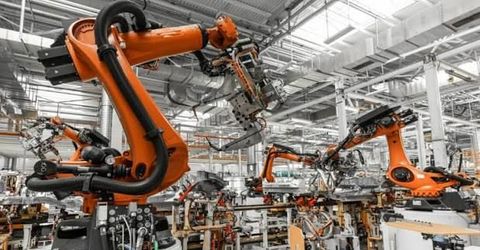
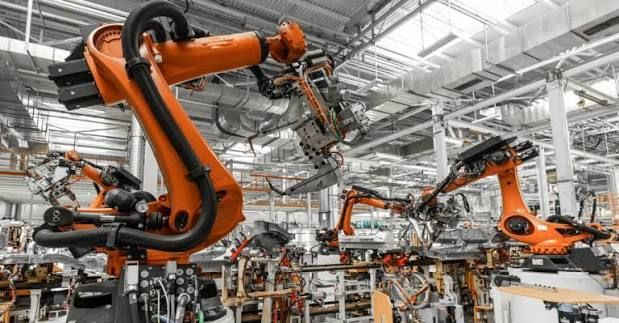
- Robots: Perform repetitive handling, assembly, welding, painting, or other defined tasks.
- Industrial networks: Connect controllers, sensors, machines, and monitoring systems.
- Supervisory control systems: Provide higher-level process monitoring and data collection.
These components can operate individually or as part of an integrated automation architecture.
Importance
Why factory automation matters
Manufacturing processes often involve repetitive actions, precise timing, controlled operating conditions, and coordination between multiple machines. Automation can help manage these activities consistently while allowing workers to focus on supervision, maintenance, programming, quality activities, and other responsibilities.
Automation can also be used where working conditions involve heat, chemicals, heavy materials, repetitive movements, or other hazards. In such situations, machines may perform specific physical activities while workers control, monitor, or maintain the equipment.
Production and quality considerations
Factory automation can influence several aspects of manufacturing. Sensors can continuously measure process conditions, while controllers can respond when a measurement moves outside a defined range.
For example, an automated temperature-control system can monitor a production process and adjust heating or cooling equipment according to programmed parameters. A vision system can inspect products for defined characteristics and send information to a controller for subsequent action.
However, automation does not automatically eliminate defects. Incorrect programming, sensor problems, poor calibration, equipment wear, unsuitable process parameters, and data errors can all affect an automated process.
Common automation levels
| Automation level | General description | Example |
|---|---|---|
| Manual | People perform most operations | Hand assembly |
| Mechanized | Machines assist physical work | Powered production equipment |
| Semi-automated | People and automated equipment share tasks | Automated filling with manual loading |
| Automated cell | Multiple machines coordinate a defined process | Robotic assembly cell |
| Integrated automation | Production equipment and information systems are connected | Connected manufacturing line |
The appropriate level depends on production volume, product variation, process complexity, safety requirements, and available infrastructure.
Recent Updates
Industrial robotics
From 2024 through 2026, industrial robotics has continued expanding into areas such as material handling, machine tending, assembly, inspection, and packaging. Collaborative robots, often called cobots, are also used in applications designed for interaction between people and robotic equipment under defined safety conditions.
Robot capabilities depend on their mechanical configuration, sensors, programming, payload, workspace, and application. They are not interchangeable across all manufacturing tasks.
Industrial Internet of Things
Industrial Internet of Things technologies connect machines and sensors so that operational information can be collected and analyzed. Data such as machine temperature, vibration, operating hours, energy consumption, and production status can be monitored through industrial software.
Connected systems can help manufacturers understand equipment behavior and production patterns. They also introduce cybersecurity considerations because networked industrial equipment can become part of a larger digital environment.
Artificial intelligence and machine vision
AI-based systems are increasingly being explored for visual inspection, anomaly detection, predictive analysis, and process optimization. Machine vision can use cameras and image-processing software to identify predefined characteristics on products or components.
AI-based analysis depends on suitable training data, accurate sensors, appropriate models, and clear operating conditions. Results therefore require validation within the specific manufacturing environment.
Digital twins
Digital twins are digital representations of physical equipment or processes. They can combine equipment information, sensor data, and simulation models to study how a production system behaves.
In manufacturing, digital-twin applications may be used for process analysis, equipment monitoring, production planning, or engineering studies. Their usefulness depends on the quality and completeness of the underlying data.
Laws or Policies
Factory automation is influenced by workplace safety, machinery, electrical, environmental, and data-related requirements. The applicable rules depend on the country, state, industrial sector, equipment type, and manufacturing process.
Machinery and worker safety
Automated equipment can introduce hazards involving moving parts, electrical systems, stored energy, robotic movement, heat, pressure, and unexpected machine startup. Factories therefore need appropriate safeguards, risk assessments, emergency procedures, and access controls.
In India, industrial workplaces may be subject to occupational safety requirements under central and state legislation. The Occupational Safety, Health and Working Conditions Code, along with applicable rules and sector-specific requirements, forms part of the country's workplace regulatory framework.
International manufacturers may also encounter standards concerning machinery safety, electrical equipment, functional safety, robotics, and industrial control systems. The exact standard applicable depends on the equipment and jurisdiction.
Environmental requirements
Automation systems can influence energy consumption and production efficiency, but environmental compliance remains dependent on the underlying industrial process. Factories may need controls for emissions, wastewater, hazardous materials, waste generation, noise, and resource use.
Cybersecurity
Connected automation systems can exchange information through industrial networks and enterprise systems. Cybersecurity policies may therefore address access control, authentication, network segmentation, software updates, backups, and incident response.
Tools and Resources
PLC programming environments
PLC programming software is used to configure and maintain programmable logic controllers. Common programming approaches include ladder logic, function block diagrams, structured text, and sequential function charts.
The appropriate programming environment depends on the PLC platform and the requirements of the automation system.
SCADA systems
Supervisory Control and Data Acquisition systems can collect information from industrial equipment and present it through operator interfaces. SCADA systems are commonly used where operators need visibility across multiple machines or process areas.
Manufacturing execution systems
Manufacturing execution systems, or MES platforms, connect production activities with operational information. Depending on the system, they can track production status, materials, quality information, equipment data, and workflow activities.
Simulation and digital engineering
Simulation software can model production lines, robotic movements, material flows, and process conditions before physical changes are implemented. Engineers can use these models to study possible bottlenecks and interactions.
Automation planning checklist
Before implementing or modifying factory automation, organizations commonly examine:
- Production requirements
- Machine interfaces
- Sensor requirements
- PLC and control architecture
- Robot requirements
- Electrical infrastructure
- Safety systems
- Industrial networking
- Data collection
- Maintenance procedures
- Operator training
- Cybersecurity controls
A clear understanding of the existing production process is important because automation architecture should correspond to the actual manufacturing workflow.
FAQs
What is factory automation?
Factory automation uses machines, control systems, sensors, software, and related technologies to perform or coordinate manufacturing activities with limited direct manual intervention.
What equipment is used in factory automation?
Common equipment includes PLCs, sensors, motors, drives, robots, conveyors, machine vision systems, industrial computers, human-machine interfaces, and industrial networking equipment.
How does factory automation improve manufacturing processes?
Automation can coordinate repetitive operations, monitor process conditions, manage machine sequences, and collect production information. Its effects depend on the specific process, equipment configuration, and control strategy.
What is the role of PLCs in factory automation?
A programmable logic controller receives signals from sensors and executes programmed instructions to control connected equipment. PLCs are widely used for sequencing, interlocking, motion-related functions, and process control.
Is factory automation the same as robotics?
No. Robotics is one part of factory automation. Automation can also include sensors, PLCs, conveyors, control panels, machine vision, process-control equipment, software, and industrial networks without necessarily using robots.
Conclusion
Factory automation combines machines, control systems, sensors, software, robotics, and industrial networks to coordinate manufacturing activities. Its applications range from individual automated machines to connected production environments containing multiple control and information systems. Developments from 2024 to 2026 have included increased use of industrial connectivity, robotics, AI-based analysis, machine vision, and digital twins. Safety, cybersecurity, environmental requirements, and appropriate system design remain important considerations when implementing automated manufacturing processes.