Industrial Automation Technologies: Guide to AI, IIoT & Smart Manufacturing
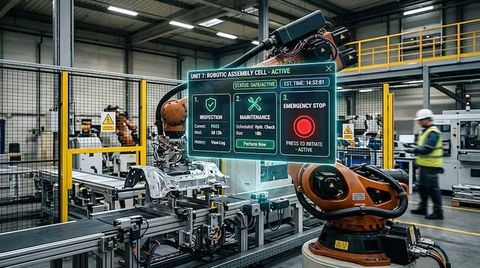
Industrial automation refers to the use of technology to control, monitor, and improve industrial processes with limited manual intervention. It includes programmable control systems, industrial robots, sensors, machine vision, industrial software, artificial intelligence, and connected equipment.
automation mainly focused on repeating predefined actions. Modern industrial automation is moving toward connected and data-driven systems. Machines can collect operating information, communicate with other equipment, and support decisions based on real-time conditions.
Three important technologies in this transition are Artificial Intelligence (AI), Industrial Internet of Things (IIoT), and smart manufacturing.
AI can analyze large amounts of production data and identify patterns. IIoT connects machines, sensors, controllers, and other industrial assets so that information can move between systems. Smart manufacturing combines these capabilities with automation, analytics, digital models, and connected production processes.
The purpose is not simply to automate every task. A modern manufacturing environment aims to make production more observable, responsive, consistent, and easier to manage.
Common applications include:
- Automated assembly and material handling
- Predictive equipment monitoring
- Machine vision for quality inspection
- Production data collection
- Energy monitoring
- Digital twins
- Robotic process automation
- Automated warehouse operations
- Industrial cybersecurity
- AI-assisted production planning
These technologies are particularly relevant as manufacturers manage increasingly complex equipment, supply chains, quality requirements, and energy considerations.
Importance: Why Smart Manufacturing Matters Today
Industrial automation matters because manufacturing operations generate large quantities of information. Temperature, vibration, pressure, speed, energy use, production rates, and quality measurements can all provide useful information when properly collected and analyzed.
IIoT systems help connect these data sources. Instead of relying only on manual readings, operators can monitor selected machine conditions through centralized dashboards or industrial software.
AI can add another layer of analysis. For example, an AI model may examine historical machine data to identify patterns associated with equipment problems. This can support predictive maintenance planning, although the accuracy of such systems depends on data quality, system design, and ongoing validation.
Automation can also support quality control. Machine vision systems can inspect products for defined characteristics, while automated controls can identify process deviations more consistently than manual observation in suitable applications.
Smart manufacturing affects several groups:
- Factory operators: receive better visibility into machine conditions and production processes.
- Engineers: can analyze operational data and improve process parameters.
- Maintenance teams: can use equipment information to plan inspections and maintenance activities.
- Plant managers: can monitor production performance through centralized information.
- Manufacturers: can improve traceability, process consistency, and resource management.
The technology also creates challenges. Older equipment may use different communication standards, while new connected systems introduce additional cybersecurity requirements. Employees may need training in data analysis, automation controls, robotics, and industrial networking.
Therefore, successful digital transformation is usually a combination of technology, workforce development, process redesign, and careful implementation.
Recent Updates and Trends in Industrial Automation
Industrial automation continued to develop rapidly during 2025 and 2026, with AI becoming a stronger part of manufacturing discussions.
In October 2025, NITI Aayog released its “Reimagining Manufacturing: India’s Roadmap to Global Leadership in Advanced Manufacturing.” The roadmap identified AI and machine learning, digital twins, robotics, and advanced technologies as important enablers for India's manufacturing development.
The roadmap also describes connected supply-chain models using technologies such as IoT and AI for visibility, predictive analytics, and information sharing.
In February 2026, the Ministry of Electronics and Information Technology highlighted AI for Manufacturing Engineering Technology and launched a white-paper concept focused on responsible and scalable AI adoption in manufacturing. The discussion emphasized productivity, skills development, sustainability, and industrial innovation.
Another important development is the growing connection between automation and cyber-physical systems. In August 2026, the Indian government reported continued implementation of the National Mission on Interdisciplinary Cyber-Physical Systems, covering AI, machine learning, IoT, robotics, autonomous systems, data analytics, and cybersecurity.
Several trends are particularly important:
| Technology | Industrial application |
|---|---|
| AI and machine learning | Prediction, optimization, quality analysis |
| IIoT sensors | Real-time machine and process monitoring |
| Digital twins | Virtual representation of equipment or processes |
| Robotics | Assembly, handling, inspection, and repetitive operations |
| Machine vision | Automated visual inspection |
| Edge computing | Local processing of industrial data |
| Industrial cybersecurity | Protection of connected equipment and networks |
| Advanced analytics | Production and energy performance analysis |
The direction is increasingly moving from isolated automation toward interconnected industrial systems.
Laws and Policies Affecting Industrial Automation in India
Industrial automation in India is influenced by manufacturing, technology, cybersecurity, data, labor, environmental, and industrial safety requirements. The exact obligations depend on the industry, location, equipment, and type of data involved.
The National Mission on Manufacturing, announced in the Union Budget 2025–26, provides a broader policy framework for strengthening manufacturing and integrating Indian industry into global value chains. The Economic Survey 2025–26 describes technology adoption and advanced manufacturing as important elements of this wider industrial strategy.
The National Mission on Interdisciplinary Cyber-Physical Systems (NM-ICPS) is another relevant government initiative. Its activities include AI, IoT, robotics, cybersecurity, technology development, and skill development.
In March 2026, the government also approved the Bharat Audyogik Vikas Yojna (BHAVYA), with an allocation of ₹33,660 crore for developing 100 plug-and-play industrial parks. The initiative is intended to strengthen industrial infrastructure and manufacturing ecosystems.
In May 2026, detailed guidelines for BHAVYA were released, providing further implementation information for the industrial-park initiative.
Manufacturers should also consider applicable occupational safety requirements, electrical and machinery standards, environmental rules, data protection obligations, and cybersecurity controls. Requirements can differ significantly between sectors such as pharmaceuticals, food processing, chemicals, automotive, electronics, and heavy engineering.
Technology adoption should therefore be evaluated alongside applicable legal and technical requirements rather than treated as a purely software or equipment decision.
Tools and Resources for Learning Industrial Automation
People learning industrial automation can use a combination of educational, analytical, and technical resources.
Useful categories include:
- PLC programming simulators: Help learners understand industrial control logic.
- IIoT dashboards: Demonstrate how sensor information can be collected and visualized.
- Digital twin platforms: Help explain virtual models of machines and production systems.
- Data analytics tools: Support analysis of machine, production, and energy datasets.
- AI development environments: Allow users to experiment with predictive models.
- CAD and simulation software: Useful for understanding automated equipment and production layouts.
- Industrial networking laboratories: Help explain communication between controllers, sensors, and machines.
- Cybersecurity assessment checklists: Useful for reviewing connected industrial environments.
- Maintenance templates: Can organize inspection records, machine history, and maintenance observations.
- Energy calculators: Help estimate electricity consumption and identify areas for monitoring.
For beginners, a practical learning path can start with automation fundamentals, followed by PLC concepts, industrial sensors, networking, data analytics, IIoT, robotics, AI, and cybersecurity.
The best resource depends on the user's role. Operators may need practical control and monitoring knowledge, while engineers may require deeper skills in programming, data analysis, industrial communication, and system integration.
Frequently Asked Questions
What is industrial automation?
Industrial automation uses control systems, software, sensors, robots, and other technologies to monitor or operate industrial processes with reduced manual intervention. The level of automation varies by application.
What is IIoT in manufacturing?
IIoT, or Industrial Internet of Things, connects industrial machines, sensors, controllers, and software systems so operational data can be collected, communicated, and analyzed.
How is AI used in smart manufacturing?
AI can analyze production and machine data for applications such as predictive maintenance, quality inspection, anomaly detection, demand analysis, and process optimization. Results depend on the quality and relevance of the available data.
What is a digital twin?
A digital twin is a digital representation of a physical machine, process, system, or facility. It can combine operational data with a model to support monitoring, analysis, simulation, or optimization.
Does automation eliminate the need for human workers?
Automation can reduce the need for people to perform certain repetitive tasks, but human roles remain important in supervision, maintenance, engineering, safety, troubleshooting, quality decisions, and system management. The effect varies by industry and application.
Conclusion
Industrial automation is evolving from basic machine control into a broader digital manufacturing environment. AI, IIoT, robotics, machine vision, digital twins, and advanced analytics are increasingly connected with traditional automation technologies.