Industrial robots are programmable machines designed to perform physical tasks such as assembly, welding, packaging, inspection, and material handling. They emerged to address the need for precision, repeatability, and efficiency in manufacturing environments where manual processes were slow, inconsistent, or hazardous.
Automation and machine control systems work alongside industrial robots to coordinate movement, timing, and decision-making. These systems rely on sensors, controllers, and software to ensure robots operate accurately within complex production environments. Over time, industrial robotics has expanded beyond traditional factories into logistics, electronics, pharmaceuticals, and food processing.
Common concepts often associated with this field include:
-
Industrial automation systems
-
Robotic arms and manipulators
-
Machine control technology
-
Programmable logic controllers
-
Smart manufacturing infrastructure
Together, these elements form the foundation of modern automated production.
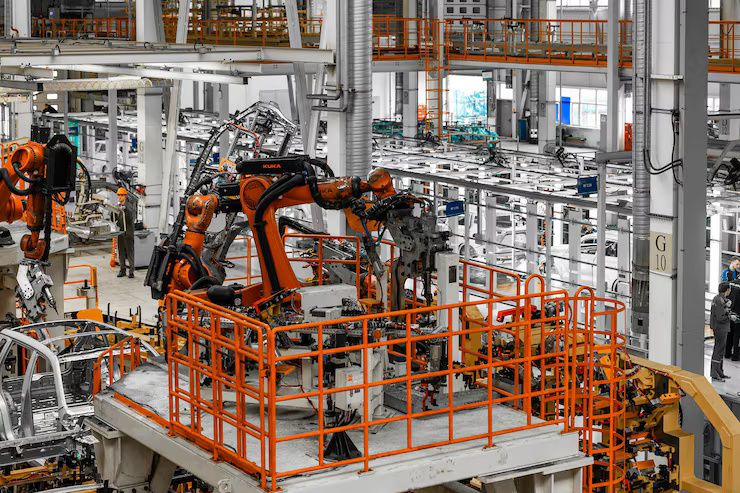
Importance of Industrial Robots in Modern Industry
Industrial robots play a significant role in addressing today’s manufacturing challenges. As global demand for high-quality products increases, industries require systems that can maintain consistency while scaling output.
Industrial robotics matters because it:
-
Improves operational accuracy and repeatability
-
Reduces exposure to hazardous working conditions
-
Supports continuous production cycles
-
Enables data-driven manufacturing decisions
Industries most affected include automotive manufacturing, electronics assembly, metal fabrication, and logistics. Small and medium enterprises are also increasingly adopting automation as machine control platforms become more flexible and modular.
From a broader perspective, industrial robots help solve issues such as:
-
Production variability
-
Human error in repetitive tasks
-
Inefficient use of resources
-
Limited real-time process visibility
These factors explain why automation and robotics are central to discussions around productivity and industrial modernization.
Recent Updates and Industry Trends
Over the past year, industrial robotics has continued to evolve rapidly, influenced by advances in software, connectivity, and artificial intelligence.
Key developments observed during 2025 include:
-
Increased use of AI-enabled robot controllers for adaptive motion planning
-
Wider deployment of collaborative robots designed to work near humans
-
Expansion of digital twin technology for simulation and system testing
-
Greater focus on energy-efficient automation systems
In early 2025, several manufacturing regions reported higher adoption of smart factory frameworks that integrate robotics with industrial IoT platforms. Machine control software updates released throughout mid-2025 emphasized predictive maintenance, allowing systems to identify faults before failures occur.
Another notable trend is the growing standardization of robot programming interfaces, which simplifies integration across different automation environments.
Laws, Policies, and Regulatory Environment
Industrial robots are governed by safety and compliance frameworks that vary by country but share common principles. Regulations typically focus on workplace safety, system reliability, and operator protection.
Key regulatory considerations often include:
-
Machine safety standards for industrial equipment
-
Electrical and mechanical compliance requirements
-
Risk assessment and hazard mitigation procedures
-
Workplace safety codes related to automated machinery
Many governments also support automation adoption through industrial modernization programs and digital manufacturing initiatives. These policies aim to improve competitiveness while ensuring that automation systems meet strict safety and operational guidelines.
Organizations deploying industrial robots must align machine control systems with national and international standards to ensure compliance and reduce operational risk.
Tools and Resources for Industrial Robotics
A wide range of tools and resources support learning, planning, and managing industrial automation systems. These tools focus on design, simulation, monitoring, and optimization rather than commercial transactions.
Helpful resources include:
-
Robot simulation software for workflow modeling
-
Industrial automation calculators for cycle time analysis
-
Machine control documentation libraries
-
Online knowledge bases on robotics standards
-
Open technical frameworks for industrial communication
Below is a simplified table showing common tool categories and their purpose:
| Tool Category | Primary Function | Typical Use Case |
|---|---|---|
| Simulation Platforms | Virtual testing of robot motion | Layout planning |
| Machine Control Software | Coordinate sensors and actuators | Process control |
| Monitoring Dashboards | Real-time performance tracking | Fault detection |
| Data Analytics Tools | Analyze production metrics | Efficiency insights |
These resources help engineers, planners, and researchers understand how automation systems behave before physical deployment.
Industrial Robot Types and Applications
Industrial robots are categorized based on structure and motion capabilities. Each type serves specific operational needs.
Common robot categories include:
-
Articulated robots for complex movement
-
SCARA robots for high-speed assembly
-
Cartesian robots for linear positioning
-
Delta robots for lightweight, fast tasks
The following table outlines typical applications:
| Robot Type | Motion Characteristics | Common Applications |
|---|---|---|
| Articulated | Multi-axis rotational movement | Welding, painting |
| SCARA | Horizontal compliance | Electronics assembly |
| Cartesian | Linear axis motion | Pick-and-place |
| Delta | Parallel arm structure | Packaging, sorting |
Understanding these categories helps clarify how machine control systems are tailored for different automation scenarios.
Frequently Asked Questions About Industrial Robots
What is the difference between industrial robots and automation systems?
Industrial robots are physical machines that perform tasks, while automation systems include the software, controllers, and sensors that manage how those robots operate.
How do machine control systems improve accuracy?
Machine control systems process sensor data in real time, adjusting robot motion and timing to maintain precision during operations.
Are industrial robots limited to manufacturing?
No. They are increasingly used in logistics, healthcare-related manufacturing, food processing, and electronics assembly.
What skills are needed to understand industrial robotics?
Basic knowledge of mechanics, control systems, and industrial software concepts helps in understanding how robots function within automated environments.
How is data used in robotic automation?
Operational data supports monitoring, diagnostics, and long-term optimization of automated processes.
Conclusion
Industrial robots and machine control systems form the backbone of modern automation. They exist to improve accuracy, safety, and efficiency in environments where consistency and reliability are essential. Recent advancements in software intelligence, connectivity, and system integration continue to expand their role across industries.
Understanding the context, importance, regulatory environment, and available tools provides a clear foundation for learning about industrial robotics. As automation technologies evolve, they remain a key component in shaping how industries design, monitor, and optimize complex processes.