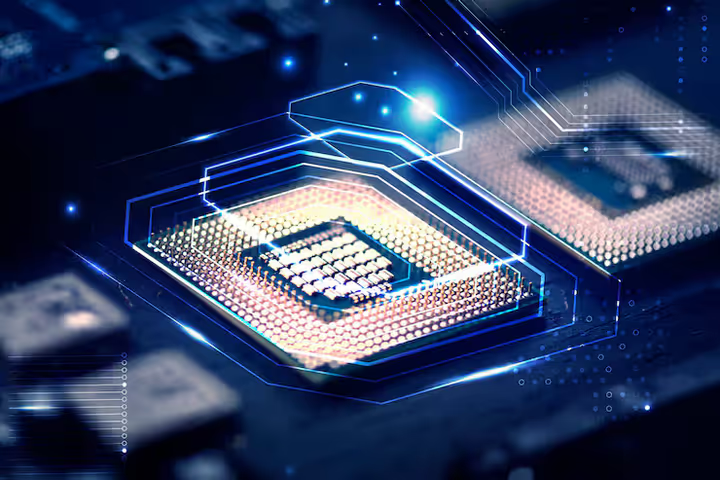
Next-Generation Chips: Advanced Semiconductor Technology, Design, and AI Applications
Next-generation chips are advanced semiconductor devices designed to perform increasingly complex computing tasks while managing power consumption, heat, physical size, and manufacturing constraints.
The term includes next generation chips, next gen semiconductor chips, specialized AI processors, high-performance computing devices, and other advanced integrated circuits.
Semiconductor chips are built from extremely small electronic components, including transistors, interconnects, memory elements, and logic circuits. These components work together to process information in computers, smartphones, vehicles, industrial equipment, communication systems, and data centers.
As computing requirements have increased, semiconductor development has moved beyond simply making individual components smaller. Modern advanced semiconductor technology also involves new transistor structures, chiplet-based designs, specialized accelerators, advanced packaging, memory integration, and software-aware hardware design.
How advanced chips are developed
The development of a chip generally involves several stages. Advanced chip design begins with defining the required functions and performance characteristics. Engineers then create circuit designs, verify them using specialized software, and prepare the design for manufacturing.
The physical manufacturing process involves creating microscopic structures on semiconductor wafers. Multiple processing steps can include deposition, lithography, etching, implantation, cleaning, and inspection.
After fabrication, chips are tested and packaged. Packaging connects the semiconductor die to external systems and can also provide thermal management and communication between multiple dies.
Importance
Next-generation chips affect many areas of modern life because digital systems increasingly depend on specialized computing hardware. Smartphones, cloud computing platforms, electric vehicles, industrial automation equipment, medical devices, telecommunications infrastructure, and consumer electronics all rely on semiconductor technology.
AI chips and artificial intelligence chips have become particularly important because machine-learning workloads can involve large numbers of mathematical operations performed simultaneously. Conventional central processing units can perform these tasks, but specialized processors can be designed around the computational patterns commonly used in artificial intelligence.
Why chip architecture matters
Chip performance is influenced by several factors rather than transistor dimensions alone. These include:
- Processing architecture, which determines how instructions and calculations are handled.
- Memory architecture, which affects how quickly data can move between processing units and memory.
- Power efficiency, which influences energy consumption and heat generation.
- Packaging, which affects communication between chips and thermal management.
- Software compatibility, which determines how effectively applications can use available hardware.
This means two chips produced using similar manufacturing technologies can have significantly different characteristics because of differences in architecture and intended use.
Major application areas
Next-generation chips are being developed for a wide range of applications.
| Application area | Typical semiconductor requirement | Example technologies |
|---|---|---|
| Artificial intelligence | Parallel computing and high memory bandwidth | AI accelerators, GPUs, specialized processors |
| Data centers | High processing capacity and energy management | CPUs, accelerators, networking chips |
| Mobile devices | Computing within limited power and space | Application processors, neural processors |
| Automotive systems | Real-time processing and reliability | Vehicle processors, sensor processors |
| Industrial automation | Control, sensing, and edge computing | Embedded processors, AI accelerators |
| Telecommunications | High-speed data processing | Networking and signal-processing chips |
| Consumer electronics | Integrated computing and connectivity | System-on-chip designs |
The appropriate architecture depends on the workload. A processor designed for a data center may have very different priorities from a chip intended for a battery-powered device.
Recent Updates
From 2024 through 2026, semiconductor development has continued to focus on artificial intelligence, advanced manufacturing, chiplet architectures, high-bandwidth memory, advanced packaging, and energy efficiency. These developments reflect the growing computing requirements of data centers and AI applications.
AI-focused semiconductor development
AI workloads have increased demand for processors capable of handling large-scale parallel calculations. Modern AI chips may include specialized matrix-processing units, large memory systems, and high-speed connections between processing components.
Artificial intelligence chips are also being developed for edge applications. Instead of sending every calculation to a remote data center, some devices can process AI workloads locally. This can reduce dependence on continuous network communication and can support applications where response time or data handling is important.
Chiplets and advanced packaging
Advanced semiconductor manufacturing is increasingly connected with packaging technology. Instead of placing an entire computing system on a single large piece of silicon, designers can divide functions among multiple smaller dies known as chiplets.
Chiplets can be combined within a single package using high-density interconnections. This approach allows different types of processing, memory, and input/output functions to be integrated into one computing platform.
Advanced packaging can therefore become an important part of advanced semiconductor technology, particularly as conventional scaling becomes more technically demanding.
New transistor structures
Semiconductor manufacturers continue to develop transistor structures that can improve control of electrical current at very small dimensions. Newer architectures can use structures that surround or more effectively control the conducting channel.
The transition to new transistor designs requires changes throughout the manufacturing process, including design tools, fabrication equipment, process control, and testing.
Semiconductor supply-chain development
The semiconductor industry has also continued to diversify manufacturing capacity geographically. Governments and private organizations in several regions are supporting domestic semiconductor production, research, packaging facilities, and workforce development.
These efforts are intended to improve supply-chain resilience and expand local capabilities across different parts of semiconductor production.
Laws or Policies
Semiconductor manufacturing is influenced by regulations covering technology exports, environmental protection, workplace safety, intellectual property, data security, and industrial development. Because requirements vary between countries, companies involved in chip development and manufacturing must follow the rules applicable to their locations and activities.
Semiconductor policies in India
India has increased its focus on domestic semiconductor capabilities through government initiatives supporting semiconductor fabrication, packaging, design, and related infrastructure. The India Semiconductor Mission is a central part of this policy direction.
Government-supported semiconductor programs can involve financial incentives and institutional frameworks for semiconductor and display manufacturing, packaging, and design activities. Eligibility and conditions depend on the specific program and project.
International technology controls
Semiconductor technology is also affected by international trade controls. Certain advanced computing devices, manufacturing equipment, and semiconductor technologies can be subject to export restrictions depending on the destination, technical specifications, and applicable national rules.
Environmental and workplace regulations can also apply to semiconductor fabrication because manufacturing involves specialized chemicals, gases, high temperatures, electrical equipment, and controlled production environments.
Organizations working in this field generally need to evaluate applicable requirements for:
- Chemical handling and environmental emissions.
- Worker health and industrial safety.
- Equipment and technology imports.
- Export controls and trade restrictions.
- Intellectual property protection.
- Waste treatment and resource management.
The precise requirements depend on the country, facility, technology, and intended application.
Tools and Resources
Understanding next-generation semiconductor technology often requires both technical and industry resources. Different tools are used during design, manufacturing, testing, and analysis.
Chip design and simulation tools
Electronic design automation software is used to create and verify integrated circuits. These tools can support functions such as logic design, physical layout, timing analysis, power analysis, and verification.
Simulation platforms allow engineers to evaluate circuit behavior before physical manufacturing. This can help identify design problems during the development process.
Semiconductor manufacturing resources
Manufacturing facilities use sophisticated equipment to create and inspect semiconductor structures. Important process areas include:
- Lithography for transferring patterns onto semiconductor materials.
- Deposition for placing thin material layers.
- Etching for removing selected material.
- Metrology for measuring microscopic structures.
- Inspection systems for identifying manufacturing defects.
- Wafer testing for evaluating electrical characteristics.
Industry information sources
Organizations such as SEMI, IEEE, JEDEC, and the International Technology Roadmap for Devices and Systems provide technical information, standards, research, and industry references.
Government semiconductor agencies and trade departments can also provide information about national programs, regulations, manufacturing incentives, and technology policies.
For general readers, semiconductor company annual reports, technical documentation, university research publications, and educational resources can help explain developments without requiring specialist engineering knowledge.
FAQs
What are next generation chips?
Next generation chips are advanced semiconductor devices designed for modern computing requirements. They can incorporate new transistor structures, specialized processing units, advanced packaging, chiplets, and other architectural approaches.
How do next gen semiconductor chips differ from older chips?
Differences can include transistor architecture, processing design, memory systems, packaging, power management, and specialized computing capabilities. Smaller manufacturing dimensions are only one part of semiconductor development.
What are AI chips and artificial intelligence chips used for?
AI chips and artificial intelligence chips are designed to accelerate computational workloads used in machine learning and other AI applications. They may perform large numbers of parallel mathematical operations and can be used in data centers, personal devices, vehicles, and industrial systems.
What is advanced semiconductor manufacturing?
Advanced semiconductor manufacturing refers to highly developed processes used to create modern integrated circuits. It can involve advanced lithography, transistor structures, process control, inspection, and packaging technologies.
Why is advanced chip design important?
Advanced chip design determines how processing units, memory, interconnects, power systems, and other components work together. Architecture has a major influence on how a chip handles its intended workload.
Conclusion
Next-generation chips combine advances in semiconductor architecture, manufacturing, packaging, memory, and specialized computing. AI processors have become an important area because artificial intelligence workloads require substantial parallel computing and data movement. Developments from 2024 through 2026 have also increased attention to chiplets, advanced packaging, new transistor structures, and semiconductor supply-chain resilience. Government policies and international regulations continue to influence how semiconductor technologies are developed, manufactured, traded, and deployed.