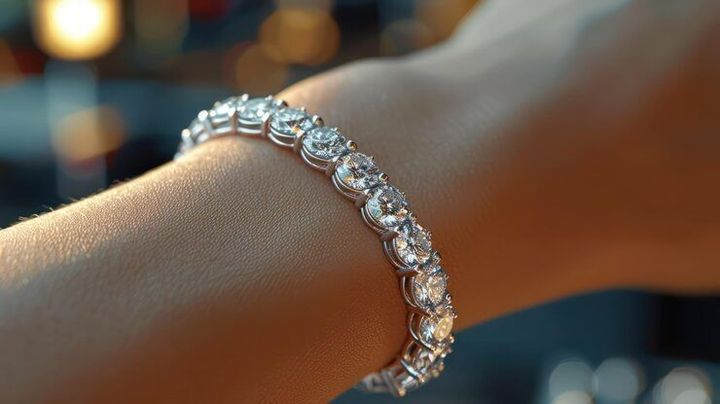
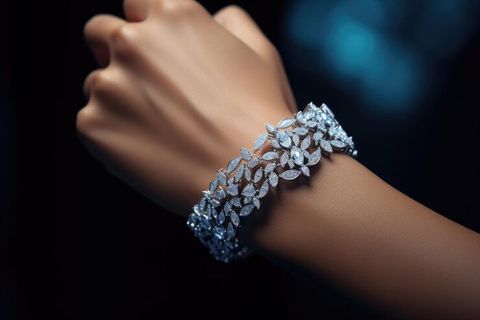
The term “tennis bracelet” became widely recognized after a famous sporting moment when a professional player paused a match to retrieve a fallen diamond bracelet. Since then, the name has been associated with elegant, flexible bracelets featuring a continuous line of diamonds.
These bracelets were developed to combine durability, comfort, and visual uniformity. Earlier designs were often rigid, but the tennis bracelet introduced flexibility while maintaining consistent gemstone alignment.
Key Features of a Tennis Bracelet
A typical diamond tennis bracelet includes:
-
A continuous row of round or square diamonds
-
Individual settings such as prong, bezel, or channel
-
Precious metals like gold or platinum
-
A secure clasp mechanism for durability
The design focuses on simplicity, allowing the natural brilliance of diamonds to stand out rather than relying on heavy ornamentation.
Why Diamond Tennis Bracelets Matter in Modern Jewelry Culture
Diamond tennis bracelets remain important because they balance timeless design with everyday usability. They are subtle yet elegant, making them suitable for both casual and formal settings.
Who They Influence
This jewelry style is relevant to several groups:
-
Jewelry designers exploring classic aesthetics
-
Consumers seeking durable luxury accessories
-
Collectors studying gemstone craftsmanship
-
Fashion professionals analyzing trends
Key Reasons for Their Continued Importance
-
Demonstrate precision gemstone setting techniques
-
Highlight diamond grading standards
-
Reflect advancements in jewelry craftsmanship
-
Support discussions on ethical sourcing
Because diamonds are arranged in a continuous line, any inconsistency in quality becomes noticeable, making these bracelets useful for gemstone evaluation.
Recent Trends and Industry Updates
Recent industry reports highlight evolving trends in diamond tennis bracelet design and production. These updates reflect both technological advancements and changing consumer preferences.
Key Trends in 2025
-
Increased use of lab-grown diamonds
-
Growing popularity of minimalist luxury jewelry
-
Integration of advanced CAD design tools
-
Improved clasp technologies with safety mechanisms
Mixed Diamond Shape Designs
Modern designs are experimenting with a variety of diamond shapes, including:
-
Oval diamonds
-
Emerald-cut diamonds
-
Pear-shaped diamonds
This approach adds uniqueness while preserving the traditional bracelet structure.
Regulations and Policies Affecting Diamond Jewelry
The diamond industry operates under international and national regulations to ensure ethical sourcing and consumer protection. These frameworks help maintain transparency in gemstone trade.
Key Regulatory Areas
-
Accurate gemstone labeling
-
Metal purity standards
-
Import and export documentation
-
Environmental and mining regulations
The Kimberley Process Certification Scheme is a major global initiative that aims to prevent conflict diamonds from entering the market.
Country-Level Regulations
-
European Union: Requires clear labeling under consumer laws
-
United States: FTC guidelines enforce transparency in gemstone disclosure
These regulations are especially important for tennis bracelets due to their multiple gemstones and sourcing requirements.
Tools and Resources for Learning About Diamond Jewelry
Various tools and resources are available to help individuals understand diamond quality and jewelry design. These resources are widely used in education and professional settings.
Common Learning Tools
-
Diamond grading charts
-
Gemstone identification guides
-
Jewelry CAD software
-
Metal purity reference charts
-
Jewelry care guides
Digital Tools
-
Diamond clarity simulators
-
Cut comparison charts
-
Design software programs
-
Appraisal templates
Diamond Evaluation Factors
| Diamond Characteristic | Description | Why It Matters |
|---|
| Cut | Quality of shaping and symmetry | Affects brilliance and sparkle |
| Color | Degree of colorlessness | Impacts visual brightness |
| Clarity | Presence of internal inclusions | Determines purity |
| Carat Weight | Size of the diamond | Influences overall appearance |
Common Diamond Size Categories
| Diamond Size Category | Typical Use |
|---|
| Micro Diamonds | Lightweight bracelet designs |
| Medium Diamonds | Everyday balanced jewelry |
| Larger Diamonds | High-visibility statement pieces |
These tools help users better understand how quality and structure influence bracelet design.
Frequently Asked Questions
What is a diamond tennis bracelet?
A diamond tennis bracelet is a flexible bracelet featuring a continuous line of individually set diamonds connected by metal links.
Why is it called a tennis bracelet?
The name originated after a tennis player paused a match to recover a fallen diamond bracelet, bringing attention to the design.
What metals are commonly used?
Common metals include:
-
Yellow gold
-
White gold
-
Rose gold
-
Platinum
How are diamonds arranged?
Diamonds are arranged in a single, uniform row to create a balanced and consistent appearance.
What determines diamond quality?
Diamond quality is evaluated using four main factors:
-
Cut
-
Color
-
Clarity
-
Carat weight
Jewelry Design Insights and Industry Observations
The jewelry industry continues to innovate while preserving traditional bracelet styles. Designers are experimenting with new materials and techniques to enhance both aesthetics and sustainability.
Emerging Design Approaches
-
Alternative gemstone combinations
-
Sustainable materials
-
Advanced metal finishing
-
Lightweight structural designs
Popular Design Features
| Design Feature | Trend Level |
|---|
| Classic round diamonds | High |
| Mixed diamond shapes | Moderate |
| Colored gemstones | Moderate |
| Lab-grown diamonds | Increasing |
These trends show that while classic designs remain dominant, innovation continues to shape the future of jewelry.
Conclusion
Diamond tennis bracelets remain one of the most enduring designs in fine jewelry. Their continuous structure showcases precision craftsmanship and timeless elegance.
Modern advancements such as CAD design, improved clasp systems, and lab-grown diamonds are enhancing both functionality and design possibilities. At the same time, regulations ensure ethical sourcing and transparency within the industry.
For anyone interested in jewelry design or gemstone evaluation, tennis bracelets offer a clear example of how tradition, technology, and craftsmanship come together in modern jewelry.