Energy-Efficient Motors: Insights into Long-Term Savings and Performance
Electric motors account for a substantial share of industrial and commercial electricity consumption. Upgrading to energy-efficient models is one of the most reliable ways to reduce operating costs, lower energy demand, and improve system reliability.
Electric motors account for a substantial share of industrial and commercial electricity consumption. Upgrading to energy-efficient models is one of the most reliable ways to reduce operating costs, lower energy demand, and improve system reliability. Modern high-efficiency motors deliver measurable savings over their service life while often providing better performance characteristics than older designs. This article examines how energy-efficient motors achieve their advantages, the factors that influence long-term savings, and practical considerations for selection and operation.
Why Motor Efficiency Matters
Even small improvements in motor efficiency produce significant results because many motors run for thousands of hours per year.
Energy Use and Operating Cost Impact
A motor’s efficiency determines how much of the electrical input power is converted into useful mechanical work. The remainder is lost as heat. Because energy costs accumulate continuously, a higher-efficiency motor can repay its price premium through reduced electricity consumption, often within a few years, and then continue generating savings for the rest of its life.
Broader System and Environmental Benefits
Efficient motors run cooler, which can extend bearing and insulation life and reduce cooling requirements in the surrounding environment. Lower energy demand also decreases associated greenhouse-gas emissions when electricity is generated from fossil sources, supporting corporate sustainability goals and regulatory compliance.
What Makes a Motor Energy-Efficient
Efficiency gains come from design and material improvements that reduce the main sources of loss.
Design and Material Advances
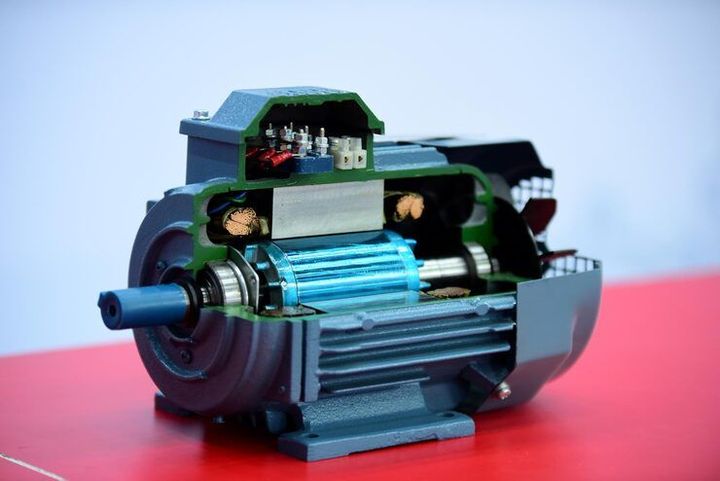
Energy-efficient motors typically use higher-grade electrical steel with lower core losses, optimized rotor and stator designs, improved slot configurations, and better-quality windings. Reduced fan and windage losses, tighter manufacturing tolerances, and improved bearings also contribute. Premium-efficiency and super-premium designs push these refinements further.
Efficiency Classifications and Standards
International and regional standards define efficiency classes (such as IE3, IE4, and IE5 under the IEC system). These classifications allow users to compare motors on a consistent basis. Many jurisdictions now require minimum efficiency levels for new motors, accelerating the shift away from older, less efficient designs.
Performance Beyond Efficiency
Modern efficient motors often deliver higher starting torque, better partial-load performance, and improved power factors compared with older motors of the same rating. They are frequently designed for compatibility with variable-frequency drives, enabling additional system-level savings when speed control is appropriate.
Long-Term Savings and Economic Considerations
The financial case for energy-efficient motors rests on total cost of ownership rather than purchase price alone.
Calculating Payback and Lifetime Savings
Simple payback is estimated by dividing the extra cost of the higher-efficiency motor by the annual energy-cost reduction. Annual savings equal the difference in power losses multiplied by operating hours and the electricity rate. Because motors often operate 4,000–8,000 hours per year, even modest efficiency gains of 2–5 percentage points produce substantial cumulative savings over a 10–20 year service life.
Factors That Influence Actual Savings
Operating hours, load profile, electricity price, and motor size all affect results. Motors that run continuously or near full load deliver the fastest returns. Partial-load operation is also important: many efficient designs maintain relatively high efficiency across a broader load range. Electricity-price increases and available rebates or incentives further improve the economics.
Maintenance and Reliability Contributions
Cooler operation typically reduces thermal stress on windings and bearings, which can lower maintenance frequency and extend mean time between failures. Avoiding one major repair or unplanned outage can outweigh the initial cost difference. When combined with proper alignment, lubrication, and power quality, efficient motors often deliver both energy and reliability benefits.
Selecting and Applying Energy-Efficient Motors
Choosing the right motor and installing it correctly determines whether expected savings are realized.
Matching Motor to Application
Select the efficiency class appropriate to the duty cycle and load characteristics. Oversizing reduces efficiency and power factor; undersizing risks overload and premature failure. Consider the full operating profile, including starting requirements, ambient temperature, altitude, and whether speed control will be used.
Integration with Drives and Systems
When process conditions allow variable speed, pairing an efficient motor with a properly configured variable-frequency drive frequently yields larger savings than the motor upgrade alone. Ensure the motor is rated for inverter duty if it will operate with a drive. System-level measures—correct sizing of pumps, fans, and compressors, elimination of throttling, and improved mechanical design—amplify motor efficiency gains.
Installation and Commissioning Practices
Proper alignment, secure mounting, correct electrical connections, and adequate ventilation are essential. Verify that voltage and frequency match the motor nameplate and that power quality is acceptable. Document baseline energy use where practical so that actual savings can be confirmed after the upgrade.
Maintaining Efficiency Over Time
Efficiency is not static; it can degrade without proper care.
Lubrication, Cleanliness, and Monitoring
Follow recommended bearing lubrication intervals and quantities. Keep cooling passages and fans clean so that the motor can dissipate heat effectively. Periodic vibration and temperature monitoring helps detect developing problems before they increase losses or cause failure.
Rewinds and Replacement Decisions
When a motor fails, evaluate whether rewinding can restore original efficiency or whether replacement with a higher-efficiency unit is more economical. Poor-quality rewinds can permanently reduce efficiency. For older, inefficient motors still in service, planned replacement often provides a better long-term outcome than repeated repairs.
Energy-efficient motors offer a proven combination of lower operating costs, improved reliability, and reduced environmental impact. The greatest benefits appear when efficiency is evaluated on a total-cost-of-ownership basis, motors are correctly matched to their applications, and supporting practices—proper installation, maintenance, and system optimization—are maintained. In most continuous or high-hour applications, the long-term savings substantially outweigh the initial premium, making high-efficiency motors one of the most practical investments available for industrial and commercial facilities. Evaluating current motor populations, prioritizing high-use applications, and applying sound selection and maintenance practices will capture the performance and economic advantages these designs deliver.