Essential Hospital Equipment Guide : Medical Devices, Healthcare Technology & Patient Care
Hospitals depend on a wide range of equipment to support diagnosis, treatment, monitoring, emergency response, surgery, and everyday patient care. From basic examination devices to advanced imaging systems, each category has a specific role within the healthcare environment.
Modern hospital equipment combines mechanical engineering, electronics, medical science, software, and digital connectivity. The goal is not simply to add more technology, but to provide healthcare professionals with dependable tools that support accurate decisions and safe clinical practices.
This guide explains the major categories of hospital equipment, why they matter, recent developments, important Indian regulations, and practical resources that can help people understand healthcare technology more clearly.
Understanding Essential Hospital Equipment
Hospital equipment can generally be grouped according to its clinical purpose. Some devices support diagnosis, while others monitor patients, assist treatment, or maintain essential hospital infrastructure.
Common categories include:
- Diagnostic equipment: Imaging systems, laboratory analyzers, ultrasound equipment, and diagnostic monitors.
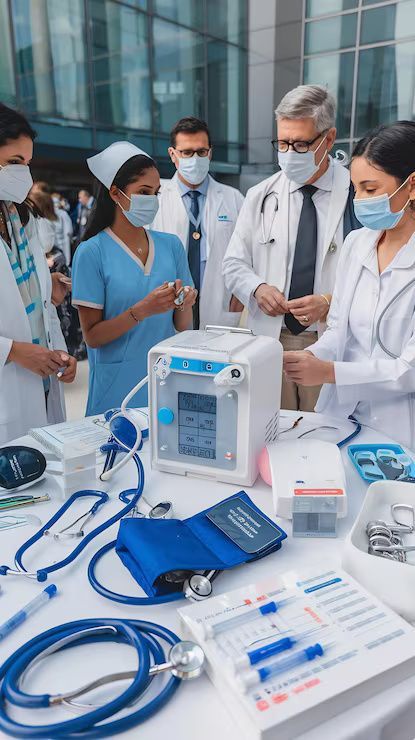
- Patient monitoring equipment: ECG machines, pulse oximeters, blood pressure monitors, cardiac monitors, and vital-sign systems.
- Emergency equipment: Defibrillators, emergency ventilators, suction equipment, resuscitation devices, and emergency carts.
- Surgical equipment: Operating tables, surgical lights, electrosurgical equipment, anesthesia machines, and sterilization systems.
- Critical-care equipment: Intensive-care ventilators, infusion pumps, patient monitors, and specialized respiratory equipment.
- Laboratory equipment: Centrifuges, microscopes, hematology analyzers, chemistry analyzers, and sample-processing systems.
- Hospital infrastructure equipment: Medical gas systems, oxygen-generation systems, backup power equipment, refrigeration systems, and sterilization infrastructure.
The right equipment depends on the hospital's clinical departments, patient population, available infrastructure, and regulatory requirements.
Why Hospital Equipment Matters Today
Reliable medical equipment is an important part of modern healthcare because clinical decisions often depend on timely and accurate information. A patient monitor can continuously track vital signs, while diagnostic imaging can help clinicians investigate internal conditions without invasive procedures.
Equipment also supports emergency preparedness. During critical situations, devices such as defibrillators, ventilators, infusion pumps, and oxygen systems can become essential components of immediate patient management.
Healthcare technology also affects hospital workflows. Digital monitoring systems can reduce repetitive manual recording, while connected equipment can help organize patient information and make clinical observations easier to review.
The main benefits of appropriate hospital equipment include:
- Better monitoring of patient conditions
- Faster access to important clinical information
- Support for emergency response
- More consistent diagnostic procedures
- Improved infection-control practices
- Better coordination between clinical departments
- Support for specialized treatment environments
However, technology alone does not guarantee better healthcare. Equipment must be appropriately selected, correctly installed, regularly maintained, and used by trained personnel.
Major Equipment Categories and Their Uses
| Equipment Category | Common Examples | Main Purpose |
|---|---|---|
| Patient Monitoring | ECG, pulse oximeter, vital-sign monitor | Monitoring physiological conditions |
| Imaging | X-ray, ultrasound, CT, MRI | Diagnostic imaging |
| Respiratory Care | Ventilator, oxygen system, nebulizer | Respiratory support |
| Emergency Care | Defibrillator, suction unit | Emergency response |
| Laboratory | Analyzer, microscope, centrifuge | Testing and analysis |
| Surgery | Operating table, surgical light | Surgical procedures |
| Sterilization | Autoclave, sterilizer | Infection-control support |
| Infusion | Infusion and syringe pumps | Controlled medication delivery |
Recent Developments in Hospital Equipment
Hospital equipment has continued to evolve during 2025 and 2026, particularly in medical device regulation, software, digital connectivity, and risk classification.
In April 2025, India's Central Drugs Standard Control Organization published a draft revision of risk-based classifications for cardiovascular and neurological medical devices. This reflects the continuing development of India's medical-device regulatory framework.
During 2025, CDSCO also published updated classifications and regulatory information covering areas such as oncology, radiotherapy, interventional radiology, and other device categories. These developments highlight the importance of understanding the regulatory classification of medical devices before their use in healthcare environments.
Another important development has been the growing role of medical-device software. On July 21, 2026, CDSCO published a guidance document concerning medical-device software under the Medical Devices Rules, 2017. This is relevant as hospitals increasingly use software-enabled monitoring, diagnostic, and clinical technologies.
Recent technology trends include:
- AI-assisted image analysis
- Connected patient monitoring
- Cloud-supported healthcare data management
- Software-enabled medical devices
- Remote equipment monitoring
- Digital diagnostic workflows
- Improved sterilization monitoring
- More detailed equipment safety tracking
These developments do not eliminate the need for clinical judgment. Instead, they provide additional information that qualified healthcare professionals can use when making decisions.
Laws and Policies in India
Medical devices in India are primarily regulated under the Medical Devices Rules, 2017, operating within the broader framework of the Drugs and Cosmetics Act. Devices are regulated using a risk-based classification system, with requirements depending on the nature and risk level of the device.
Hospitals and healthcare institutions should therefore consider regulatory status, applicable licensing requirements, technical documentation, safety information, and conformity requirements when selecting medical devices.
Recent regulatory activity demonstrates that the framework continues to evolve. In November 2025, CDSCO issued a circular concerning the requirement for appropriate CDSCO or State Licensing Authority licensing in medical-device procurement by procurement agencies.
The Indian regulatory environment can involve several authorities and frameworks depending on the equipment category. For example:
- CDSCO: Medical-device regulation and oversight.
- BIS: Applicable Indian standards for relevant equipment and infrastructure.
- AERB: Radiation-related equipment and radiation safety requirements.
- Clinical Establishments framework: Requirements applicable to healthcare establishments in jurisdictions where the relevant legislation is adopted.
- Biomedical waste rules: Requirements concerning the handling and disposal of applicable healthcare waste.
- Data-protection requirements: Relevant when connected medical equipment processes identifiable digital health information.
Hospitals should verify the latest applicable requirements because regulations, classifications, technical standards, and administrative procedures can change.
Choosing Equipment for Different Hospital Areas
Different departments require different combinations of equipment. A general hospital may need broad diagnostic, emergency, laboratory, surgical, and monitoring capabilities, while a specialized facility may require equipment designed for a narrower clinical purpose.
For intensive-care areas, patient monitoring, respiratory support, infusion systems, emergency equipment, and reliable power infrastructure are particularly important.
Diagnostic departments may require imaging systems and laboratory analyzers, while operating rooms require surgical equipment, anesthesia systems, sterilization infrastructure, and appropriate environmental controls.
A practical evaluation can consider:
- Clinical purpose
- Patient safety
- Accuracy and performance
- Regulatory classification
- Compatibility with existing systems
- Electrical and environmental requirements
- User training requirements
- Maintenance planning
- Data connectivity
- Infection-control requirements
- Availability of technical documentation
The cheapest or most technologically advanced device is not automatically the most appropriate choice. Equipment should match the actual clinical requirement and operating environment.
Tools and Resources for Understanding Hospital Equipment
Several types of resources can help healthcare professionals, students, administrators, and general readers understand medical equipment.
Useful resources include:
- Medical-device classification databases for identifying regulatory categories.
- Equipment comparison templates for evaluating technical specifications.
- Maintenance logs for recording inspections, calibration, and preventive maintenance.
- Inventory management spreadsheets for tracking equipment locations and status.
- Equipment risk-assessment templates for identifying operational hazards.
- Clinical equipment training manuals for understanding safe operation.
- Radiation-safety calculators and reference tools for applicable imaging environments.
- Hospital planning checklists for evaluating infrastructure requirements.
- Digital learning platforms for studying medical-device fundamentals.
- Standards databases for researching applicable technical requirements.
When using online information, readers should distinguish between educational material and official regulatory guidance. For compliance decisions, the latest applicable government notification or regulatory document should take priority.
Frequently Asked Questions
What is hospital equipment?
Hospital equipment includes medical devices, diagnostic systems, monitoring technologies, emergency equipment, laboratory instruments, surgical systems, and infrastructure technologies used to support patient care.
What is the most important hospital equipment?
There is no single device that is most important for every hospital. Requirements depend on the hospital's departments and clinical activities. Emergency equipment, patient monitors, diagnostic systems, and essential infrastructure are commonly important across many healthcare environments.
How is medical equipment regulated in India?
Medical devices in India are regulated primarily through the Medical Devices Rules, 2017, under the broader Drugs and Cosmetics Act framework. Regulatory requirements vary according to device classification and intended use.
Why is preventive maintenance important?
Preventive maintenance helps identify equipment problems before they affect routine operation. It can include inspection, calibration, cleaning, testing, software checks, and replacement of appropriate components according to manufacturer and institutional procedures.
Is hospital equipment becoming more digital?
Yes. Many modern medical devices now incorporate software, connectivity, digital records, automated measurements, and data-sharing capabilities. The growing regulatory attention to medical-device software in India during 2026 reflects this broader technological development.
Conclusion
Essential hospital equipment forms the technological foundation of modern patient care. Diagnostic systems help clinicians investigate health conditions, monitoring equipment provides continuous information, emergency devices support urgent treatment, and specialized technologies enable advanced clinical procedures.
Disclaimer: The information provided in this article is for informational purposes only. We do not make any claims or guarantees regarding the accuracy, reliability, or completeness of the information presented. The content is not intended as professional advice and should not be relied upon as such. Readers are encouraged to conduct their own research and consult with appropriate professionals before making any decisions based on the information provided in this article.