Industrial Agitator Tanks: A Simple Guide to Mixing Systems and Applications
Industrial agitator tanks are specialized containers equipped with mechanical systems designed to mix, blend, or homogenize liquids and solids. These tanks are widely used in industries such as chemical processing, pharmaceuticals, food production, and water treatment. Their primary purpose is to ensure uniform consistency, improve reaction rates, and maintain stable product quality.
Industrial agitator tanks are designed to solve the challenge of uneven mixing in industrial processes. Without proper agitation, materials may settle, separate, or react inefficiently, leading to inconsistent results. These tanks use rotating impellers, paddles, or blades to create controlled fluid movement.
They are essential because many industrial operations require precise mixing conditions. Whether dissolving powders, suspending particles, or maintaining temperature uniformity, agitator tanks play a critical role in modern manufacturing.
Why Industrial Agitator Tanks Matter Today
Industrial agitator tanks are vital for maintaining efficiency and product quality across industries. As sectors focus on consistency, safety, and sustainability, the need for effective mixing solutions continues to grow.
Key Benefits of Agitator Tanks
- Ensure uniform product quality in large-scale production
- Improve chemical reaction efficiency and reduce processing time
- Maintain safety by preventing material separation or buildup
- Support energy-efficient operations with optimized designs
Industries That Rely on Agitator Tanks
- Chemical and petrochemical manufacturing
- Pharmaceutical and biotechnology production
- Food and beverage processing
- Wastewater and environmental treatment
These tanks address common challenges such as sedimentation, uneven temperature distribution, and incomplete mixing. By solving these issues, they help improve operational efficiency and reduce waste.
Recent Updates and Trends in Industrial Agitator Tanks
Industrial agitator tank technology has evolved significantly, especially with the rise of automation and digital monitoring. Recent developments reflect a shift toward smarter and more sustainable systems.
Key Trends in 2025
- Adoption of smart sensors for real-time monitoring
- Integration of automation systems for precise control
- Development of energy-efficient impeller designs
- Use of corrosion-resistant materials for longer lifespan
- Implementation of predictive maintenance using data analytics
Digital transformation has enabled remote monitoring of agitator performance. Operators can now detect issues early and maintain consistent output across facilities.
Sustainability is another major focus. Industries are optimizing designs to reduce energy consumption while maintaining effective mixing performance.
Laws and Policies Affecting Industrial Agitator Tanks
Industrial agitator tanks must comply with safety and environmental regulations. These policies ensure safe operation and responsible industrial practices.
Key Regulatory Considerations
- Safety standards for pressure vessels and rotating equipment
- Environmental regulations for emissions and waste handling
- Industry-specific compliance (e.g., pharmaceutical standards)
- Energy efficiency policies for reduced power consumption
In India, organizations such as the Bureau of Indian Standards (BIS) set guidelines for equipment safety and quality. Environmental compliance is also influenced by the Central Pollution Control Board (CPCB).
Importance of Compliance
- Ensures safe equipment operation
- Protects workers and the environment
- Maintains consistent product quality
Industries must regularly update systems to align with evolving regulations.
Tools and Resources for Industrial Agitator Tanks
Various tools help engineers design, operate, and maintain agitator tanks efficiently. These resources improve performance and reduce operational risks.
Common Tools Used
- Mixing calculators for speed and power optimization
- Computational Fluid Dynamics (CFD) software for flow simulation
- Monitoring systems for temperature, viscosity, and flow tracking
- Maintenance planning tools for inspections and repairs
- Technical documentation and design templates
Common Agitator Types and Applications
| Agitator Type | Common Use Case | Key Feature |
|---|---|---|
| Propeller | Low-viscosity liquids | High-speed mixing |
| Turbine | Medium-viscosity fluids | Strong radial flow |
| Paddle | Gentle mixing applications | Low shear force |
| Anchor | High-viscosity materials | Wall scraping capability |
These tools and configurations help industries achieve efficient and reliable mixing performance.
Key Components of an Industrial Agitator Tank
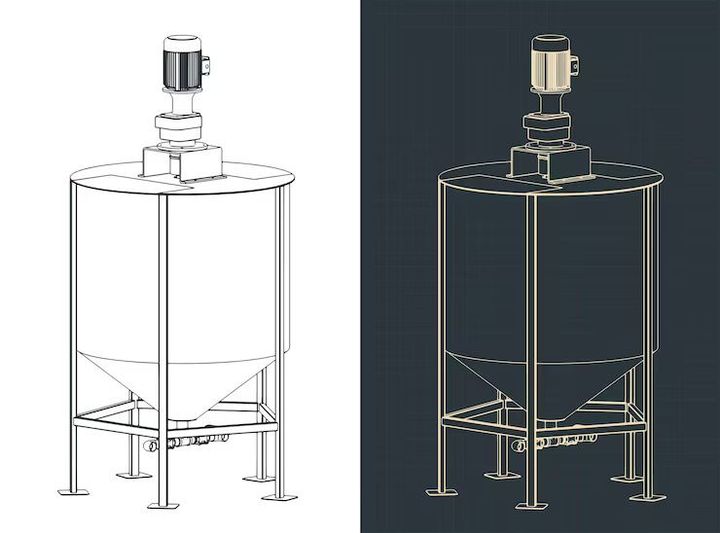
Understanding the main components of an agitator tank is essential for selecting and maintaining the right system.
Core Components
- Tank vessel: Holds the material being processed
- Agitator shaft: Transfers motion from the motor
- Impeller or blade: Creates mixing movement
- Motor and gearbox: Provide power and speed control
- Seals and bearings: Prevent leaks and ensure smooth operation
Each component contributes to efficient mixing and long-term durability.
Common Applications Across Industries
Industrial agitator tanks are widely used due to their versatility. They support both simple and complex industrial processes.
Typical Applications
- Mixing chemicals for industrial reactions
- Blending ingredients in food production
- Maintaining suspension in wastewater treatment
- Producing pharmaceutical solutions
These applications highlight the importance of proper design and operation for optimal performance.
Frequently Asked Questions
What is the main function of an industrial agitator tank?
The primary function is to mix or homogenize materials to achieve uniform consistency and improve process efficiency.
How do agitator tanks improve efficiency?
They enhance mixing speed, ensure even distribution, and reduce processing time, leading to higher productivity.
What factors affect agitator performance?
Key factors include:
- Impeller design
- Rotation speed
- Fluid viscosity
- Tank geometry
Are agitator tanks energy efficient?
Modern designs focus on optimizing blade shapes and reducing power consumption while maintaining effective mixing.
How often should agitator tanks be maintained?
Maintenance frequency depends on usage, but regular inspections and monitoring help prevent breakdowns and extend equipment life.
Conclusion
Industrial agitator tanks are fundamental to many industrial processes. They ensure efficient mixing, consistent product quality, and reliable operations across sectors.
With advancements in smart technologies, automation, and energy-efficient designs, these systems continue to evolve. Understanding their components, applications, and regulatory requirements helps organizations improve performance and decision-making.
As industries move toward sustainability and digitalization, agitator tanks will remain essential in modern manufacturing and processing environments.