Industrial Biscuit Manufacturing Guide to Modern Production Processes and Quality Standards
Biscuits are among the world's most widely consumed baked foods, serving as everyday snacks, breakfast items, and ingredients in numerous food products.
Behind every consistently shaped, evenly baked biscuit is a carefully managed industrial biscuit manufacturing process that combines food science, engineering, automation, and quality control. Modern manufacturing facilities are designed to produce large quantities of biscuits while maintaining consistent taste, texture, appearance, and food safety standards.
Advances in food processing technology have transformed biscuit production into a highly automated operation where precise ingredient handling, controlled baking conditions, and continuous quality monitoring work together to improve efficiency. Understanding the complete manufacturing process helps food industry professionals, engineering students, quality specialists, and curious readers appreciate the complexity behind large-scale food production. This industrial biscuit manufacturing guide explores raw materials, production stages, equipment, quality standards, packaging, operational considerations, and future trends shaping the biscuit industry.
This article explains industrial biscuit manufacturing fundamentals, modern production processes, essential equipment, quality assurance practices, food safety principles, decision-making considerations, and technological innovations.
What Is Industrial Biscuit Manufacturing?
Industrial biscuit manufacturing is the large-scale production of biscuits using specialized food processing equipment, standardized formulations, automated production lines, and quality management systems.
Unlike small-batch baking, industrial manufacturing emphasizes process consistency, production efficiency, hygiene, and repeatable product quality.
Modern facilities integrate ingredient handling, mixing, dough preparation, forming, baking, cooling, inspection, packaging, and storage into a continuous manufacturing workflow.
These production systems enable manufacturers to maintain uniform product characteristics while meeting regulatory and consumer expectations.
Raw Materials Used in Biscuit Production
The quality of finished biscuits begins with carefully selected ingredients.
Wheat flour forms the structural foundation of most biscuit recipes by providing starch and gluten that influence texture.
Sugar contributes sweetness, color development, and product structure during baking.
Fats or oils affect tenderness, mouthfeel, and product stability.
Leavening agents help create the desired texture by generating gases during baking.
Water supports dough formation and ingredient hydration.
Additional ingredients may include milk solids, cocoa, chocolate, nuts, spices, salt, emulsifiers, flavorings, natural colors, dietary fiber, and functional ingredients depending on the product formulation.
Consistent ingredient quality supports reliable manufacturing performance.
Modern Biscuit Manufacturing Process
Industrial production follows a carefully controlled sequence of operations.
Ingredient Preparation
Raw materials are received, inspected, stored, and measured according to standardized production formulations before entering the mixing process.
Dough Mixing
Industrial mixers combine ingredients under carefully controlled conditions to produce uniform dough with consistent texture and moisture content.
Dough Forming
The prepared dough is sheeted, molded, rotary-cut, wire-cut, or deposited into the desired biscuit shapes depending on product design.
Baking
Continuous tunnel ovens expose biscuits to controlled temperature profiles that influence texture, color, moisture reduction, and flavor development.
Cooling
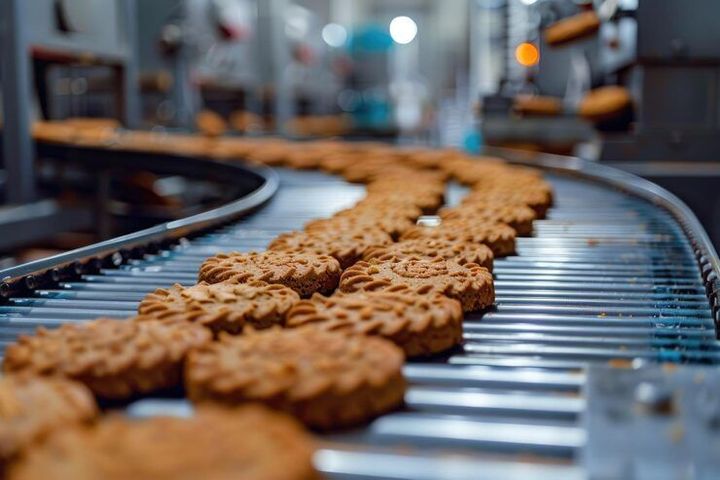
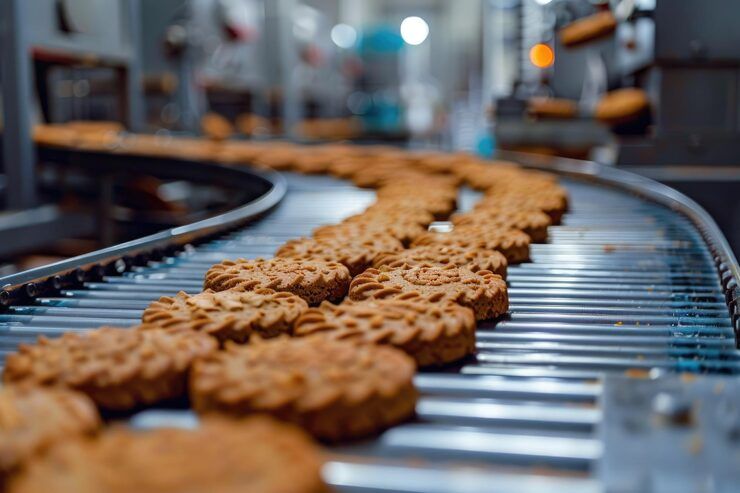
After baking, biscuits pass through cooling conveyors where temperature gradually decreases before packaging.
Proper cooling helps preserve product quality while preventing moisture-related issues.
Inspection and Packaging
Finished biscuits undergo visual inspection, dimensional checks, weight verification, and quality evaluation before automated packaging systems prepare products for storage and distribution.
Equipment Used in Industrial Biscuit Manufacturing
Modern production facilities rely on integrated processing equipment.
Ingredient handling systems transport raw materials efficiently throughout the production line.
Industrial mixers ensure consistent dough preparation across large production batches.
Sheeters, rotary molders, cutting machines, and forming equipment create uniform biscuit shapes.
Continuous baking ovens maintain controlled heating conditions during production.
Cooling conveyors stabilize product temperature before packaging.
Inspection systems may incorporate cameras, sensors, and automated quality monitoring technologies.
Packaging equipment seals products efficiently while helping preserve freshness during storage and transportation.
Together, these systems create highly coordinated manufacturing operations.
Quality Standards and Food Safety
Quality assurance is essential throughout biscuit manufacturing.
Manufacturers typically implement standardized quality management systems to monitor ingredient quality, process consistency, and finished product characteristics.
Routine laboratory testing evaluates moisture levels, texture, dimensions, microbiological quality, and packaging integrity.
Food safety programs emphasize sanitation, hygiene, allergen management, traceability, and preventive process controls.
Regular equipment maintenance, employee training, and documented operating procedures further support consistent manufacturing performance.
These practices help maintain product quality while meeting regulatory and industry standards.
Practical Applications
Industrial biscuit manufacturing serves diverse food markets.
Everyday biscuits are produced for retail consumers through high-volume manufacturing lines.
Nutritional biscuits may incorporate specialized ingredients to support different dietary preferences.
Premium products often include chocolate, cream fillings, fruit ingredients, seeds, or specialty grains.
Manufacturers also produce biscuits for hospitality, institutional catering, export markets, and food ingredient applications.
These diverse products demonstrate the flexibility of modern biscuit manufacturing systems.
Decision Guide: Understanding Industrial Biscuit Manufacturing
Evaluating industrial biscuit manufacturing depends on production capacity, automation level, ingredient handling, baking technology, quality assurance systems, food safety practices, packaging efficiency, and operational flexibility.
Facilities producing large product volumes often prioritize continuous automated production lines that maximize consistency and efficiency, while manufacturers with broader product ranges may emphasize flexible equipment capable of handling multiple biscuit varieties. Production planning also considers energy efficiency, sanitation procedures, maintenance accessibility, and future expansion opportunities.
An industrial biscuit manufacturing comparison generally evaluates production workflow, equipment integration, process automation, quality management systems, baking consistency, operational efficiency, and packaging capabilities.
In many cases, highly automated production systems tend to improve consistency because standardized process control reduces variation between production batches.
The real difference appears when manufacturing technology, quality management, and food safety systems work together throughout the entire production process.
Emerging Trends in Industrial Biscuit Manufacturing
The biscuit industry continues adopting advanced manufacturing technologies.
Automation increasingly supports ingredient handling, process monitoring, quality inspection, and packaging operations.
Artificial intelligence and machine learning assist predictive maintenance, production optimization, and quality analysis.
Vision inspection systems continue improving defect detection during high-speed production.
Manufacturers are also exploring energy-efficient baking technologies, environmentally responsible packaging materials, and digital production monitoring systems.
Growing consumer interest in nutrition is encouraging innovation in formulations that incorporate whole grains, alternative flours, plant-based ingredients, and reduced-sugar recipes.
These developments continue shaping the future of industrial biscuit manufacturing.
Frequently Asked Questions
1. What is industrial biscuit manufacturing?
Industrial biscuit manufacturing is the large-scale production of biscuits using automated equipment, standardized processes, and quality management systems.
2. What are the main stages of biscuit production?
The primary stages include ingredient preparation, dough mixing, dough forming, baking, cooling, inspection, packaging, and storage.
3. Why is quality control important in biscuit manufacturing?
Quality control helps maintain consistent product characteristics, food safety, production efficiency, and compliance with industry standards.
4. What equipment is commonly used in biscuit manufacturing?
Industrial mixers, dough forming machines, tunnel ovens, cooling conveyors, inspection systems, and automated packaging equipment are widely used.
5. What factors should be considered when evaluating biscuit manufacturing systems?
Production capacity, automation, ingredient handling, baking consistency, quality assurance, food safety, operational efficiency, and packaging capabilities should all be evaluated.
Conclusion
Industrial biscuit manufacturing combines food science, engineering, automation, and quality management to produce consistent, safe, and high-quality baked products on a large scale. Understanding production processes, equipment, ingredient selection, quality standards, and food safety practices provides valuable insight into one of the world's most advanced food manufacturing industries. This comprehensive industrial biscuit manufacturing guide demonstrates how modern production technology supports efficiency, consistency, and product excellence throughout every stage of manufacturing. As automation and food processing technologies continue advancing, industrial biscuit manufacturing will remain an important contributor to the global food industry.