Industrial Manufacturing Insights: Processes, Equipment and Trends
Industrial manufacturing is the process of transforming raw materials, components, and resources into finished or semi-finished products through organized production systems.
It covers a wide range of activities, including machining, casting, forming, welding, assembly, packaging, material handling, and quality inspection.
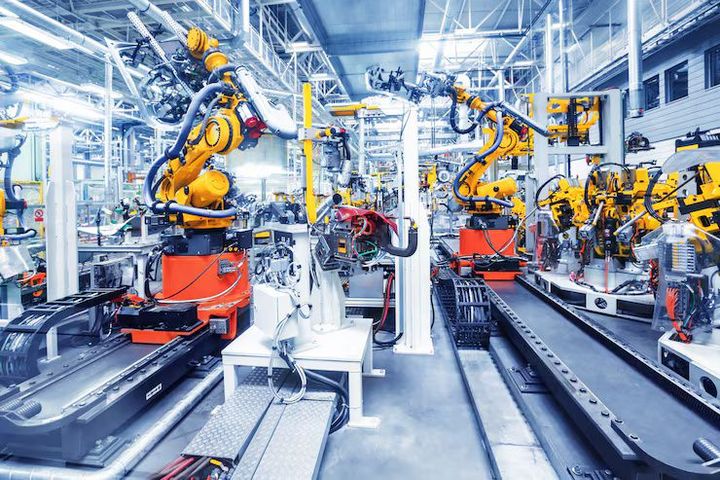
Modern industrial manufacturing increasingly combines physical equipment with automation, sensors, software, data analytics, robotics, and artificial intelligence. Understanding manufacturing processes, equipment, safety requirements, and current technology trends can help students, professionals, researchers, and general readers understand how modern production environments operate.
Context
Industrial manufacturing has developed from labor-intensive production methods into highly coordinated systems that combine machinery, engineering principles, information technology, and process management. Traditional manufacturing may involve machines operated directly by people, while modern facilities can integrate programmable controls, robotics, computer-aided systems, and connected sensors.
A manufacturing process generally begins with raw materials or components and progresses through several controlled stages. Depending on the industry, these stages may include material preparation, cutting, forming, machining, joining, surface treatment, assembly, inspection, and packaging.
Common manufacturing processes include:
- Machining, such as turning, milling, drilling, and grinding
- Forming processes, including forging, stamping, and extrusion
- Casting and molding
- Welding and other joining techniques
- Additive manufacturing and 3D printing
- Automated assembly and material handling
- Testing, measurement, and quality inspection
Equipment selection depends on material characteristics, production requirements, dimensional accuracy, process complexity, safety considerations, and the intended manufacturing environment.
A modern manufacturing system may also connect machines to industrial networks. Sensors can collect information about temperature, vibration, pressure, speed, energy use, and other operating conditions. This information can support process monitoring and analysis.
Importance
Industrial manufacturing plays an important role in sectors such as automotive production, aerospace, electronics, pharmaceuticals, food processing, construction materials, energy equipment, and consumer products.
Manufacturing performance can influence product consistency, resource use, production capacity, workplace safety, and supply-chain resilience. Reliable processes are particularly important when products require precise dimensions, controlled materials, or strict quality requirements.
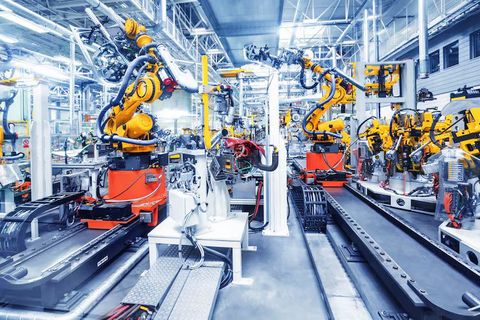
Equipment also has a direct effect on manufacturing performance. CNC machines, industrial robots, presses, conveyors, inspection systems, compressors, furnaces, and automated storage systems each perform different functions within production environments.
Several factors are commonly considered when evaluating a manufacturing process:
| Factor | Manufacturing Consideration |
|---|---|
| Material | Type, strength, thickness, temperature behavior |
| Process | Machining, forming, casting, joining, or additive production |
| Equipment | Capacity, precision, controls, and compatibility |
| Quality | Dimensional accuracy, consistency, and inspection |
| Safety | Machine guarding, energy isolation, and operator protection |
| Data | Sensors, monitoring, analytics, and traceability |
| Sustainability | Energy, material use, waste, and emissions |
Manufacturing also affects many other parts of the economy because industrial facilities require raw materials, components, transportation, engineering, maintenance, automation technology, and quality systems.
Recent Updates
Between 2024 and 2026, industrial manufacturing has continued moving toward connected and data-driven production. Artificial intelligence, machine learning, digital twins, industrial Internet of Things systems, robotics, advanced sensing, and automated decision support have become important areas of research and development.
A 2026 NIST roadmap identifies AI and machine learning as important technologies for smart manufacturing, including applications involving industrial data analytics, advanced sensing, autonomous systems, additive and laser-based manufacturing, digital twins, robotics, logistics, and sustainable manufacturing. It also highlights challenges involving industrial data, heterogeneous control systems, reliability, explainability, and trustworthy operation.
Digital twins are another significant development. A digital twin is a virtual representation of a physical machine, process, or manufacturing system that can be synchronized with operational data. NIST research describes their potential for observing, diagnosing, predicting, and optimizing manufacturing systems.
In 2024, NIST also highlighted the growing importance of standards for manufacturing digital twins, including ISO 23247 and work related to interoperability, data management, validation, and trustworthiness.
During 2025 and 2026, research has also examined AI-assisted production planning, digital value-stream mapping, robotics, and data sharing. These developments indicate a broader shift from isolated automation toward connected manufacturing systems in which machines, software, people, and production data interact.
Sustainability is another continuing trend. Manufacturers are increasingly examining energy consumption, material efficiency, waste reduction, process optimization, and environmental performance alongside traditional production measurements.
Laws or Policies
Manufacturing regulations differ according to country, industry, equipment type, and workplace conditions. Companies must therefore consult the rules applicable to their specific location and operation.
In the United States, OSHA has requirements covering machine guarding under its general industry standards. OSHA identifies hazards involving moving machine parts, points of operation, rotating components, flying particles, and other mechanical risks. Its requirements also address lockout/tagout procedures for hazardous energy during applicable maintenance activities.
Machine safeguarding can involve physical barriers, point-of-operation guards, interlocked systems, electronic safety devices, and other appropriate protective measures. OSHA emphasizes that safeguards should prevent contact with dangerous moving parts without creating additional hazards.
The European Union is also updating its machinery framework. Regulation (EU) 2023/1230 establishes health and safety requirements for machinery, related products, and partly completed machinery. The regulation generally applies from 20 January 2027, with certain provisions applying earlier. The consolidated legislation was updated in 2026.
In India, the Occupational Safety, Health and Working Conditions Code, 2020 is part of the country's labour-code framework. The Ministry of Labour and Employment publishes the Code alongside other national labour codes and related implementation information.
Because regulatory requirements can change, manufacturers should consult current government legislation, technical standards, and applicable regulatory authorities before making compliance decisions.
Tools and Resources
Several resources can help readers understand industrial manufacturing processes, equipment, standards, and technology.
Useful resources include:
- NIST resources for smart manufacturing, measurement science, and digital twins
- OSHA guidance for machine guarding and workplace safety in the United States
- EUR-Lex for current European Union legislation and machinery regulations
- National government manufacturing and labour-regulation portals
- ISO standards and technical documentation for manufacturing systems
- CAD, CAM, and simulation platforms for process planning and design
- Manufacturing execution systems for production monitoring and traceability
- Industrial data platforms for machine monitoring and analytics
Calculators and templates can also support manufacturing analysis. Examples include production-capacity worksheets, equipment-utilization calculations, process-flow diagrams, material-balance sheets, energy-use calculations, preventive-maintenance schedules, and quality inspection checklists.
For digital manufacturing projects, attention should also be given to data quality, sensor compatibility, cybersecurity, interoperability, and model validation. NIST research specifically identifies standards and reliable data management as important considerations for practical digital-twin implementation.
FAQs
What is industrial manufacturing?
Industrial manufacturing is the organized conversion of raw materials, components, or intermediate products into finished or semi-finished products using defined processes, equipment, people, and control systems.
What are common industrial manufacturing processes?
Common processes include machining, casting, forming, welding, molding, assembly, additive manufacturing, surface treatment, material handling, and quality inspection.
What equipment is used in industrial manufacturing?
Equipment varies by industry and process. Examples include CNC machines, presses, furnaces, conveyors, industrial robots, welding systems, inspection instruments, pumps, compressors, and automated control systems.
How is AI being used in manufacturing?
AI can support areas such as predictive analysis, quality inspection, process monitoring, production planning, anomaly detection, robotics, and digital-twin applications. NIST's 2026 roadmap identifies AI and machine learning as significant areas within smart manufacturing.
Why are machine safety regulations important?
Machine safety regulations establish requirements intended to reduce risks from moving machinery, hazardous energy, points of operation, and other workplace hazards. Specific requirements depend on the jurisdiction and type of manufacturing activity.
Conclusion
Industrial manufacturing combines processes, equipment, people, engineering methods, and increasingly digital technologies to transform materials into useful products. Current developments in AI, robotics, digital twins, connected sensors, and advanced automation are changing how production systems are monitored and managed.
Understanding manufacturing requires attention to both technical processes and the wider factors that influence production, including safety, regulations, data, quality, and environmental performance.
For readers studying industrial manufacturing, examining individual processes and equipment can provide a practical foundation for understanding larger production systems.
As manufacturing technology continues to evolve, reliable data, appropriate standards, effective safety practices, and careful technology integration will remain important elements of modern industrial production.