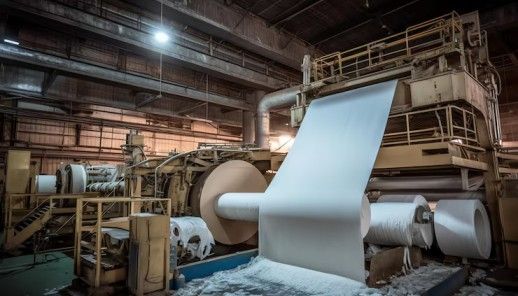
Paper mill machinery refers to the specialized equipment used to convert raw materials like wood pulp, recycled fiber, or agricultural residues into finished paper products. These machines perform essential functions such as pulping, screening, bleaching, pressing, drying, calendaring, and cutting.
A typical paper machine is a continuous system where pulp slurry is formed into a thin sheet on a moving wire or fabric, pressed to remove water, dried over heated cylinders, and finished to required thickness and texture.
The existence of paper mill machinery makes large-scale paper production possible, enabling industries to meet global demand for packaging, writing materials, tissue, and specialty papers.
Why Paper Mill Machinery Matters Today
Paper mill machinery plays a critical role in everyday life and modern industry. Its importance is reflected in several ways:
-
Packaging Demand: With the global rise in e-commerce and food delivery, packaging papers and boards are in high demand.
-
Sustainability Needs: Advanced machinery supports recycling of wastepaper into usable products, reducing reliance on virgin fibers.
-
Efficiency & Scale: Large paper machines can run at speeds exceeding 1,000 meters per minute, producing tons of paper every day.
-
Quality Control: Precision equipment ensures papers meet diverse requirements—ranging from glossy magazine sheets to strong corrugated packaging.
-
Employment & Economy: Paper mills provide vital economic contributions in regions with forestry, pulp, and recycling industries.
Without efficient machinery, industries would struggle to keep up with rising global demand for paper-based goods and sustainable alternatives to plastics.
Recent Trends and Developments in Paper Mill Machinery
The paper industry continues to evolve with new technologies and sustainability efforts. Key updates from the past year include:
-
Sustainable Fiber Integration (2024–2025): More mills are adapting equipment to process non-wood fibers such as bamboo, bagasse, and wheat straw.
-
Automation & Industry 4.0 (2024): Advanced sensors, AI, and IoT tools are being added to paper machines to optimize speed, water usage, and energy efficiency.
-
Water Reduction Initiatives (2025): Modern machinery is being designed to use less fresh water, responding to global scarcity concerns.
-
High-Performance Recycled Paper (2025): Technological improvements in pulping and de-inking systems are helping increase the share of recycled fibers in high-quality grades.
-
Compact & Modular Machines (2025): Smaller-scale, modular machinery is becoming popular in developing markets for localized production of tissue and packaging papers.
These developments reflect a focus on sustainability, digital transformation, and efficiency in paper manufacturing.
Regulatory and Policy Context Affecting Paper Mill Machinery
Paper mills operate under strict environmental and safety regulations because of their water, energy, and chemical use. Policies influence machinery design, operation, and upgrades.
-
Environmental Regulations:
-
In the U.S., the EPA’s Cluster Rule governs water discharges and air emissions from pulp and paper mills.
-
In the EU, Integrated Pollution Prevention and Control (IPPC) directives require mills to adopt Best Available Techniques (BAT) to minimize pollution.
-
Many Asian countries have introduced stricter effluent treatment and energy efficiency requirements since 2024.
-
-
Worker Safety Standards:
-
Machinery must comply with occupational safety rules such as OSHA standards in the U.S. or equivalent local regulations to reduce risks from rotating parts, high heat, and chemicals.
-
-
Sustainability Programs:
-
Governments often support recycling infrastructure and energy-efficient machinery upgrades through grants, incentives, or carbon reduction programs.
-
Compliance ensures not only environmental responsibility but also operational stability for mills.
Helpful Tools and Resources for Paper Mill Machinery
Several tools, platforms, and resources support the planning, monitoring, and operation of paper mill machinery:
-
Process Control Systems: Distributed Control Systems (DCS) and Quality Control Systems (QCS) monitor machine performance and maintain paper quality.
-
Energy & Water Calculators: Online calculators from organizations like TAPPI (Technical Association of the Pulp and Paper Industry) help estimate efficiency gains.
-
CAD & Simulation Software: Tools like AutoCAD, COMSOL, or specialized mill simulation software aid in designing and optimizing machinery layouts.
-
Industry Associations & Portals:
-
TAPPI (tappi.org) – Educational resources and best practices.
-
PaperAge (paperage.com) – News and insights on global mills and machinery.
-
Pulp and Paper Canada – Updates on regulations and technologies.
-
-
Research Databases: Platforms like ScienceDirect and ResearchGate provide technical studies on pulp and paper machinery improvements.
These resources help engineers, operators, and researchers make informed decisions about machinery design, efficiency, and maintenance.
Common Questions About Paper Mill Machinery
What are the main sections of a paper machine?
A paper machine typically includes the forming section (where pulp slurry becomes a sheet), pressing section (water removal), drying section (using heated cylinders), calendaring section (smoothing and finishing), and reel section (winding the paper roll).
How much water is used in paper manufacturing?
Although traditional paper machines consume large volumes of water, modern systems are designed to reuse and recycle much of it. Current best practices allow mills to use less than 10 cubic meters of fresh water per ton of paper.
Is paper mill machinery energy intensive?
Yes, drying and pulping consume significant energy. However, mills increasingly use combined heat and power systems, waste heat recovery, and renewable energy sources to reduce overall consumption.
Can recycled paper be made on the same machines?
Yes. With proper pulping and de-inking systems, recycled fibers can be processed on standard paper machines. Adjustments may be required to achieve desired quality levels.
What are the recent innovations in paper mill machinery?
Recent innovations include AI-assisted process control, modular compact machines for smaller mills, water-efficient systems, and improved de-inking technologies for recycling.
Final Thoughts
Paper mill machinery remains essential for producing the wide range of paper products that support global communication, packaging, and hygiene needs. With growing emphasis on sustainability, efficiency, and digital control, the industry is moving toward machinery that conserves resources while maintaining productivity and quality.
By understanding how machinery works, the role of policies, and the latest trends, stakeholders—from engineers and operators to students and researchers—can better appreciate the complex systems that turn raw pulp into everyday paper products.