PCB Drilling Machines Explore: Explore Types, Components, Precision, Applications, and Planning Factors
PCB drilling machines are specialized equipment used to create precise holes in printed circuit boards (PCBs). These holes can be used for vias, plated through-holes, component mounting, alignment, tooling, and mechanical fastening. In modern PCB production, drilling is an important step because hole position, diameter, and quality can influence later fabrication and assembly processes.
PCB drilling developed alongside the growth of electronic circuit manufacturing. Early board production relied more heavily on manual positioning and conventional drilling methods. As circuit layouts became denser and multilayer boards became more common, computer-controlled drilling systems were introduced to improve positioning and repeatability.
Today, PCB drilling machines can include CNC mechanical drilling systems, multi-spindle machines, drilling and routing systems, and laser drilling equipment. Mechanical drilling remains widely used for conventional holes, while laser technology is associated with smaller features such as microvias in high-density interconnect designs.
What a PCB Drilling Machine Does
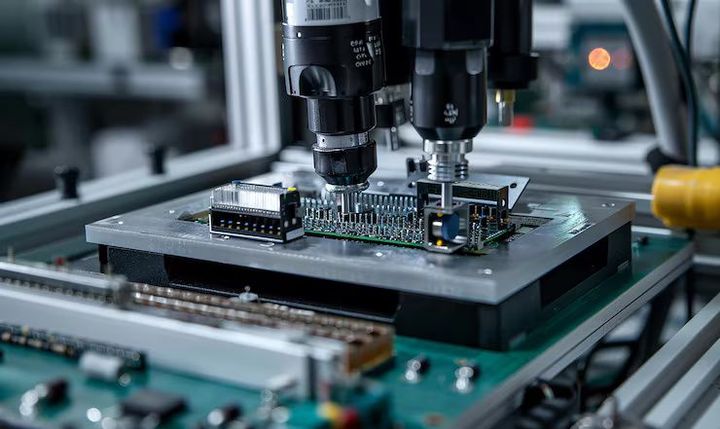
A PCB drilling machine follows programmed coordinates or another controlled positioning method to place a rotating drill or other drilling tool at specified locations on a board. The machine then removes material to create the required hole.
The process normally involves loading the PCB panel, aligning it, selecting the appropriate drilling program and tools, drilling the programmed pattern, and inspecting the resulting holes. CNC systems can read digital manufacturing information and repeat the same drilling pattern across multiple boards.
Main Types of PCB Drilling Machines
PCB drilling machines can be grouped according to their drilling method, spindle arrangement, and level of automation.
- Single-spindle machines use one drilling spindle and can suit prototype or lower-volume processing.
- Multi-spindle machines use several spindles or drilling heads to increase throughput for repeated operations.
- CNC PCB drilling machines use computer-controlled movement to position the drill according to programmed coordinates.
- Drilling and routing machines combine hole drilling with processes such as board outline routing and slot cutting.
- Laser drilling machines use focused laser energy rather than a conventional rotating drill and are commonly associated with microvia applications.
The appropriate machine type depends on PCB construction, hole dimensions, production volume, required precision, and the processes that must be completed.
Importance
PCB drilling matters because holes form part of the physical and electrical structure of many circuit boards. A drilled hole may connect different layers through a plated structure, accommodate a component lead, provide a mounting point, or support board alignment.
As PCB designs become denser, the available space around each hole can become smaller. This makes positional accuracy and repeatability increasingly important. A drilling error can affect connections, component placement, board assembly, or later inspection.
Precision in PCB Drilling
Precision involves more than simply producing a hole at a particular coordinate. The machine must maintain consistent positioning while the drill enters the board and passes through its material layers.
Important precision factors include:
- Positioning accuracy
- Repeatability
- Drill diameter
- Spindle stability
- Tool runout
- Board alignment
- Machine vibration
- Worktable rigidity
- Tool wear
- Material thickness
For multilayer PCBs, registration between layers is particularly important. The hole must correspond correctly with the intended pads, copper structures, and other features within the board stack.
Mechanical Drilling and Laser Drilling
Mechanical drilling uses rotating drill bits to physically remove PCB material. It is widely used for conventional through-holes and other relatively larger openings. Drill wear, tool breakage, material behavior, and chip removal are among the factors that must be managed during the process.
Laser drilling is a non-contact process that uses a focused beam to remove material. It can be used for small features and microvias, particularly in high-density PCB designs. The appropriate laser type and process parameters depend on the board materials and construction.
Recent Updates
From 2024 through 2026, PCB drilling technology has continued to develop around automation, precision, digital programming, and integration with other board-processing operations. Current CNC systems can combine controlled motion with software-based production data, automatic tool management, alignment systems, and monitoring functions.
Vision-assisted alignment is another area of development. Camera-based systems can identify board features and help establish the correct drilling position before machining. This can be useful where panel registration or board positioning requires additional control.
Automation and CNC Control
CNC control allows drilling coordinates to be stored digitally rather than relying on repeated manual positioning. This supports consistent processing when the same board design must be produced multiple times.
Modern PCB drilling equipment can also be combined with routing and milling functions. Such systems can process holes, slots, board outlines, and other features within a coordinated workflow.
Smaller Features and High-Density Boards
The continued development of compact electronics has increased demand for boards with dense layouts and smaller interconnections. Laser drilling is particularly relevant to microvia structures used in some HDI PCB designs, while mechanical drilling remains important for conventional holes.
Process Monitoring
Machine monitoring is also becoming more relevant. Sensors and software can be used to observe machine movement, spindle behavior, tool condition, or other process parameters. Monitoring can help identify abnormal conditions before they affect a larger number of boards, although the available functions differ between machine designs.
Laws or Policies
PCB drilling machines used in India can be affected by general machinery safety requirements, electrical safety provisions, workplace rules, and applicable Indian Standards. The exact requirements depend on the machine type, its electrical configuration, workplace environment, and whether a particular product category is covered by a mandatory regulatory measure.
India's Machinery and Electrical Equipment Safety framework has undergone changes during 2024–2026. The Ministry of Heavy Industries currently lists the withdrawal of the Machinery and Electrical Equipment Safety (Omnibus Technical Regulation) Order, 2024, dated January 2026, along with related amendment and implementation documents. Therefore, the applicable regulatory position should be checked against the latest government notification rather than relying on an older implementation schedule.
For machinery that falls under applicable Indian requirements, standards related to risk assessment, machine guarding, electrical safety, and specific machine categories may be relevant. The 2025 amendment information had referenced IS 16819:2018/ISO 12100:2010 as a general machinery safety standard for covered equipment.
Workplace operators should also follow applicable occupational safety requirements, manufacturer instructions, electrical precautions, machine guarding provisions, and dust or debris control procedures. Regulatory requirements can change, so manufacturers and facility operators should consult current government notifications and relevant standards for the specific equipment.
Tools and Resources
Several technical resources can help users understand PCB drilling machines and plan a suitable drilling process.
PCB Design and Manufacturing Files
PCB manufacturing normally begins with digital design information that identifies hole locations, dimensions, board layers, and other manufacturing features. Common production data formats can be prepared through electronic design automation software and converted into machine-readable drilling information.
Machine Manuals
A machine manual provides specific information about spindle operation, tool installation, programming, alignment, maintenance, safety systems, and operating limits. It is more appropriate for machine-specific procedures than a general PCB drilling guide.
Drill Bit References
PCB drill charts can help users understand relationships among drill diameter, board thickness, material type, and drilling requirements. Carbide drill bits are commonly associated with CNC PCB drilling because they are designed for the materials and high-speed conditions used in PCB fabrication.
Planning Data Table
The following table summarizes several factors that can be reviewed when planning a PCB drilling process:
| Planning factor | What to examine |
|---|---|
| PCB material | FR-4, flexible material, composite, or other substrate |
| Board thickness | Total thickness and layer structure |
| Hole type | Via, through-hole, mounting, tooling, or mechanical hole |
| Hole diameter | Required finished and drilled dimensions |
| Machine type | CNC mechanical, multi-spindle, drilling-routing, or laser |
| Alignment | Panel registration and fixture positioning |
| Tooling | Drill diameter, material, shank, and tool condition |
| Spindle | Speed range, stability, and runout |
| Production volume | Prototype, small batch, or repeated production |
| Inspection | Hole position, diameter, wall condition, and board quality |
Inspection Equipment
Inspection can involve optical measurement systems, microscopes, dimensional gauges, and other PCB inspection equipment. The exact method depends on the board design and the characteristics that must be verified.
Hole diameter, location, burr formation, wall condition, and registration can all be relevant inspection points. For complex multilayer boards, additional inspection methods may be required.
FAQs
What is a PCB drilling machine?
A PCB drilling machine is equipment designed to create controlled holes in printed circuit boards. CNC versions use programmed coordinates to position drilling tools accurately and repeatedly.
What are the main types of PCB drilling machines?
Common types include single-spindle CNC machines, multi-spindle machines, drilling and routing systems, and laser drilling machines. Mechanical systems are widely used for conventional holes, while laser systems are associated with microvia applications.
How does a PCB drilling machine achieve precision?
Precision comes from coordinated machine components such as the spindle, motion guides, drive system, worktable, alignment system, tooling, and CNC software. Board stability and tool condition also affect the final hole position and quality.
What are PCB drilling machines used for?
They are used to create vias, plated through-hole openings, component mounting holes, tooling holes, alignment holes, and other openings required during PCB fabrication. Some combined machines can also perform routing and slot cutting.
What factors should be considered when planning PCB drilling?
Important factors include PCB material, board thickness, hole diameter, hole type, layer count, required positional accuracy, production volume, machine configuration, drill tooling, spindle characteristics, alignment method, and inspection requirements.
Conclusion
PCB drilling machines are specialized systems used to create accurate and repeatable holes in printed circuit boards. Their designs range from CNC mechanical and multi-spindle equipment to drilling-routing systems and laser machines for specific small-feature applications. Precision depends on machine stability, tooling, alignment, software, material characteristics, and process control. Current developments are increasingly focused on automation, digital manufacturing data, vision alignment, monitoring, and the processing of dense PCB designs.