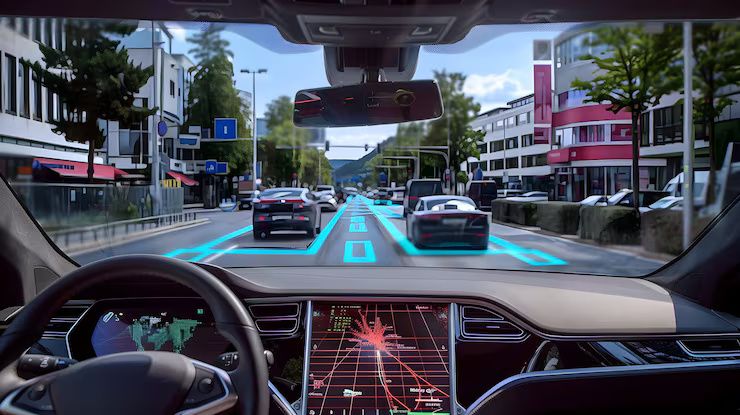
Self-driving car sensors are advanced technologies that allow vehicles to detect their surroundings and make driving decisions without constant human control. These sensors gather real-time data about road conditions, nearby vehicles, pedestrians, traffic signals, and obstacles. The information collected is processed by onboard software systems that interpret the environment and guide the vehicle’s actions.
Autonomous driving technology has developed as part of the broader evolution of artificial intelligence, machine learning, and smart mobility systems. As cities grow and transportation demand increases, researchers and automotive manufacturers have been exploring ways to make travel safer and more efficient. Self-driving vehicles rely heavily on sensor systems because machines cannot “see” the road the same way humans do. Instead, they depend on cameras, radar, LiDAR, ultrasonic sensors, and GPS technology to build a digital map of their surroundings.
These sensors work together to create a detailed understanding of the environment. Each type of sensor has a different role, and combining their data allows the vehicle to make reliable decisions while driving. This technology is a foundational element of modern autonomous vehicle systems.
Importance
Self-driving car sensors play a critical role in enabling autonomous transportation. Their ability to collect accurate environmental data helps vehicles operate safely in complex traffic situations.
The importance of these sensors is growing as governments, technology companies, and automotive manufacturers invest heavily in autonomous mobility solutions. Several factors highlight why this topic matters today.
• Road safety improvement – Many road accidents are caused by human error. Autonomous systems powered by sensors aim to reduce such risks by detecting hazards quickly and reacting consistently.
• Efficient traffic management – Sensor-driven vehicles can communicate with digital traffic systems, potentially reducing congestion and improving traffic flow.
• Accessibility and mobility – Autonomous vehicles may support transportation for elderly individuals or people with limited mobility.
• Urban transportation innovation – Cities exploring smart transportation systems often consider autonomous vehicles as part of long-term infrastructure plans.
Industries affected by this technology include automotive manufacturing, transportation logistics, software development, urban planning, and insurance. The development of reliable sensor systems is essential because autonomous vehicles depend on precise data to operate safely.
Types of Sensors Used in Self-Driving Cars
Different sensors serve different purposes in autonomous vehicles. Together they provide a complete view of the driving environment.
| Sensor Type | Primary Function | Key Capability |
|---|---|---|
| LiDAR | Measures distance using laser pulses | Creates detailed 3D maps |
| Radar | Detects objects using radio waves | Works well in poor weather |
| Cameras | Captures visual information | Recognizes traffic signs and lanes |
| Ultrasonic Sensors | Detects nearby obstacles | Supports parking and short-range detection |
| GPS and Navigation Sensors | Determines vehicle location | Supports route planning |
These sensors continuously collect environmental information, which is analyzed by artificial intelligence systems to guide vehicle movement.
Sensor Data Processing in Autonomous Vehicles
The sensor system in an autonomous vehicle works through a process known as sensor fusion. Sensor fusion combines data from multiple sources to improve accuracy and reliability.
A simplified process looks like this:
| Step | Process | Description |
|---|---|---|
| 1 | Data Collection | Sensors capture environmental information |
| 2 | Data Processing | AI systems analyze sensor data |
| 3 | Environment Mapping | Vehicle builds a digital model of surroundings |
| 4 | Decision Making | Software determines safe driving actions |
| 5 | Vehicle Control | Steering, acceleration, and braking are adjusted |
This multi-layer system allows vehicles to respond quickly to road conditions.
Recent Updates
Autonomous vehicle technology has seen rapid progress over the past year. Several developments between 2024 and early 2026 highlight the continued advancement of sensor technology.
One important trend is the improvement of solid-state LiDAR sensors. These newer sensors are smaller, more durable, and more energy efficient compared to earlier mechanical LiDAR systems. Automotive manufacturers are experimenting with integrating these sensors directly into vehicle bodies.
Another major development is the expansion of AI-driven perception systems. Modern algorithms can process sensor data faster and identify objects more accurately. Machine learning models are now trained using large driving datasets, helping vehicles better recognize pedestrians, cyclists, and road signs.
Autonomous vehicle testing programs have also expanded in several regions. Technology companies and automotive manufacturers continue to run pilot programs to test sensor systems under real-world driving conditions.
Additionally, vehicle-to-infrastructure communication systems are becoming more common. These systems allow vehicles to receive information from traffic lights, road sensors, and digital infrastructure, improving the accuracy of sensor-based navigation.
Laws and Policies
Regulation plays a significant role in the development and deployment of autonomous vehicles. Governments establish rules to ensure safety while encouraging innovation in transportation technology.
In India, autonomous vehicle deployment is still under evaluation. The Ministry of Road Transport and Highways (MoRTH) has explored the potential of connected vehicle technology and advanced driver assistance systems. While fully autonomous vehicles are not widely approved for public roads, research and pilot testing continue within regulatory frameworks.
Other countries have introduced more structured testing regulations. For example:
• The United States allows autonomous vehicle testing in multiple states under controlled guidelines.
• The European Union has introduced safety standards and testing rules for advanced driver assistance systems and autonomous vehicle trials.
• Several Asian countries are developing smart city transportation programs that include autonomous vehicle experiments.
These policies aim to ensure that sensor systems and autonomous technologies meet strict safety requirements before widespread deployment.
Tools and Resources
Researchers, engineers, and technology developers use various digital tools and platforms to study and develop self-driving car sensors. These tools help analyze sensor data, simulate driving environments, and test autonomous systems.
Helpful tools and resources include:
• Simulation platforms for testing autonomous vehicle behavior in virtual environments
• Machine learning frameworks used to train object detection and perception models
• Sensor data visualization software that helps analyze LiDAR and radar outputs
• Digital mapping platforms that create high-definition maps for autonomous navigation
• Autonomous vehicle development kits used by researchers and universities
Some commonly used software platforms include:
| Tool | Purpose |
|---|---|
| Autonomous driving simulators | Testing vehicle behavior in digital environments |
| AI development frameworks | Training perception and decision models |
| Sensor visualization tools | Interpreting LiDAR and radar data |
| Mapping software | Creating high-definition road maps |
These tools help researchers refine sensor technologies and improve the reliability of autonomous driving systems.
Frequently Asked Questions
What are self-driving car sensors?
Self-driving car sensors are technologies that allow vehicles to detect their environment. They gather data about nearby objects, road conditions, traffic signals, and other vehicles to support autonomous navigation.
How many sensors does an autonomous vehicle typically use?
A typical autonomous vehicle uses multiple sensor types, including cameras, radar, LiDAR, ultrasonic sensors, and GPS. These sensors work together to provide a complete understanding of the driving environment.
Why is LiDAR important in autonomous vehicles?
LiDAR is important because it creates detailed three-dimensional maps of the surrounding environment. This helps the vehicle detect objects accurately and understand distances between obstacles.
Can self-driving car sensors work in bad weather?
Some sensors perform better than others in difficult weather conditions. Radar sensors generally work well in rain or fog, while cameras and LiDAR systems may require additional data processing to maintain accuracy.
Are autonomous vehicles fully available today?
Most vehicles currently use advanced driver assistance systems (ADAS) rather than full autonomy. Fully autonomous vehicles are still being tested and developed before widespread public use.
Conclusion
Self-driving car sensors are a fundamental component of autonomous vehicle technology. These sensors enable vehicles to detect their surroundings, analyze environmental data, and make driving decisions without direct human control. The combination of LiDAR, radar, cameras, ultrasonic sensors, and GPS systems provides the foundation for safe and reliable autonomous navigation.
Advancements in artificial intelligence, machine learning, and sensor hardware continue to improve the capabilities of these systems. Research programs and pilot projects around the world are exploring how autonomous vehicles can integrate into modern transportation networks.
Regulations and safety standards will remain essential as this technology evolves. Governments, researchers, and automotive manufacturers are working together to ensure that sensor systems meet strict safety expectations before autonomous vehicles become widely available.
As innovation continues, self-driving car sensors will remain central to the future of intelligent transportation and smart mobility systems.