Swiss Turning Machine Overview: Essential Components and Working Principles
Swiss turning machine technology is widely used in modern manufacturing when very small, detailed, and accurate metal or plastic parts are needed.
A Swiss turning machine, also known as a Swiss type lathe or Swiss screw machine, is designed to hold and support long, slender material close to the cutting tool. This unique design helps reduce vibration and improves accuracy during machining.
Originally developed in Switzerland to produce precise watch components, this machining method has expanded into many industries that require consistent dimensions and fine surface finishes. Today, precision turning machine technology supports the production of components used in healthcare, electronics, aerospace, automotive manufacturing, and industrial equipment. Modern Swiss machining equipment often combines automation, digital controls, and advanced software to improve efficiency while maintaining high precision machining standards.
Context
Origins of Swiss Turning Technology
The Swiss turning machine was developed to solve the challenge of machining extremely small and delicate components without bending or movement during cutting. Traditional lathes support material farther from the cutting area, while a Swiss type lathe guides the material through a guide bushing positioned close to the cutting tools.
This arrangement allows the cutting tools to remove material with greater stability. Over time, improvements in computer numerical control (CNC) transformed the traditional Swiss screw machine into an advanced automatic Swiss lathe capable of producing complex parts with minimal manual intervention.
How the Working Principle Differs
Unlike many conventional lathes, the workpiece moves along its length while the cutting tools remain positioned around it. The guide bushing continuously supports the material near the cutting zone.
This design provides several practical advantages:
- Better dimensional accuracy
- Reduced vibration during machining
- Improved surface quality
- Consistent production of small and long components
- Efficient machining of intricate geometries
Essential Components
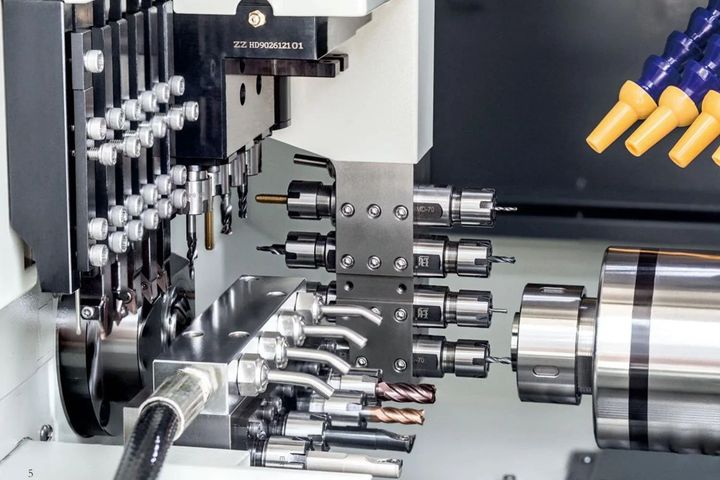
A Swiss turning machine includes several important parts that work together.
| Component | Primary Function |
|---|---|
| Guide bushing | Supports the material close to the cutting area |
| Spindle | Rotates the workpiece |
| Cutting tools | Remove material to create the desired shape |
| Tool holders | Secure multiple cutting tools |
| CNC controller | Controls machining movements and programming |
| Bar feeder | Supplies raw material automatically |
| Coolant system | Reduces heat and removes chips |
| Chip conveyor | Moves waste material away from the machining area |
Materials Commonly Machined
Swiss machining equipment processes many materials depending on the final application, including:
- Stainless steel
- Aluminum
- Brass
- Titanium
- Copper alloys
- Engineering plastics
- Medical-grade alloys
Importance
Supporting Precision Manufacturing
Many industries depend on components with extremely small tolerances. A precision turning machine makes it possible to produce these parts consistently, even when thousands of identical pieces are required.
Because accuracy is maintained throughout production, manufacturers can reduce variation between finished components.
Medical Component Machining
Medical component machining requires exceptionally accurate dimensions because many parts are used in instruments, implants, and diagnostic equipment. Swiss machining technology supports the production of tiny components that must fit together with very little variation.
The machining process also allows manufacturers to create smooth finishes and detailed features that may be difficult with conventional equipment.
Electronics and Micro Components
Consumer electronics continue to become smaller while containing more internal parts. Swiss turning technology plays an important role in producing connectors, miniature shafts, pins, and fasteners.
Micro machining solutions are especially valuable when components measure only a few millimeters in diameter.
Automotive and Aerospace Applications
Automotive systems contain numerous precision-machined components used in fuel systems, sensors, braking systems, and transmission assemblies.
Similarly, aerospace manufacturers rely on high precision machining for lightweight parts where accuracy contributes to proper assembly and reliable operation.
Benefits of Automation
An automatic Swiss lathe provides several operational advantages.
- Continuous material feeding
- Reduced manual handling
- Consistent machining cycles
- Improved repeatability
- Efficient production of complex parts
Automation also supports stable production during extended machining runs while reducing interruptions.
Recent Updates
Greater Automation
Current manufacturing trends continue moving toward higher levels of automation. Modern automated turning machines frequently include robotic part handling, automatic inspection systems, and continuous production monitoring.
These developments help improve consistency while reducing manual adjustments.
Smart Machining Systems
Smart machining systems have become increasingly common across advanced manufacturing facilities. These systems collect machine information in real time and assist operators in monitoring equipment performance.
Examples include:
- Tool wear monitoring
- Machine health monitoring
- Production tracking
- Predictive maintenance alerts
- Energy usage analysis
Digital Machining Solutions
Digital machining solutions connect production equipment with software platforms that assist planning, scheduling, and quality management.
Integrated digital systems help manufacturers review machining data, improve workflow visibility, and identify production trends.
Multi-Axis Capabilities
Many Swiss turning machines now combine turning with milling, drilling, threading, and engraving in a single machining cycle. This reduces the need to move components between different machines, helping maintain dimensional consistency.
Improved Software Integration
Modern CNC programming software has become easier to use while supporting increasingly complex machining operations. Simulation tools allow programmers to visualize machining paths before production begins, reducing programming errors and improving process planning.
Laws or Policies
Workplace Safety Regulations
Swiss turning machines are subject to workplace safety requirements in many countries. Government occupational safety authorities generally require machine guarding, emergency stop systems, operator training, and routine equipment maintenance.
These measures are intended to reduce workplace risks during machining operations.
Quality Management Standards
Many manufacturing facilities producing precision components follow internationally recognized quality management standards. These standards establish documented procedures for inspection, measurement, traceability, and process control.
While certification requirements vary between industries, quality documentation remains an important part of precision manufacturing.
Medical Manufacturing Requirements
Medical component machining is often governed by additional quality and documentation requirements because finished components may become part of healthcare equipment or medical devices.
Manufacturers commonly perform detailed inspections, maintain production records, and validate machining processes according to applicable regulations.
Environmental Considerations
Industrial machining equipment may also be affected by environmental regulations covering:
- Coolant handling
- Metal chip recycling
- Waste disposal
- Energy efficiency
- Air emissions
Specific requirements vary depending on regional laws and manufacturing activities.
Tools and Resources
CNC Programming Software
Programming software allows engineers to create machining instructions for Swiss turning machines. Many programs also simulate machining operations before production begins.
CAD and CAM Platforms
Computer-aided design (CAD) software creates digital component drawings, while computer-aided manufacturing (CAM) software converts these designs into machining instructions.
Together, these tools improve planning and reduce programming errors.
Measurement Equipment
Inspection equipment helps verify finished dimensions throughout production.
Common examples include:
- Digital calipers
- Micrometers
- Coordinate measuring machines (CMM)
- Optical measurement systems
- Surface roughness measurement instruments
Material Data Resources
Engineering material databases contain information about material properties, machining recommendations, hardness values, and cutting parameters. These references assist engineers during process planning.
Machine Monitoring Platforms
Many digital machining solutions include dashboards that display machine status, production progress, maintenance schedules, and quality information in a centralized interface.
FAQs
What is a Swiss turning machine?
A Swiss turning machine is a specialized CNC machine that supports material with a guide bushing close to the cutting tools. This design improves stability and enables highly accurate machining of small, slender components.
How does a Swiss type lathe differ from a conventional lathe?
A Swiss type lathe moves the workpiece through a guide bushing while the cutting tools remain positioned around it. Conventional lathes generally hold the workpiece farther from the cutting area, making them more suitable for different part geometries.
What industries use precision turning machine technology?
Precision turning machine technology is widely used in medical component machining, electronics manufacturing, aerospace production, automotive manufacturing, telecommunications, and industrial equipment production.
What materials can Swiss machining equipment process?
Swiss machining equipment commonly processes stainless steel, aluminum, brass, titanium, copper alloys, engineering plastics, and other materials suitable for high precision machining applications.
What are digital machining solutions?
Digital machining solutions combine CNC equipment with software that monitors production, machine performance, maintenance information, and manufacturing data. These systems improve production visibility and process management.
Conclusion
Swiss turning machine technology has evolved from traditional watchmaking into an important manufacturing process used across many industries. Its unique guide bushing design supports accurate machining of small and complex components while reducing vibration during cutting. Modern automation, smart machining systems, and digital machining solutions continue to expand the capabilities of Swiss type lathe technology. As manufacturing requirements become increasingly precise, these machines remain an important part of advanced industrial production.