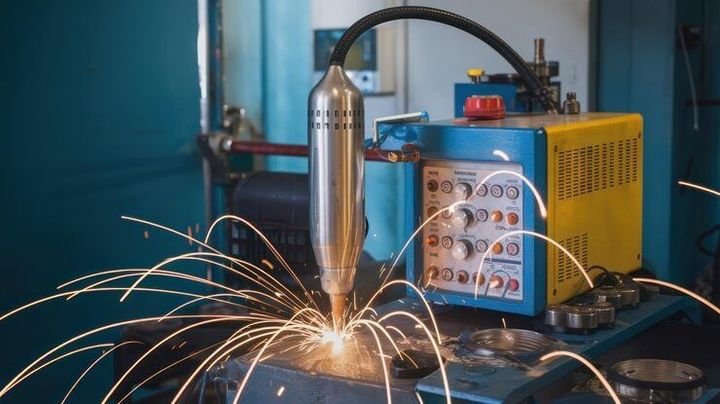
Ultrasonic welding is an advanced manufacturing process used to join materials, especially thermoplastics and certain metals, through high-frequency vibrations. It is widely applied in industries such as electronics, automotive, medical devices, packaging, and consumer goods assembly.
The process involves four key components that work together to generate precise bonding:
-
Power supply (converts electrical energy into high-frequency energy)
-
Converter (transforms electrical energy into mechanical vibrations)
-
Booster (adjusts vibration amplitude)
-
Horn or sonotrode (applies vibration to materials)
When pressure and ultrasonic vibration are applied simultaneously, localized heat forms at the contact point. This allows materials to bond without adhesives, screws, or fasteners, making the process efficient and clean.
Ultrasonic welding machines are designed for high precision and repeatability. This makes them ideal for automated production systems and modern smart factories.
Importance
Ultrasonic welding plays a crucial role in industrial automation and precision manufacturing. As industries demand compact, lightweight, and durable products, reliable joining technologies are essential.
Key Benefits
This technology is important because it:
-
Supports high-speed automated assembly lines
-
Reduces material waste compared to traditional fastening methods
-
Improves product consistency and structural integrity
-
Enables micro-joining for electronic components
-
Supports clean-room manufacturing for medical devices
Another major advantage is energy efficiency. Heat is generated only at the joint, reducing overall energy consumption and supporting sustainability goals.
Major Industry Applications
Industries that rely heavily on ultrasonic welding include:
-
Automotive manufacturing (wire harnesses, dashboards, battery components)
-
Medical device production (catheters, filters, housings)
-
Electronics manufacturing (connectors, sensors, enclosures)
-
Packaging industry (plastic films and sealed packaging)
-
Renewable energy (battery modules, solar components)
In sectors like electric vehicles and semiconductors, precision welding directly impacts safety, reliability, and compliance.
Recent Updates
In 2025, ultrasonic welding technology has evolved significantly with digitalization and automation.
Key Developments
Recent advancements include:
-
Integration of Industrial IoT (IIoT) monitoring systems
-
AI-based weld quality inspection
-
Real-time vibration analysis and predictive maintenance
-
Servo-driven welding systems for enhanced control
-
Increased use in electric vehicle battery assembly
The growth of electric vehicle production has driven demand for ultrasonic metal welding, particularly for battery connections.
Smart Factory Integration
Fully automated welding cells are now integrated into smart factory environments. These systems allow centralized monitoring of:
-
Weld strength
-
Cycle time
-
Machine performance
Servo-controlled welders provide precise amplitude control, which is essential for delicate components such as microelectronics and medical filters.
Sustainability is also a growing focus. Manufacturers are adopting energy-efficient systems to align with ESG (Environmental, Social, and Governance) goals.
Laws and Policies
Ultrasonic welding machines must comply with various industrial and safety regulations depending on the region.
United States Regulations
-
OSHA standards for machine safety, guarding, and noise exposure
-
FDA quality system regulations for medical devices
European Union Standards
-
CE marking requirements
-
Machinery Directive compliance
-
Electromagnetic Compatibility (EMC) standards
-
RoHS regulations
Industry-Specific Compliance
-
ISO 13485 for medical devices
-
ISO 9001 for quality management
-
Cleanroom and sterilization standards
Environmental regulations also apply, especially regarding energy use and workplace noise levels. Governments are encouraging Industry 4.0 adoption, promoting modernization of welding systems.
Tools and Resources
Various tools support ultrasonic welding operations and process optimization.
Common Industrial Tools
-
Weld parameter monitoring software
-
Amplitude control systems
-
Vibration frequency analyzers
-
CAD/CAM software
-
Finite Element Analysis (FEA) tools
-
Process validation templates
Data Monitoring Parameters
Manufacturers track key metrics such as:
-
Weld time
-
Energy output
-
Pressure levels
-
Amplitude settings
-
Weld strength
Application Comparison Table
| Application Area | Typical Material | Precision Level | Automation Compatibility |
|---|
| Electronics Assembly | Thermoplastics | High | High |
| Automotive Components | Plastic/Metal | Very High | High |
| Medical Devices | Medical-grade polymers | Extremely High | High |
| Packaging Systems | Thin films | Moderate | High |
Basic Workflow
The ultrasonic welding process typically follows these steps:
-
Position components in a fixture
-
Apply controlled pressure
-
Activate ultrasonic vibration
-
Maintain weld time
-
Allow cooling under pressure
-
Inspect joint quality
Digital simulation tools help engineers optimize designs and predict weld strength before production.
Technical Insights
Ultrasonic welding operates within frequency ranges of 15 kHz to 40 kHz. Higher frequencies are used for smaller and more delicate components.
Key Parameters Affecting Weld Quality
-
Amplitude
-
Pressure
-
Weld time
-
Energy input
-
Material properties
Modern servo-controlled welders improve precision and consistency by controlling energy delivery more accurately.
Manufacturing Focus Areas (2025)
| Focus Area | Industry Priority |
|---|
| Automation Integration | High |
| Battery Manufacturing | High |
| Energy Efficiency | High |
| AI-Based Quality Monitoring | Growing |
| Manual Operation Reduction | High |
These priorities reflect broader trends in digital transformation and smart manufacturing.
Frequently Asked Questions
What materials can be joined using ultrasonic welding?
Ultrasonic welding is commonly used for thermoplastics and soft metals like aluminum and copper. It is ideal for precision applications in electronics and automotive industries.
Is ultrasonic welding suitable for medical devices?
Yes. It is widely used in medical manufacturing because it creates clean, contamination-free joints without adhesives.
How is it different from traditional welding?
Traditional welding uses external heat sources such as flames or arcs. Ultrasonic welding uses mechanical vibrations to generate localized heat at the joint.
Which industries benefit the most?
Automotive, electronics, medical devices, packaging, aerospace, and renewable energy industries benefit significantly from this technology.
Does it support automation?
Yes. Ultrasonic welding machines are designed for integration into automated production lines and Industry 4.0 systems.
Conclusion
Ultrasonic welding machines are a vital component of modern manufacturing. They enable precise, efficient, and reliable joining of materials across multiple industries.
In 2025, advancements such as AI monitoring, smart factory integration, and sustainability initiatives continue to shape this technology. Compliance with global regulations ensures safety and quality.
As industries evolve, ultrasonic welding remains essential for innovation, automation, and global production efficiency.