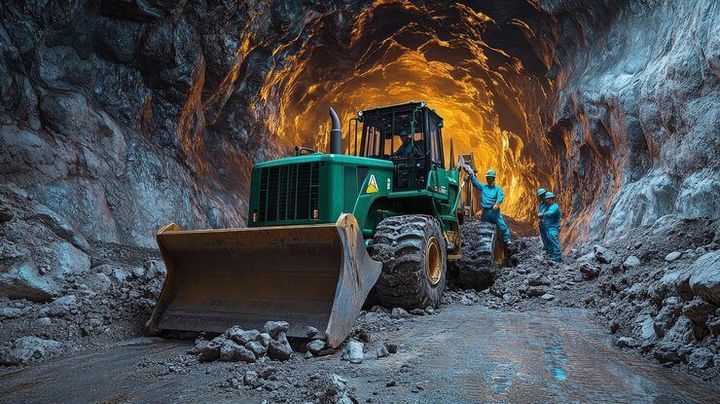
Underground mining environments present unique challenges such as narrow tunnels, limited ventilation, uneven terrain, and strict safety requirements. To address these conditions, specialized machines known as Load-Haul-Dump (LHD) loaders are used. These machines are designed to improve efficiency while maintaining high safety standards.
Underground loaders perform three essential functions in the mining cycle. They collect blasted material, transport it through tunnels, and dump it into designated systems such as trucks or conveyors. Their compact design and advanced features allow them to operate effectively in confined spaces.
Key Functions of Underground Loaders
-
Collecting blasted rock or ore from the mine face
-
Transporting materials through underground tunnels
-
Dumping materials into trucks, ore passes, or conveyors
These machines often include articulated steering, powerful hydraulics, and advanced automation systems. Modern versions may also feature electric power options and real-time monitoring capabilities.
Types of Underground Mining Loaders
Different types of underground loaders are used depending on operational requirements and environmental conditions. Each type offers specific benefits suited to particular mining scenarios.
Common Loader Types and Applications
| Loader Type | Typical Application | Key Feature |
|---|
| Diesel Underground Loader | Traditional mining operations | High power for heavy loads |
| Electric Underground Loader | Low-emission environments | Reduced ventilation requirements |
| Battery-Electric Loader | Sustainable mining projects | Lower noise and emissions |
| Remote-Controlled Loader | Hazardous mining zones | Enhanced operator safety |
These machines are widely used in mining operations involving gold, copper, coal, and other minerals. Their versatility makes them essential for modern underground mining processes.
Why Underground Mining Loaders Matter Today
Underground mining loaders play a critical role in improving productivity, safety, and environmental performance. As global demand for minerals increases, efficient underground operations become more important.
Mining activities are expanding deeper underground, making material handling more complex. Loaders help streamline operations and reduce risks associated with manual labor.
Key Benefits
-
Efficient movement of materials in confined spaces
-
Reduced human exposure to hazardous environments
-
Faster transportation of ore
-
Improved productivity through automation
Industries and Stakeholders Impacted
-
Mining companies and engineering teams
-
Environmental and safety regulators
-
Automation technology providers
-
Infrastructure and construction sectors
These machines also contribute to safer workplaces by minimizing exposure to hazards such as dust, gas, and rock falls.
Recent Industry Updates and Technology Trends
The underground mining sector has seen rapid technological advancements in recent years. In 2025, there was a noticeable shift toward battery-electric loaders due to their environmental benefits.
Automation and digital integration are also transforming mining operations. Autonomous loaders and AI-based monitoring systems are becoming more common in modern mines.
Key Trends
-
Adoption of battery-electric LHD machines
-
Use of artificial intelligence for predictive maintenance
-
Expansion of autonomous loader operations
-
Growth of digital fleet management systems
Autonomous loaders use sensors, cameras, and navigation systems to operate without direct human input. This enables continuous operation and reduces downtime.
Performance Monitoring Metrics
-
Hydraulic pressure
-
Engine performance
-
Energy consumption
-
Equipment temperature
-
Operational cycles
These metrics help engineers optimize performance and reduce operational disruptions.
Regulations, Safety Rules, and Government Policies
Underground mining is heavily regulated due to safety and environmental risks. Equipment such as loaders must comply with strict national and international standards.
Regulatory frameworks focus on ensuring worker safety, reducing emissions, and maintaining operational transparency. Governments enforce these rules through inspections and certification processes.
Key Regulatory Areas
-
Worker safety standards
-
Equipment certification requirements
-
Emission control regulations
-
Noise exposure limits
-
Dust and ventilation management
Common Compliance Requirements
-
Regular equipment inspections
-
Operator training programs
-
Hazard monitoring systems
-
Air quality and ventilation standards
Many governments are also encouraging the use of electric mining equipment to support sustainability goals.
Tools and Digital Resources for Underground Mining
Modern underground mining operations rely on digital tools to improve efficiency and decision-making. These tools help monitor equipment, plan operations, and analyze performance data.
Common Digital Tools
-
Mine planning software
-
Fleet management systems
-
Equipment monitoring platforms
-
Predictive maintenance tools
-
Geological mapping software
These technologies enable real-time tracking and optimization of mining operations. They also improve safety and operational transparency.
Digital Tool Overview
| Tool Category | Function |
|---|
| Mine Planning Software | Designs underground layouts |
| Fleet Management Systems | Tracks equipment location and performance |
| Maintenance Platforms | Monitors equipment health |
| Data Analytics Tools | Analyzes productivity metrics |
| Simulation Software | Tests operational scenarios |
Some mines also use wireless communication systems to transmit data from loaders to control centers. This enhances coordination and operational efficiency.
Operational Performance Overview
The performance of underground loaders is measured using specific operational indicators. These metrics help improve efficiency and reduce downtime.
Key Performance Metrics
| Performance Metric | Description |
|---|
| Bucket Capacity | Volume of material per load |
| Cycle Time | Time to complete loading and dumping |
| Energy Consumption | Power used during operations |
| Machine Availability | Percentage of uptime |
| Maintenance Frequency | Regularity of servicing |
Monitoring these indicators allows mining companies to optimize operations and extend equipment lifespan.
Frequently Asked Questions
What is an underground mining loader?
An underground mining loader is a machine designed to collect, transport, and load materials within underground mining environments.
What does LHD mean?
LHD stands for Load-Haul-Dump, which describes the machine’s primary functions in the mining process.
Why are electric loaders gaining popularity?
Electric loaders reduce emissions, improve air quality, and lower ventilation requirements in underground mines.
How do automated loaders work?
They use sensors, navigation systems, and software algorithms to operate along predefined routes without manual control.
Which industries rely on underground mining equipment?
Industries such as mineral extraction, energy production, electronics manufacturing, and infrastructure development depend on these machines.
Conclusion
Underground mining loaders are essential for efficient and safe mineral extraction. Their specialized design allows them to operate effectively in challenging underground environments.
Technological advancements such as automation, battery-electric systems, and digital monitoring are transforming the mining industry. These innovations improve productivity, safety, and sustainability.
As mining operations continue to evolve, underground loaders will remain a key component of modern mining infrastructure. Understanding their role helps highlight their importance in supporting global industries and resource demand.