A Professional Guide to Industrial Batteries: Advanced Battery Technologies and Industry Best Practices
Industrial batteries are rechargeable or non-rechargeable battery systems designed for applications that require electrical energy for equipment, facilities, transportation systems, telecommunications, and backup power.
Unlike small consumer batteries, industrial batteries are generally integrated into larger electrical systems where capacity, voltage, monitoring, safety, and operating conditions must be considered together.
Industrial battery systems can use several battery chemistries. Lead-acid batteries have been widely used for stationary backup applications, while lithium-ion technologies have become increasingly important for energy storage and industrial equipment. Other chemistries, including nickel-based batteries and emerging technologies, can also be used for specific operating environments.
An industrial battery converts stored chemical energy into electrical energy when power is required. Rechargeable systems can reverse this process by receiving electrical energy through a charging system. A complete installation may include batteries, battery racks or cabinets, chargers, inverters, thermal controls, protection equipment, and monitoring software.
How Industrial Battery Systems Work
An industrial battery installation normally operates as part of a larger electrical network. During charging, electrical energy is transferred into the battery cells. During discharge, chemical reactions inside the cells produce electrical energy that can be supplied to connected equipment.
The operating process depends on the battery chemistry and system design. Some installations are intended for short-duration backup, while others are designed to store electricity for several hours.
Typical components include:
- Battery cells and modules
- Battery racks or enclosures
- Battery management systems
- Chargers and power converters
- Inverters
- Circuit protection equipment
- Thermal management equipment
- Monitoring and control systems
These components work together to maintain controlled electrical operation.
Common Industrial Battery Types
| Battery type | Common application | Main characteristic |
|---|---|---|
| Lead-acid | Backup power and telecommunications | Established stationary technology |
| Lithium-ion | Energy storage and industrial equipment | High energy density and flexible system design |
| Nickel-based | Industrial and specialized applications | Tolerance of certain operating conditions |
| Flow batteries | Long-duration stationary storage | Energy and power can be configured separately |
| Sodium-based technologies | Emerging energy storage applications | Uses alternative battery chemistry |
The appropriate technology depends on factors such as operating temperature, required discharge duration, cycling pattern, available space, safety requirements, and electrical configuration.
Importance
Supporting Reliable Electrical Power
Industrial facilities depend on stable electrical power for control systems, communication equipment, manufacturing machinery, data systems, and other critical operations. A backup power battery system can provide stored electrical energy when the primary electricity source is interrupted.
The battery does not necessarily replace the main electrical supply. Instead, it can act as one part of a broader power continuity arrangement that may also include generators, uninterruptible power supplies, renewable generation, and electrical distribution equipment.
Supporting Energy Storage
Industrial energy storage systems allow electricity to be stored and used at a later time. This can be useful when electricity generation and electricity demand do not occur at the same time.
For example, an industrial facility may use stored electricity during a period when renewable generation is lower. Energy storage can also help manage changes in electrical demand and support certain grid-related functions.
Industrial Lithium-Ion Batteries
Industrial lithium ion batteries have become increasingly common in applications that require compact energy storage, repeated charging and discharging, and electronic monitoring.
Lithium-ion systems are used in areas such as:
- Industrial vehicles
- Material-handling equipment
- Telecommunications
- Renewable energy storage
- Data infrastructure
- Backup power
- Microgrids
- Industrial automation
Different lithium-ion chemistries have different characteristics. Selection therefore involves more than comparing energy capacity alone.
Supporting Industrial Operations
Industrial batteries can be used in warehouses, factories, mines, telecommunications facilities, transportation infrastructure, and utility installations. Their role depends on the electrical requirements of the facility.
In some applications, batteries provide short periods of backup power. In others, industrial battery storage systems can operate as larger energy assets connected to electrical distribution networks.
Battery Management
Industrial battery management systems monitor battery conditions and help control charging and discharging. Depending on the design, these systems can track cell voltage, temperature, current, state of charge, and other operating parameters.
Monitoring is important because battery cells can behave differently as they age or experience changing temperatures. A management system can help identify abnormal operating conditions and provide information for system supervision.
Recent Updates
Growth of Lithium-Ion Energy Storage
From 2024 through 2026, industrial energy storage has continued to expand as electricity networks incorporate more variable renewable generation and organizations examine methods for managing electrical demand.
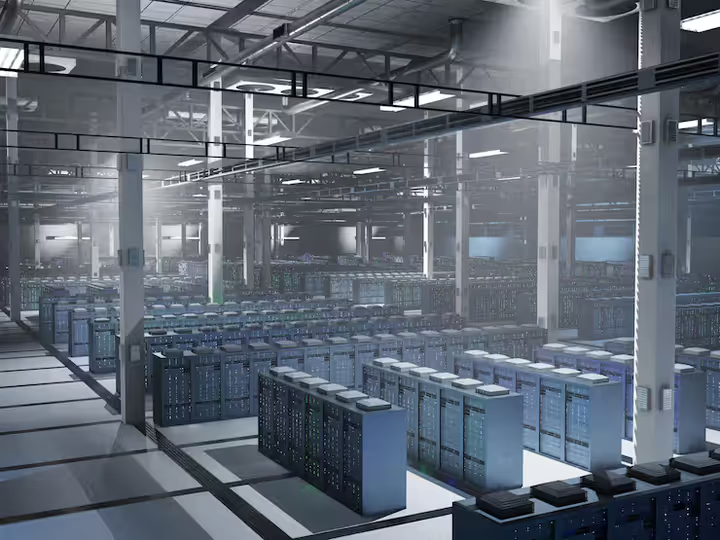
Lithium ion battery energy storage remains an important part of this development. Larger battery installations increasingly combine battery modules with power conversion systems, thermal controls, fire protection, and digital monitoring.
Greater Use of Digital Monitoring
Modern battery installations increasingly collect operational information from individual cells, modules, racks, and system-level components. Digital monitoring can provide information about temperature, voltage, current, state of charge, and system alarms.
This information can be integrated with facility management platforms and electrical control systems. Data analysis can also help operators identify changes in battery behavior over time.
Improvements in Thermal Management
Temperature affects battery performance, safety, and usable life. Industrial battery systems therefore increasingly use controlled thermal management, particularly when many battery modules operate within a confined enclosure.
Depending on system design, thermal management can involve air circulation, liquid cooling, heating elements, sensors, and automated controls.
Grid-Connected Storage
Battery storage is increasingly being connected to electrical grids rather than operating only as isolated backup equipment. Grid-connected systems can be configured for functions such as energy shifting, frequency support, renewable integration, and demand management.
The exact functions available depend on the electrical market, grid rules, system configuration, and local regulations.
Greater Attention to Battery Recycling
As more batteries reach the end of their operating lives, recycling and material recovery have become important parts of battery management. Lithium, nickel, cobalt, copper, aluminum, and other materials can potentially be recovered through appropriate recycling processes.
Battery recycling also requires careful handling because damaged or improperly managed batteries can create electrical, chemical, and fire hazards.
Laws or Policies
Indian Regulatory Framework
In India, industrial battery systems are affected by rules covering battery waste management, environmental protection, electrical safety, and hazardous material handling. The regulatory framework includes the Battery Waste Management Rules, which establish responsibilities related to batteries placed on the market and their collection and recycling.
India has also introduced Extended Producer Responsibility requirements for battery waste. These requirements are intended to increase accountability for the management of batteries after their useful operating period.
Electrical Safety
Industrial battery installations can involve high electrical currents, stored energy, and potentially hazardous materials. Electrical installation requirements may address insulation, grounding, protection devices, enclosure design, ventilation, emergency arrangements, and maintenance procedures.
Specific requirements depend on the battery chemistry, installation type, voltage level, facility classification, and applicable Indian standards.
Transportation and Waste Handling
Batteries can be subject to transportation and waste-handling requirements, particularly when they are damaged, discarded, or classified as hazardous materials. Lithium-ion batteries require particular attention because physical damage, short circuits, or inappropriate handling can create thermal events.
Facilities handling large battery quantities may therefore need procedures covering storage, inspection, transportation, emergency response, and recycling.
Standards and Compliance
Battery installations may also be designed according to applicable Indian and international technical standards. These standards can address battery performance, electrical safety, testing, enclosure requirements, electromagnetic compatibility, and system integration.
Because regulations and technical standards can change, the applicable requirements should be confirmed for the specific installation and location.
Tools and Resources
Battery Sizing Calculators
Battery sizing tools can help estimate the required capacity for a particular application. Basic calculations generally consider load power, operating duration, system voltage, usable battery capacity, efficiency, and reserve requirements.
A simplified energy calculation can be expressed as:
Required energy = Power demand × operating time
Actual system sizing requires additional factors such as conversion losses, temperature, battery characteristics, discharge limits, and reserve capacity.
Battery Monitoring Software
Battery monitoring platforms collect operating information from battery management systems and related equipment. Common measurements include:
- Cell voltage
- Module temperature
- Current
- State of charge
- State of health
- Charging status
- Alarm conditions
- Historical operating data
These measurements help operators understand system behavior.
Battery Standards and Technical Documentation
Useful resources include battery manufacturer technical documentation, electrical standards, battery testing procedures, recycling guidelines, installation manuals, and energy-storage design references.
Organizations involved in industrial energy systems may also use engineering calculations, electrical diagrams, load profiles, battery degradation models, and thermal assessments when planning installations.
Energy Management Platforms
Industrial energy management software can combine information from batteries, electrical meters, renewable generation, and facility loads. Such platforms can help visualize energy flows and operating patterns.
An enterprise battery management platform may also integrate multiple battery installations into a centralized monitoring environment, depending on the architecture.
FAQs
What are industrial batteries used for?
Industrial batteries are used for backup power, energy storage, industrial vehicles, telecommunications, renewable energy integration, and other applications requiring controlled electrical energy storage.
How do industrial battery storage systems work?
Industrial battery storage systems store electrical energy in battery cells and release it when required. Power conversion equipment connects the battery to the electrical system, while monitoring and protection equipment manages operating conditions.
What are industrial lithium ion batteries used for?
Industrial lithium ion batteries are used in energy storage, material-handling equipment, telecommunications, backup power, electric industrial vehicles, and other applications requiring rechargeable energy storage.
What does an industrial battery management system do?
An industrial battery management system monitors battery conditions such as voltage, current, temperature, and state of charge. It can also support charging control, protection functions, fault detection, and system monitoring.
What do OEM industrial battery manufacturers produce?
OEM industrial battery manufacturers can produce battery cells, modules, packs, cabinets, battery management systems, and integrated energy-storage equipment. The specific configuration depends on the application and electrical requirements.
Conclusion
Industrial batteries are used across backup power, energy storage, industrial equipment, telecommunications, and renewable energy applications. Industrial battery systems combine battery cells with power electronics, protection equipment, thermal management, monitoring, and control systems. Recent developments have focused on lithium-ion energy storage, digital monitoring, thermal management, grid-connected applications, and battery recycling. Safe operation depends on appropriate system design, electrical protection, regulatory compliance, and proper handling throughout the battery life cycle.