Concrete Pump Trucks: Complete Equipment & Operations Guide
Concrete pump trucks have become an important part of modern construction projects.
These specialized machines help transport and place concrete quickly, accurately, and efficiently in locations that may be difficult to reach using traditional methods.
From residential buildings and bridges to high-rise towers and infrastructure projects, concrete pump trucks support faster concrete placement while improving workflow on construction sites. As construction technology continues to advance, these machines are becoming more capable, reliable, and versatile.
Understanding how concrete pump trucks work, their components, applications, and operational practices can help readers gain valuable insight into one of the construction industry's most important pieces of equipment.
Quick Facts Table
| Topic | Purpose | Key Components | Main Benefits | Common Applications |
|---|---|---|---|---|
| Concrete Pump Trucks | Transport and place concrete efficiently | Boom, pump system, hopper, hydraulic system, pipeline, outriggers | Faster placement, improved reach, operational efficiency | Buildings, bridges, tunnels, foundations, industrial projects |
What Are Concrete Pump Trucks?
Concrete pump trucks are specialized construction vehicles that transfer liquid concrete from mixer trucks to the desired placement location through a pumping system and delivery pipeline.
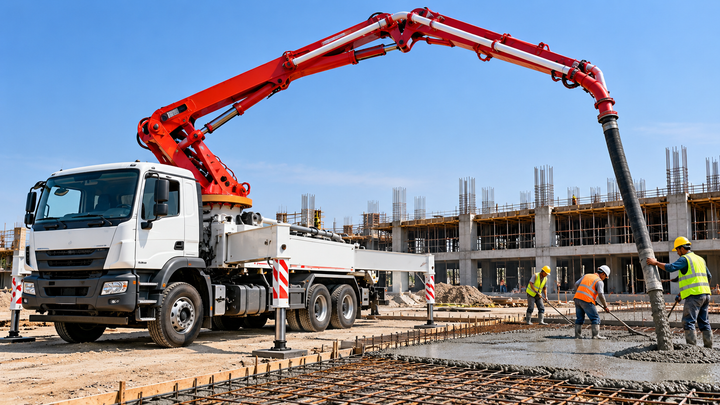
Most truck-mounted concrete pumps include a folding boom that extends horizontally and vertically, allowing operators to place concrete accurately at elevated or difficult-to-access locations. Because of this extendable boom, these machines are often called boom pumps.
Why Are Concrete Pump Trucks Important?
Large construction projects often require concrete placement in areas that are difficult for conventional equipment to access.
Concrete pump trucks help by:
- Improving placement accuracy
- Reducing manual handling
- Supporting large-volume pours
- Reaching elevated structures
- Improving construction productivity
- Enhancing workflow efficiency
- Supporting complex project layouts
- Reducing project delays
These advantages make concrete pump trucks valuable assets across many construction environments.
Industry Trends
- Infrastructure development continues to increase demand for advanced concrete placement equipment.
- Larger boom designs support high-rise construction projects.
- Remote-control operation improves placement precision.
- Automation technologies are improving operational monitoring.
- Predictive maintenance tools help improve equipment reliability.
- Digital fleet management platforms are becoming more common.
- Advanced hydraulic systems improve pumping performance.
Understanding the Concept
A concrete pump truck combines mobility, pumping capability, and extended reach into a single machine.
The system receives concrete from a mixer truck and uses hydraulic pressure to move the material through pipelines and boom sections. This allows operators to place concrete exactly where it is needed without extensive manual transportation.
Major Components of Concrete Pump Trucks
- Truck Chassis
- Concrete Pump System
- Hopper
- Hydraulic Cylinders
- Hydraulic Power Unit
- Delivery Pipeline
- Boom Assembly
- Outriggers
- Control Systems
- Remote Controls
- Stabilization Systems
- Safety Monitoring Systems
Equipment Categories Table
| Equipment Category | Examples |
|---|---|
| Pumping Equipment | Pump Unit, Hydraulic Pistons |
| Delivery Systems | Pipeline, End Hose |
| Structural Components | Boom Assembly, Chassis |
| Stability Systems | Outriggers, Stabilizers |
| Hydraulic Systems | Hydraulic Pumps, Cylinders |
| Control Systems | Remote Controls, Monitoring Platforms |
| Safety Systems | Emergency Controls, Sensors |
Key Features and Core Components
Modern concrete pump trucks typically include:
- Hydraulic pumping systems
- Multi-section boom assemblies
- Remote-control operation
- High-capacity hoppers
- Stabilization outriggers
- Intelligent monitoring systems
- Automated safety controls
- Heavy-duty truck chassis
- Precision placement systems
- Advanced hydraulic technologies
These features help improve efficiency and accuracy during concrete placement operations.
Main Types of Concrete Pumps
Boom Pump Trucks
Boom pumps utilize an articulating boom mounted on a truck chassis. They are commonly used for high-rise construction, large foundations, bridges, and major infrastructure projects.
Line Pumps
Line pumps transfer concrete through manually connected pipelines and hoses. They are often used for residential projects, sidewalks, and smaller construction sites.
Stationary Pumps
Stationary pumps remain fixed in one location and deliver concrete through extended pipeline systems across large project areas.
Concrete Pump Types Comparison
| Pump Type | Primary Equipment | Reach Capability |
|---|---|---|
| Boom Pump Truck | Pump and Boom Assembly | High |
| Line Pump | Pump and Pipeline | Medium |
| Stationary Pump | Fixed Pump System | High |
| Trailer Pump | Trailer-Mounted Pump | Medium |
| Mixer Pump Truck | Mixer and Pump System | Medium |
What Equipment Is Used in a Concrete Pump Truck?
Concrete pump trucks utilize several integrated systems including the truck chassis, hydraulic pump unit, boom assembly, delivery pipeline, hopper, control systems, outriggers, and safety devices. Each component contributes to efficient concrete placement.
How Does a Concrete Pump Truck Work?
- A mixer truck delivers fresh concrete to the job site.
- Concrete is discharged into the hopper.
- Hydraulic pistons draw concrete into the pumping chamber.
- The pump system pushes concrete through delivery pipelines.
- The boom positions the pipeline above the placement area.
- Operators control the boom movement using remote controls.
- Concrete is placed accurately at the required location.
- The process continues until the pour is completed.
What Is the Role of the Boom?
The boom is a folding articulating arm mounted on the truck. It carries the concrete delivery pipeline and allows operators to place concrete at significant heights and distances. Boom reach is one of the most important performance characteristics of a concrete pump truck.
What Is the Function of the Pumping System?
The pumping system uses hydraulic pistons to move concrete through the delivery pipeline. This system provides continuous concrete flow and supports accurate placement across the construction site.
Operations and Safety Procedures
Safe operation is essential for successful concrete placement.
Pre-Operation Inspection
Operators typically inspect:
- Hydraulic systems
- Pipeline connections
- Boom structure
- Outriggers
- Control systems
- Safety devices
- Fuel and fluid levels
Site Preparation
Before operation:
- Ground conditions are evaluated.
- Outriggers are positioned.
- Safety zones are established.
- Equipment stability is verified.
Pumping Operations
During placement:
- Concrete flow is monitored.
- Boom movement is controlled carefully.
- Communication is maintained between crew members.
- Equipment performance is continuously observed.
Industry Applications
Residential Construction
Used for foundations, slabs, driveways, and multi-story residential structures.
Commercial Buildings
Support concrete placement for office buildings, shopping complexes, and institutional facilities.
High-Rise Construction
Boom pumps provide the reach required for elevated concrete placement.
Bridge Construction
Support large-scale infrastructure projects requiring long-distance placement.
Tunnel Projects
Pipeline systems enable concrete delivery in restricted environments.
Industrial Facilities
Support concrete placement in manufacturing plants and processing facilities.
Transportation Infrastructure
Used in highways, airports, rail systems, and public works projects.
Real-World Examples
Example: High-Rise Building
A boom pump truck places concrete for upper floors where direct access by mixer trucks is not possible.
Example: Bridge Construction
Extended boom reach enables concrete placement over large spans and difficult terrain.
Example: Industrial Foundation
A stationary pump system delivers concrete across large industrial sites where long-distance pumping is required.
Example: Tunnel Development
Pipeline systems transport concrete through confined underground construction areas.
Benefits and Advantages
Concrete pump trucks provide numerous advantages:
- Faster concrete placement
- Improved placement accuracy
- Reduced labor requirements
- Better site efficiency
- Extended reach capability
- Consistent concrete flow
- Enhanced project productivity
- Support for complex structures
- Reduced material handling
- Improved construction workflow
Important Factors to Consider
When evaluating concrete pump trucks, consider:
- Boom reach
- Pumping capacity
- Site conditions
- Project size
- Pipeline requirements
- Stability requirements
- Maintenance needs
- Operator experience
- Safety considerations
- Accessibility constraints
Common Challenges and Solutions
| Challenge | Impact | Solution |
|---|---|---|
| Pipeline Blockage | Interrupted Flow | Proper Mix Design and Cleaning |
| Limited Access | Placement Difficulties | Extended Boom Reach |
| Equipment Wear | Reduced Performance | Preventive Maintenance |
| Ground Instability | Safety Concerns | Proper Outrigger Setup |
| Hydraulic Issues | Operational Delays | Routine Inspection |
Maintenance Approaches
Preventive Maintenance
Regular inspections and scheduled servicing help maintain operational reliability.
Predictive Maintenance
Monitoring equipment performance helps identify potential issues before failures occur.
Condition-Based Maintenance
Maintenance activities are based on actual equipment condition rather than fixed intervals.
Reliability-Centered Maintenance
Focuses on maintaining critical systems that have the greatest impact on performance.
Future Trends and Industry Insights
Several innovations are shaping the future of concrete pump trucks:
- Smart monitoring systems
- Remote diagnostics
- Digital fleet management
- Predictive maintenance technologies
- Advanced hydraulic systems
- Automation-assisted controls
- Equipment performance analytics
- Enhanced safety technologies
- Intelligent operational monitoring
- Connected construction equipment
These developments are expected to improve efficiency, reliability, and operational visibility across construction projects.
Expert Insights
Concrete pump trucks have transformed modern concrete placement by combining mobility, precision, and pumping capability into a single machine. Their ability to deliver concrete to elevated and difficult-to-access locations makes them an essential part of many construction projects.
As construction technology advances, future concrete pump trucks are expected to incorporate more intelligent monitoring systems, automation technologies, and predictive maintenance capabilities, further improving operational performance and project efficiency.
Key Takeaways
- Concrete pump trucks transport and place concrete efficiently.
- Boom pumps provide extended reach for complex projects.
- Hydraulic pumping systems ensure continuous concrete flow.
- Outriggers improve stability during operation.
- Remote controls support accurate placement.
- Multiple pump types support different project requirements.
- Maintenance plays a key role in equipment reliability.
- Future technologies will improve automation and monitoring.
Frequently Asked Questions (FAQ)
What is a concrete pump truck?
A concrete pump truck is a vehicle equipped with a pumping system and boom used to transport and place concrete.
How does a concrete pump truck work?
It pumps concrete through pipelines using hydraulic pressure and delivers it through a boom or hose system.
What is a boom pump?
A boom pump is a truck-mounted concrete pump equipped with an articulating boom for extended reach.
What are outriggers?
Outriggers are stabilizing supports that help prevent tipping during pumping operations.
What is the hopper used for?
The hopper receives concrete from the mixer truck before pumping begins.
What projects use concrete pump trucks?
Buildings, bridges, tunnels, industrial facilities, airports, and infrastructure projects commonly use concrete pump trucks.
What is the difference between a boom pump and a line pump?
Boom pumps use an articulating boom, while line pumps use manually connected pipelines and hoses.
Why is maintenance important?
Maintenance helps improve equipment reliability, safety, and operational efficiency.
What determines boom reach?
Boom length, configuration, and design determine the reach capability of a concrete pump truck.
What is predictive maintenance?
Predictive maintenance uses operational data to identify potential equipment issues before failures occur.
What safety measures are important during operation?
Proper setup, equipment inspection, operator training, and stability checks are critical for safe operation.
What is the future of concrete pump truck technology?
Future systems are expected to utilize intelligent monitoring, automation, and advanced diagnostics.
Conclusion
Concrete pump trucks play a vital role in modern construction by enabling efficient, accurate, and reliable concrete placement. Through the combination of hydraulic pumping systems, boom assemblies, stabilization technologies, and intelligent controls, these machines support projects ranging from residential foundations to large-scale infrastructure developments.
As construction practices continue to evolve, advancements in automation, monitoring systems, and maintenance technologies are expected to further improve the performance and capabilities of concrete pump trucks. Understanding their components, operation, applications, and best practices provides valuable insight into one of the construction industry's most important equipment categories.