The Ultimate Guide to Industrial Ultrasonic Cleaning: Working, Benefits, and Uses
Industrial ultrasonic cleaning is a precision cleaning method. It removes contamination from complex components using high-frequency sound waves.
The process reaches surfaces that brushes and manual methods may miss. It can clean holes, grooves, internal passages, and intricate geometries. This makes ultrasonic technology useful across many industrial environments.
Quick Answer: What Is Industrial Ultrasonic Cleaning?
- Industrial ultrasonic cleaning uses high-frequency sound waves within a cleaning liquid.
- Sound energy creates microscopic bubbles through acoustic cavitation.
- These bubbles rapidly form and collapse near contaminated surfaces.
- Cavitation helps loosen oils, particles, residues, and other contaminants.
- Ultrasonic energy can reach small openings and complex component geometries.
- Cleaning performance depends on frequency, temperature, chemistry, and treatment time.
- Industrial systems can support manual, automated, and multi-stage cleaning processes.
What Is Industrial Ultrasonic Cleaning?
Industrial ultrasonic cleaning uses acoustic energy to remove contamination from manufactured components.
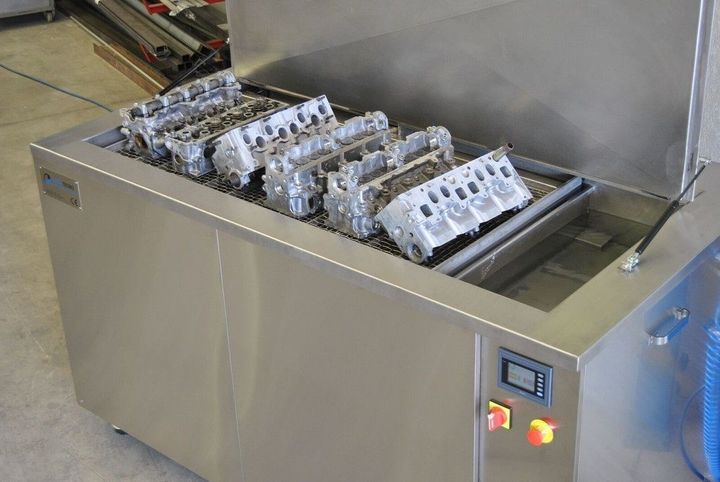
Parts are usually immersed in a liquid-filled tank. Ultrasonic transducers then introduce high-frequency vibrations into the liquid.
These vibrations create cavitation throughout the cleaning medium. Cavitation provides microscopic cleaning action across immersed surfaces.
The process can address contaminants such as:
- Oils
- Grease
- Metal particles
- Polishing compounds
- Carbon deposits
- Dust
- Machining residues
- Flux residues
- Fine particulate contamination
The appropriate process depends on the component and contamination type.
How Does Industrial Ultrasonic Cleaning Work?
The cleaning process involves several coordinated stages.
How Are Ultrasonic Waves Generated?
An ultrasonic generator converts electrical energy into a high-frequency electrical signal.
This signal reaches ultrasonic transducers. The transducers convert electrical energy into mechanical vibration.
These vibrations travel through the tank and cleaning liquid.
What Is Acoustic Cavitation?
Acoustic cavitation is central to ultrasonic cleaning.
Alternating pressure waves create microscopic cavities within the liquid. These bubbles grow and eventually collapse.
Their collapse produces localized mechanical action near component surfaces.
This action helps separate contaminants from the underlying material.
How Does Cavitation Clean Complex Components?
Cleaning liquid can enter small spaces around immersed components.
Cavitation can therefore occur within many difficult geometries.
These may include:
- Blind holes
- Small openings
- Threads
- Grooves
- Recesses
- Internal passages
- Irregular surfaces
- Detailed assemblies
This capability makes ultrasonic cleaning valuable for precision components.
What Are the Main Components of an Ultrasonic Cleaning System?
Industrial systems contain several important components.
What Does the Ultrasonic Generator Do?
The ultrasonic generator supplies controlled electrical energy.
It determines operating characteristics such as ultrasonic frequency and power delivery.
What Do Ultrasonic Transducers Do?
Transducers convert electrical signals into mechanical vibrations.
Common transducer technologies include:
- Piezoelectric transducers
- Magnetostrictive transducers
Each technology has different operating characteristics.
What Is the Purpose of the Cleaning Tank?
The tank holds the cleaning liquid and components.
Industrial tanks are commonly constructed from materials suitable for repeated cleaning cycles.
Tank dimensions depend on component size and production requirements.
Why Is the Cleaning Liquid Important?
The liquid transfers ultrasonic energy to component surfaces.
Its chemistry also influences contaminant removal.
Cleaning formulations may be selected for:
- Oils
- Grease
- Carbon deposits
- Metal particles
- Organic residues
- Process contamination
Material compatibility should always be considered.
Why Are Heating Systems Used?
Many ultrasonic systems include controlled heating.
Temperature can influence cleaning chemistry and contaminant removal.
However, excessive temperatures may reduce effective cavitation under some conditions.
What Frequencies Are Used in Industrial Ultrasonic Cleaning?
Ultrasonic frequency affects cavitation characteristics.
Lower frequencies generally produce larger and more energetic cavitation bubbles. Higher frequencies create smaller bubbles with gentler cleaning action.
Common frequency ranges may include:
- Low-frequency ultrasonic cleaning for robust components
- Medium-frequency cleaning for general industrial applications
- High-frequency cleaning for delicate precision surfaces
The appropriate frequency depends on component sensitivity and contamination.
What Factors Affect Ultrasonic Cleaning Performance?
Several variables determine cleaning effectiveness.
Important factors include:
- Ultrasonic frequency
- Power density
- Cleaning chemistry
- Liquid temperature
- Treatment duration
- Component positioning
- Contaminant characteristics
- Material properties
- Tank loading
- Liquid condition
These factors should work together as a controlled process.
What Are the Benefits of Industrial Ultrasonic Cleaning?
Ultrasonic technology provides several important process advantages.
How Does It Improve Cleaning Coverage?
Cavitation occurs throughout properly energized liquid.
This allows cleaning action to reach complex surfaces.
It can improve access to:
- Small holes
- Threads
- Internal channels
- Detailed surfaces
- Recessed areas
How Does Ultrasonic Cleaning Support Consistency?
Controlled parameters can improve process repeatability.
Operators can define:
- Cleaning duration
- Temperature
- Frequency
- Power
- Chemistry
- Rinsing stages
Standardized settings support consistent cleaning results.
Can Ultrasonic Cleaning Reduce Manual Contact?
Yes. Components can often be cleaned while immersed.
This reduces dependence on extensive brushing or manual scrubbing.
Can Ultrasonic Cleaning Handle Complex Components?
Complex geometry is one of its major strengths.
The liquid carries acoustic energy into areas that may be difficult to access mechanically.
What Materials Can Be Ultrasonically Cleaned?
Many materials can undergo ultrasonic cleaning when suitable parameters are used.
Examples include:
- Stainless steel
- Aluminum
- Brass
- Copper
- Titanium
- Glass
- Ceramics
- Certain plastics
- Precision alloys
Not every material responds identically.
Surface condition, coatings, adhesives, and component construction should be evaluated first.
Which Industries Use Industrial Ultrasonic Cleaning?
Ultrasonic cleaning appears across many industrial sectors.
How Is Ultrasonic Cleaning Used in Automotive Manufacturing?
Automotive components often contain complex passages and machined surfaces.
Applications can include cleaning:
- Engine components
- Fuel system parts
- Transmission components
- Bearings
- Valves
- Precision machined parts
How Is It Used in Aerospace Manufacturing?
Aerospace components can require controlled surface cleanliness.
Ultrasonic systems may process:
- Precision components
- Hydraulic parts
- Turbine-related components
- Machined assemblies
- Maintenance components
Process requirements depend on applicable manufacturing standards.
How Is Ultrasonic Cleaning Used in Electronics?
Electronic manufacturing can involve small components and delicate surfaces.
Applications may include removing:
- Flux residues
- Fine particles
- Process contamination
- Surface residues
Compatibility with sensitive electronic assemblies must be carefully evaluated.
How Is It Used in Precision Engineering?
Precision engineering requires controlled component cleanliness.
Ultrasonic cleaning can support:
- Bearings
- Valves
- Gears
- Precision tools
- Machined components
- Measurement components
How Is It Used in Optical Manufacturing?
Optical surfaces require careful contamination control.
Higher ultrasonic frequencies may support gentle cleaning of certain precision optical components.
What Is a Multi-Stage Ultrasonic Cleaning System?
Industrial cleaning may involve more than one processing tank.
A multi-stage system can combine several operations.
Typical stages include:
- Pre-cleaning
- Ultrasonic cleaning
- Rinsing
- Secondary rinsing
- Drying
- Final inspection
The exact sequence depends on cleanliness requirements.
How Does Degassing Improve Ultrasonic Cleaning?
Fresh cleaning liquid can contain dissolved gases.
These gases can interfere with efficient cavitation.
Degassing removes trapped gases before regular cleaning begins. This can improve ultrasonic energy transmission.
Some systems provide automated degassing functions.
How Does Component Positioning Affect Cleaning?
Correct positioning helps ultrasonic energy reach component surfaces.
Parts should not be tightly packed together.
Poor positioning can:
- Block cavitation
- Create acoustic shadows
- Trap contamination
- Restrict liquid circulation
Baskets and fixtures should support effective liquid exposure.
What Is the Difference Between Ultrasonic Cleaning and Spray Cleaning?
Both methods remove industrial contamination differently.
Ultrasonic cleaning relies mainly on acoustic cavitation within liquid.
Spray cleaning uses pressurized liquid directed toward component surfaces.
Ultrasonic cleaning is particularly useful for intricate geometries. Spray systems can be effective for accessible external surfaces.
Some industrial processes combine both technologies.
How Is Automation Used in Ultrasonic Cleaning Systems?
Modern industrial cleaning systems increasingly use automation.
Automated systems can control:
- Component loading
- Tank movement
- Cleaning duration
- Temperature
- Ultrasonic power
- Rinsing stages
- Drying cycles
- Process monitoring
Automation can improve repeatability across large production environments.
How Are Industrial Ultrasonic Cleaning Systems Maintained?
Routine maintenance helps maintain consistent performance.
Important practices include:
- Monitoring cleaning liquid
- Removing accumulated contamination
- Inspecting transducers
- Checking tank condition
- Monitoring operating temperature
- Inspecting electrical connections
- Testing ultrasonic performance
- Cleaning filtration systems
- Reviewing process parameters
Maintenance frequency depends on operating conditions.
What Can Reduce Ultrasonic Cleaning Effectiveness?
Several conditions can affect cleaning performance.
Common examples include:
- Excessive tank loading
- Incorrect frequency
- Weak ultrasonic output
- Contaminated cleaning liquid
- Poor component positioning
- Incorrect temperature
- Insufficient cleaning time
- Unsuitable cleaning chemistry
- Trapped air
- Transducer deterioration
Regular process monitoring helps identify these conditions.
How Is Industrial Ultrasonic Cleaning Technology Evolving?
Ultrasonic cleaning systems continue to become more advanced.
Important developments include:
- Digital ultrasonic generators
- Multi-frequency operation
- Automated process controls
- Real-time parameter monitoring
- Integrated filtration
- Automated material handling
- Programmable cleaning cycles
- Energy management systems
- Process data recording
- Condition monitoring
These technologies provide greater control over industrial cleaning processes.
Frequently Asked Questions
What is industrial ultrasonic cleaning used for?
It removes contaminants from industrial components using ultrasonic energy and cleaning liquid.
What creates the cleaning action?
Acoustic cavitation creates microscopic bubbles that collapse near component surfaces.
Can ultrasonic cleaning reach small holes?
Yes. Cleaning liquid and cavitation can reach many small openings and internal geometries.
Does ultrasonic frequency affect cleaning?
Yes. Frequency influences cavitation bubble size and cleaning intensity.
Why is degassing important?
Degassing removes dissolved gases that can interfere with effective cavitation.
Can ultrasonic cleaning be automated?
Yes. Industrial systems can automate cleaning, rinsing, handling, drying, and process monitoring.
Key Takeaways
Industrial Ultrasonic Cleaning Summary
- Industrial ultrasonic cleaning uses high-frequency sound energy.
- Acoustic cavitation produces the primary cleaning action.
- Ultrasonic energy can reach intricate component geometries.
- Frequency affects cavitation intensity and bubble characteristics.
- Temperature, chemistry, power, and duration influence performance.
- Multi-stage systems can combine cleaning, rinsing, and drying.
- Proper component positioning supports effective cavitation.
- Degassing can improve ultrasonic energy transmission.
- Automated controls improve process consistency.
- Routine monitoring supports reliable industrial cleaning performance.