Understanding Industrial Air Chillers: Working Principles, Types and Applications
Industrial processes often generate significant amounts of heat. Excess heat can affect equipment stability, process consistency, and production environments.
Industrial air chillers help manage these thermal conditions.
These cooling systems remove heat from process fluids or equipment. They then reject that heat through air-cooled components. Industrial chillers are widely used across manufacturing and processing environments.
Quick Answer: What Are Industrial Air Chillers?
- Industrial air chillers provide controlled cooling for industrial processes.
- They remove unwanted heat from circulating process fluids.
- Air-cooled condensers transfer collected heat into surrounding air.
- Major components include compressors, condensers, evaporators, and expansion devices.
- Common configurations include scroll, screw, and reciprocating chillers.
- Industrial chillers support manufacturing equipment and temperature-sensitive processes.
- Proper maintenance helps maintain stable cooling performance.
- Modern controls improve temperature regulation and energy management.
What Are Industrial Air Chillers?
Industrial air chillers are cooling systems designed for process and equipment temperature control.
They usually circulate chilled water or another suitable fluid. This fluid absorbs heat from industrial equipment or manufacturing processes.
The absorbed heat enters the refrigeration circuit. It is eventually transferred into the surrounding air.
Industrial chillers can support:
- Manufacturing machinery
- Process equipment
- Plastic processing
- Metalworking equipment
- Laser systems
- Food processing
- Electronics manufacturing
- Pharmaceutical processes
- Printing equipment
- Industrial automation
Their configuration depends on the required cooling conditions.
How Do Industrial Air Chillers Work?
Most industrial air chillers operate through a vapor-compression refrigeration cycle.
The cycle continuously moves heat away from the industrial process.
How Does the Evaporator Remove Process Heat?
The evaporator transfers heat from the process fluid into the refrigerant.
As the refrigerant absorbs heat, it changes into a low-pressure vapor.
The cooled process fluid then returns to the equipment.
What Does the Compressor Do?
The compressor draws refrigerant vapor from the evaporator.
It increases the refrigerant's pressure and temperature. The high-pressure vapor then travels toward the condenser.
How Does the Air-Cooled Condenser Release Heat?
The air-cooled condenser transfers refrigerant heat into ambient air.
Fans move air across condenser coils. This airflow helps remove heat from the refrigerant.
As heat leaves, the refrigerant condenses into liquid form.
What Does the Expansion Device Do?
The refrigerant passes through an expansion device before returning to the evaporator.
This component reduces refrigerant pressure.
The lower-pressure refrigerant can then absorb process heat again.
What Are the Main Components of Industrial Air Chillers?
Industrial chillers contain several interconnected components.
Compressor
The compressor circulates refrigerant through the system.
Common compressor technologies include:
- Scroll compressors
- Screw compressors
- Reciprocating compressors
- Centrifugal compressors
The suitable design depends on cooling capacity and operating conditions.
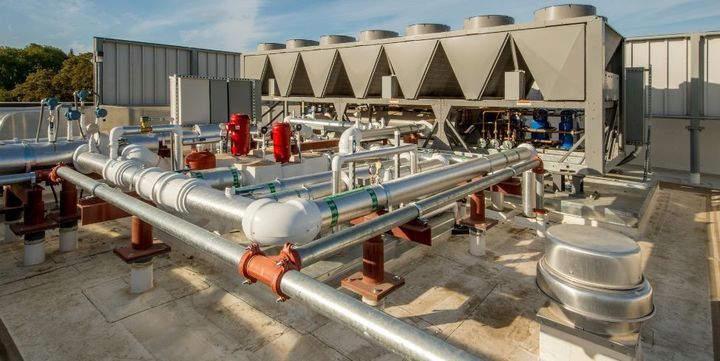
Air-Cooled Condenser
The condenser rejects heat into outdoor or surrounding air.
It typically contains:
- Condenser coils
- Cooling fins
- Electric fans
- Refrigerant piping
Clean condenser surfaces support efficient heat transfer.
Evaporator
The evaporator removes heat from the circulating process fluid.
Efficient heat transfer helps maintain stable fluid temperatures.
Expansion Device
The expansion device regulates refrigerant entering the evaporator.
It also creates the pressure reduction required for cooling.
Process Fluid Pump
The pump circulates chilled fluid between the chiller and industrial equipment.
Stable circulation supports consistent heat removal.
Storage Tank
Some industrial chiller systems include a fluid reservoir.
The reservoir can help stabilize fluid volume and temperature.
Control System
Modern chillers use electronic controllers and sensors.
These systems can monitor:
- Fluid temperature
- Refrigerant pressure
- Ambient conditions
- Compressor operation
- Pump status
- Fan operation
- System alarms
What Types of Industrial Air Chillers Are Common?
Industrial chillers can be classified by compressor technology and system configuration.
How Do Scroll Chillers Work?
Scroll chillers use scroll compressors to compress refrigerant.
They are commonly used for small and medium industrial cooling loads.
Their design provides relatively smooth compression and compact construction.
What Are Screw Chillers?
Screw chillers use rotary screw compressors.
These compressors can support larger and more continuous cooling requirements.
They are commonly found in demanding industrial environments.
What Are Reciprocating Chillers?
Reciprocating chillers use piston-driven compressors.
The pistons compress refrigerant inside cylinders.
These systems remain suitable for selected industrial cooling applications.
What Are Packaged Industrial Chillers?
Packaged chillers combine major cooling components within one integrated unit.
A packaged system may contain:
- Compressor
- Condenser
- Evaporator
- Pump
- Reservoir
- Controller
Integrated construction can simplify system configuration.
What Is the Difference Between Air-Cooled and Water-Cooled Chillers?
The primary difference involves heat rejection.
Air-cooled chillers transfer heat directly into ambient air. Fans move air across condenser coils.
Water-cooled chillers transfer heat through a separate water circuit. They often work with cooling towers.
Air-cooled systems generally avoid cooling-tower infrastructure. Their performance remains influenced by surrounding air temperature.
Why Is Process Temperature Control Important?
Many industrial processes require stable operating temperatures.
Excessive heat can affect:
- Equipment performance
- Material characteristics
- Manufacturing consistency
- Component life
- Dimensional accuracy
- Process stability
Industrial chillers help maintain defined thermal conditions.
Where Are Industrial Air Chillers Used?
Industrial chillers support many sectors.
Common environments include:
- Plastics manufacturing
- Metal processing
- Food processing
- Beverage production
- Pharmaceutical manufacturing
- Chemical processing
- Printing
- Electronics manufacturing
- Semiconductor production
- Automotive manufacturing
- Machine tools
- Industrial laboratories
Cooling requirements vary significantly between applications.
How Are Chillers Used in Plastics Manufacturing?
Plastic processing equipment generates heat during production.
Chillers can provide cooling for:
- Injection molding machines
- Extrusion equipment
- Blow molding systems
- Hydraulic circuits
- Molds
Stable cooling can improve process repeatability.
How Do Industrial Chillers Support Laser Equipment?
Industrial lasers generate concentrated thermal energy.
Cooling systems help manage temperatures around sensitive laser components.
Applications can include:
- Laser cutting
- Laser marking
- Laser welding
- Laser engraving
Stable cooling helps maintain consistent operating conditions.
How Are Chillers Used with Machine Tools?
Machine tools generate heat through motors, spindles, hydraulic systems, and cutting operations.
Chillers can cool:
- Spindles
- Cutting fluids
- Hydraulic oil
- Electrical enclosures
Temperature management can support machining accuracy.
What Factors Affect Industrial Chiller Performance?
Several operating conditions influence cooling performance.
Important factors include:
- Ambient air temperature
- Process fluid temperature
- Cooling load
- Refrigerant condition
- Condenser cleanliness
- Fluid flow rate
- Compressor condition
- Fan performance
- Heat exchanger condition
Changes in these conditions can affect system efficiency.
Why Does Ambient Temperature Matter?
Air-cooled chillers release heat into surrounding air.
Higher ambient temperatures can make heat rejection more challenging.
Proper airflow around the condenser is therefore important.
Restricted airflow can reduce cooling performance.
How Is Industrial Chiller Capacity Determined?
Cooling capacity represents the amount of heat a chiller can remove.
Several factors influence required capacity:
- Process heat load
- Fluid flow rate
- Required temperature change
- Ambient conditions
- Equipment operating schedule
- Process characteristics
Correct system sizing helps maintain stable process temperatures.
What Is Process Fluid in an Industrial Chiller?
Process fluid carries heat between industrial equipment and the chiller.
Water is commonly used in suitable environments.
Some systems use water-based mixtures for specific temperature conditions.
Fluid characteristics can affect:
- Heat transfer
- Pump performance
- Corrosion protection
- Freeze protection
- System cleanliness
Fluid selection should match system requirements.
How Are Industrial Air Chillers Maintained?
Regular maintenance supports dependable cooling.
Important maintenance activities include:
- Cleaning condenser coils
- Inspecting air filters
- Checking refrigerant conditions
- Monitoring process fluid levels
- Inspecting pumps
- Checking electrical connections
- Monitoring compressor performance
- Inspecting fans
- Cleaning heat exchangers
- Testing safety controls
Maintenance schedules should reflect operating conditions.
What Problems Can Affect Industrial Air Chillers?
Industrial chillers can experience several operating issues.
Common examples include:
- Restricted condenser airflow
- Dirty condenser coils
- Low process fluid flow
- Pump problems
- Refrigerant circuit faults
- Compressor problems
- Sensor malfunction
- Excessive ambient temperature
- Heat exchanger fouling
- Electrical faults
System monitoring can help identify abnormal conditions early.
How Can Industrial Chiller Efficiency Be Improved?
Efficient cooling depends on proper operation and maintenance.
Useful practices include:
- Keeping condenser coils clean
- Maintaining unrestricted airflow
- Monitoring fluid temperatures
- Maintaining correct fluid circulation
- Inspecting heat exchangers
- Monitoring compressor operation
- Maintaining fans
- Using appropriate control settings
Reducing unnecessary thermal load can also improve system performance.
How Is Automation Improving Industrial Air Chillers?
Modern chillers increasingly use intelligent monitoring technologies.
Important developments include:
- Digital temperature controllers
- Variable-speed fans
- Variable-speed compressors
- Remote system monitoring
- Automated fault detection
- Energy monitoring
- Process data logging
- Predictive maintenance
- Industrial control integration
- Real-time performance analysis
These technologies provide greater visibility into cooling operations.
How Do Sensors Support Chiller Operation?
Sensors continuously measure operating conditions.
Common sensors monitor:
- Temperature
- Pressure
- Fluid flow
- Fluid level
- Compressor conditions
- Ambient temperature
The controller uses this information to regulate cooling equipment.
What Safety Features Are Used in Industrial Chillers?
Industrial chillers include protective controls for abnormal conditions.
Common features may include:
- High-pressure protection
- Low-pressure protection
- Freeze protection
- Compressor overload protection
- Flow monitoring
- Temperature alarms
- Emergency shutdown controls
- Electrical protection
Exact features depend on system configuration.
Frequently Asked Questions
What is an industrial air chiller used for?
It removes unwanted heat from industrial processes and equipment.
How does an air-cooled industrial chiller reject heat?
Fans move ambient air across condenser coils to remove refrigerant heat.
What fluid does an industrial chiller circulate?
Many systems circulate water or a suitable water-based process fluid.
Do industrial chillers cool air directly?
Many industrial chillers primarily cool process fluids. Those fluids then remove heat from equipment.
Why are condenser coils important?
Condenser coils transfer collected system heat into surrounding air.
Why is regular chiller maintenance important?
Maintenance supports efficient heat transfer, stable cooling, and equipment reliability.
Key Takeaways
Industrial Air Chillers Summary
- Industrial air chillers remove unwanted heat from industrial processes.
- Most systems operate through a vapor-compression refrigeration cycle.
- Compressors circulate and compress refrigerant.
- Evaporators transfer process heat into the refrigerant.
- Air-cooled condensers release collected heat into ambient air.
- Scroll and screw compressors support different cooling requirements.
- Industrial chillers support plastics, lasers, machining, and manufacturing.
- Ambient temperature can significantly affect air-cooled chiller performance.
- Routine maintenance helps maintain efficient heat transfer.
- Digital controls are improving industrial cooling system monitoring.