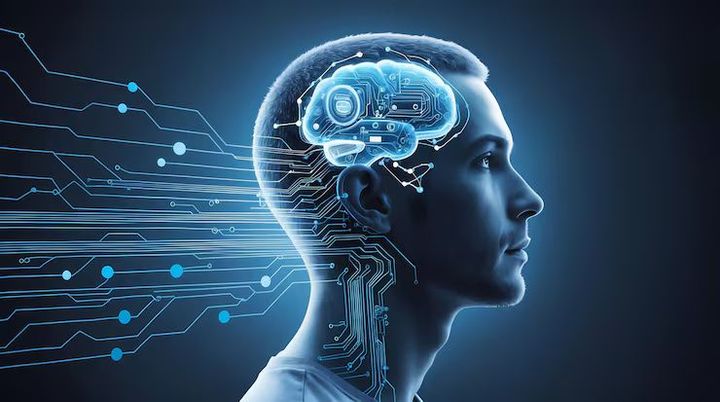
Deep Learning: An Overview of Artificial Intelligence
Deep learning is a subfield of artificial intelligence that focuses on training computer systems to recognize patterns and make decisions using layered computational models called neural networks. These models are inspired by the way the human brain processes information through interconnected neurons, though they are mathematical and computational in nature rather than biological.
Deep learning emerged as a response to the limitations of traditional rule-based programming in handling complex and unstructured data such as images, speech, and text. Earlier systems relied on predefined rules, which became inefficient as data complexity increased.
Deep learning uses multiple computational layers to transform raw data into meaningful patterns. For example, in image processing, early layers detect edges while deeper layers identify objects and shapes.
This layered approach allows systems to learn directly from data rather than relying on explicit programming.
Importance of Deep Learning
Deep learning is important because it enables computers to analyze complex data and identify patterns at scale. It has expanded the capabilities of artificial intelligence across many domains.
Key Reasons This Topic Matters
- Improves accuracy in pattern recognition
- Enables automation of complex data analysis
- Supports learning from large datasets
- Adapts to new data without manual reprogramming
These capabilities make deep learning central to modern AI systems.
Problems Deep Learning Helps Address
- Difficulty processing unstructured data
- Limitations of rule-based programming
- Challenges in scaling data analysis
- Inability to detect subtle patterns
Understanding deep learning helps explain how AI systems interpret complex information.
Recent Updates in Deep Learning
Recent developments focus on efficiency, multimodal learning, and transparency. In 2024, researchers emphasized reducing computational requirements while maintaining performance.
Key Updates (2024–2025)
- Development of more efficient and optimized models
- Growth of multimodal systems combining text, image, and audio data
- Increased focus on interpretability and transparency
- Expansion of accessible tools for learning and experimentation
These trends reflect both technical progress and broader societal concerns.
Laws and Policies Affecting Deep Learning
Deep learning is influenced by regulations related to artificial intelligence, data protection, and ethical technology use. These frameworks aim to ensure responsible development.
Key Regulatory Areas
- Data privacy and user consent requirements
- AI governance and risk-based classification
- Transparency and accountability standards
- Ethical guidelines for AI deployment
These policies help align innovation with public trust and safety.
Tools and Resources for Learning Deep Learning
Various tools support understanding and experimentation with deep learning concepts. These resources are widely used in education and research.
Helpful Resources
- Open-source machine learning libraries
- Educational courses and tutorials
- Visualization tools for neural networks
- Research papers and open datasets
- Community forums and documentation
These tools make deep learning more accessible to learners.
Common Deep Learning Model Types
Different model types are used depending on the data and application.
| Model Type | Primary Use Case | Data Type |
|---|---|---|
| Convolutional Networks | Image and video analysis | Visual data |
| Recurrent Networks | Sequential data processing | Text, time series |
| Transformer Models | Context-aware understanding | Language, multimodal |
| Autoencoders | Feature extraction and compression | Structured data |
| Generative Models | Data generation and simulation | Mixed data formats |
These models form the foundation of deep learning systems.
FAQs: Common Questions About Deep Learning
What is deep learning?
It is a method of machine learning that uses multi-layer neural networks to learn from data.
How is it different from machine learning?
Deep learning is a subset of machine learning focused on layered neural networks.
Does it require large datasets?
Typically, deep learning performs best with large amounts of data.
Why is it computationally intensive?
It involves many calculations across multiple layers during training.
Can deep learning models explain decisions?
Interpretability is improving, but many models remain complex to fully explain.
Conclusion
Deep learning represents a major advancement in artificial intelligence by enabling systems to learn complex patterns directly from data. Its layered structure allows machines to process information in ways that were previously difficult.
As research continues, deep learning is evolving toward more efficient, transparent, and accessible systems.
Understanding deep learning provides valuable insight into how modern AI technologies function and influence everyday digital experiences.