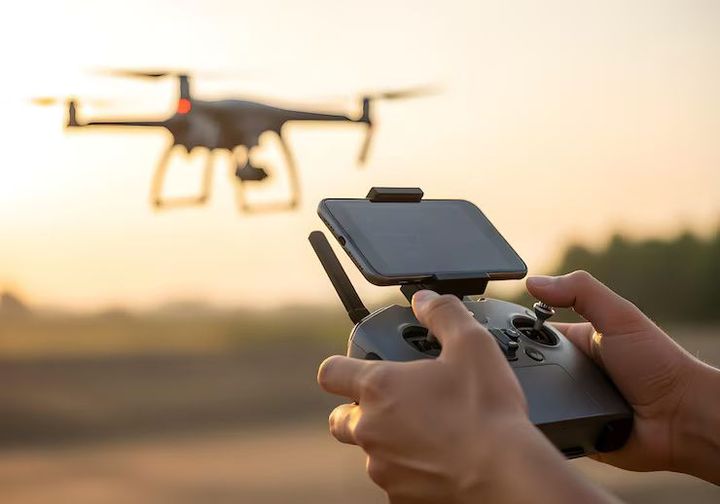
Drone Survey Guide: Explore Mapping Techniques and Aerial Data Insights
Drone surveying is a method of collecting geographic and visual data using unmanned aerial vehicles, often called drones.
A drone land survey can capture images, elevation details, and geographic coordinates from the air. This information is then processed into digital maps, 3D models, and measurement reports.
Traditional land surveying has existed for centuries and often relied on manual tools such as tripods, measuring chains, and ground markers. Over time, satellite navigation, digital imaging, and remote sensing technologies changed how surveys are performed. The aerial drone survey developed as part of this shift toward faster and more detailed data collection.
Today, drone surveys are used in many industries. A drone topographic survey helps map land elevations and surface features, while drone survey for construction projects can monitor site progress and land preparation. Similar methods are also used in mining, agriculture, energy infrastructure, and environmental studies.
Modern drone surveying equipment commonly includes high-resolution cameras, GPS receivers, sensors, and specialized software. These tools work together to capture aerial images and convert them into usable geographic information.
Importance
Drone surveying matters because many industries depend on accurate land data for planning and decision-making. Roads, buildings, farms, pipelines, and energy facilities all require measurements that reflect real-world conditions.
Improved Data Collection
An aerial drone survey can cover large areas more quickly than many traditional methods. This is especially useful in places with rough terrain, steep slopes, or limited road access. Survey teams can gather information without entering difficult or potentially unsafe locations.
Support for Construction and Infrastructure
Drone survey for construction activities helps planners monitor excavation, land grading, and structural development. Construction managers often use aerial mapping to compare current site conditions with project plans.
Some common uses include:
- Monitoring earth movement
- Measuring stockpiles
- Tracking project stages
- Reviewing drainage patterns
- Mapping transportation corridors
Applications in Agriculture
Drone survey for agriculture supports crop monitoring and land management. Farmers and agricultural planners use aerial images to observe irrigation patterns, soil conditions, and plant health.
These surveys can also help identify areas affected by erosion, water accumulation, or uneven growth. Multispectral sensors attached to drones can detect vegetation differences that are difficult to see from the ground.
Mining and Resource Mapping
A drone survey for mining can help map excavation zones, measure material volumes, and inspect active sites. Mining areas often change rapidly, so updated aerial data is useful for planning and safety monitoring.
In the energy sector, drone survey for oil and gas infrastructure may assist with pipeline inspections, facility mapping, and environmental observation. Solar energy projects also rely on aerial imaging. A drone survey for solar farms may support land assessment, panel alignment reviews, and vegetation monitoring.
Recent Updates
Drone surveying technology has continued to evolve between 2024 and 2026. Improvements in sensors, automation, and software have influenced how aerial mapping is performed across different industries.
Growth of AI-Assisted Mapping
Artificial intelligence tools are increasingly integrated into drone mapping software. These systems can identify terrain features, classify land types, and organize large image datasets more efficiently.
AI-assisted systems may help detect:
- Surface cracks
- Vegetation changes
- Water drainage patterns
- Construction progress
- Land disturbances
Expanded Sensor Capabilities
Modern drone surveying equipment now includes more advanced sensors beyond standard cameras. LiDAR technology has become more common for terrain mapping because it can measure elevation even in partially forested areas.
Thermal imaging sensors are also used in certain applications, including infrastructure monitoring and agricultural analysis.
Automated Flight Planning
Many drone platforms now include automated route planning systems. These systems guide drones along pre-programmed paths while maintaining consistent image overlap and altitude.
Automation can improve data consistency during:
| Survey Type | Common Drone Feature |
|---|---|
| Drone topographic survey | Elevation mapping sensors |
| Drone survey for construction | Progress tracking software |
| Drone survey for mining | Volume measurement tools |
| Drone survey for agriculture | Crop health imaging |
| Drone survey for solar farms | Thermal inspection capability |
| Drone survey for oil and gas | Pipeline observation sensors |
Integration With Geographic Information Systems
Survey data is increasingly linked with Geographic Information Systems (GIS). GIS platforms help organize aerial information into layered digital maps that support planning, environmental analysis, and infrastructure management.
Cloud-based mapping platforms have also become more common, allowing teams in different locations to review the same survey information remotely.
Laws or Policies
Drone surveying is regulated in many countries because drones operate within controlled airspace. Governments typically establish rules related to flight safety, pilot certification, privacy, and operational limits.
Aviation Regulations
In the United States, drone operations are regulated by the Federal Aviation Administration. Commercial drone operators generally follow Part 107 rules, which include requirements for pilot certification and operational safety.
In India, drone regulations are managed by the Directorate General of Civil Aviation. Operators may need drone registration, digital permissions, and compliance with designated airspace zones.
Other countries maintain similar aviation frameworks that define:
- Maximum flight altitude
- Restricted flight zones
- Visual line-of-sight requirements
- Drone registration procedures
- Remote pilot qualifications
Privacy and Data Protection
Drone surveys often capture aerial imagery of land and structures. Privacy laws in some regions limit how data can be collected, stored, and shared. Survey operators may need permission when working near residential areas or sensitive facilities.
Data protection regulations can also affect how mapping data is processed and archived.
Environmental and Industrial Guidelines
Mining sites, oil facilities, and protected natural areas may have additional operational restrictions. Drone survey for oil and gas infrastructure sometimes requires coordination with environmental and industrial regulators.
Similarly, a drone survey for solar farms may need to follow land-use policies or renewable energy project guidelines depending on local regulations.
Tools and Resources
Drone surveying depends on both hardware and software tools. Different projects require different combinations of equipment and digital platforms.
Drone Platforms
Several drone manufacturers produce aircraft commonly used in mapping and inspection activities. Examples include:
- DJI
- senseFly
- Parrot
These platforms may support aerial imaging, LiDAR mapping, or thermal sensing depending on the model.
Mapping Software
Drone survey data is processed using photogrammetry and GIS software. Common platforms include:
- Pix4D
- DroneDeploy
- ArcGIS
- QGIS
These tools convert aerial images into maps, terrain models, and measurement datasets.
Survey Planning Resources
Government aviation portals often provide airspace maps and drone operation guidance. Educational institutions and geographic organizations also publish mapping tutorials and survey standards.
Useful resources may include:
- Aviation authority websites
- GIS learning platforms
- Survey coordinate conversion tools
- Flight planning applications
- Environmental mapping databases
FAQs
What is a drone land survey?
A drone land survey uses aerial drones to collect geographic data and images of land areas. The information is processed into maps, terrain models, and measurement reports used in planning and analysis.
How does a drone topographic survey work?
A drone topographic survey captures overlapping aerial images and elevation data. Specialized software combines this information to create detailed surface maps that show slopes, contours, and land features.
What industries use drone survey for construction projects?
Drone survey for construction activities is commonly used in transportation, commercial building, residential development, and infrastructure planning. Survey data helps monitor land preparation and structural progress.
What equipment is used in drone surveying?
Drone surveying equipment often includes GPS systems, high-resolution cameras, LiDAR sensors, batteries, controllers, and mapping software. The specific tools depend on the survey type and terrain conditions.
How is drone survey for agriculture different from traditional field inspection?
Drone survey for agriculture provides aerial views of large farming areas. This allows users to monitor crop conditions, irrigation patterns, and land changes more efficiently than ground-only observation methods.
Conclusion
Drone surveying combines aerial imaging, geographic mapping, and digital analysis to support land measurement and infrastructure planning. Industries such as construction, mining, agriculture, and energy increasingly use drone-based data collection for mapping and monitoring purposes. Recent developments in automation, AI-assisted software, and advanced sensors have expanded the capabilities of drone surveys. Regulations and privacy rules continue to shape how drones operate in different regions, while mapping software and GIS tools help organize and interpret collected data.