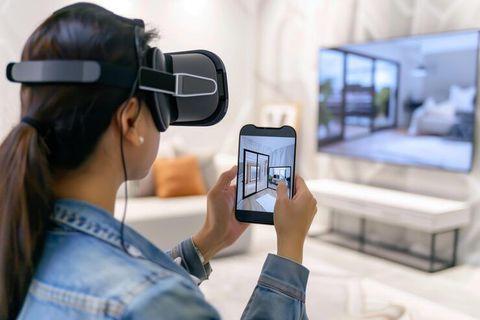
Eye-Tracking in VR/AR: Essential Guide to Gaze Interaction and Immersive Interfaces
Eye-tracking in virtual and augmented reality refers to technology that monitors and analyzes where a person is looking inside a digital environment. Sensors placed inside VR headsets or AR glasses detect eye movement, pupil position, and gaze direction. This information is then used by software to adjust digital content in real time.
Eye-tracking in virtual reality (VR) and augmented reality (AR) refers to technology that detects where a user is looking within a digital environment. It enables more natural interaction by allowing systems to respond to gaze instead of relying only on controllers or touch input.
The concept exists because immersive technologies require intuitive and seamless interaction. Traditional input methods can interrupt immersion, while gaze-based interaction makes experiences smoother and more realistic.
Modern VR and AR systems use infrared sensors, cameras, and machine-learning algorithms to detect eye movement. These systems identify the pupil and eye reflections to calculate gaze direction and trigger actions within the interface.
Key Capabilities of Eye-Tracking
- Gaze-based user interface navigation
- Foveated rendering for improved graphics efficiency
- User attention analysis for research and design
- Accessibility support for users with limited mobility
- Real-time interaction in immersive environments
Eye-tracking is now a core feature of extended reality (XR), which combines VR, AR, and mixed reality technologies.
Why Eye-Tracking Matters in Modern VR/AR Systems
Eye-tracking addresses several technical and usability challenges in immersive environments. As VR and AR expand into fields like education, healthcare, and design, accurate gaze detection improves system responsiveness.
Foveated Rendering and Performance
Foveated rendering is a major application of eye-tracking. It focuses high-resolution rendering only on the area where the user is looking, reducing detail in peripheral vision.
This technique lowers GPU workload while maintaining visual quality, making high-performance VR more efficient.
Understanding User Attention
Eye-tracking helps researchers analyze how users interact with virtual environments. It provides insights into attention patterns, decision-making, and visual focus.
Accessibility Improvements
Gaze-based interaction allows users with limited mobility to navigate interfaces. This makes VR and AR more inclusive and accessible.
Key Benefits and Use Cases
| Feature | How Eye-Tracking Helps | Example Use Case |
|---|---|---|
| Foveated Rendering | Reduces GPU load while maintaining clarity | High-resolution VR gaming |
| Gaze Interaction | Enables intuitive navigation | Menu selection in VR apps |
| User Behavior Analysis | Tracks attention and interaction patterns | UX research and testing |
| Accessibility Support | Allows gaze-based control | Assistive communication tools |
| Immersive Training | Enhances realism in simulations | Medical or aviation training |
These benefits support developers, researchers, designers, educators, and healthcare professionals working with immersive technologies.
Recent Developments and Trends
Eye-tracking technology has advanced rapidly due to improvements in XR hardware and artificial intelligence. Over the past year, several trends have shaped its development.
Integration in Next-Generation Headsets
New mixed-reality devices released in 2024 and 2025 include built-in eye-tracking. These systems support spatial computing and more natural navigation.
Improved Sensor Accuracy
Advancements in sensors and calibration systems allow accurate tracking even during rapid head movement or changing lighting conditions.
AI-Powered Gaze Analysis
Artificial intelligence models analyze eye movement patterns to detect focus, fatigue, and engagement. This is useful in training simulations and user research.
Multimodal Interaction Systems
Modern XR platforms combine eye-tracking with other technologies:
- Hand tracking
- Facial expression tracking
- Spatial mapping
- Voice interaction
These combined inputs create more responsive and immersive user experiences.
Privacy-Focused Innovations
Developers are exploring on-device processing and secure storage to protect sensitive gaze data. This is important as eye-tracking can reveal behavioral patterns.
Laws, Privacy Policies, and Regulations
Eye-tracking involves biometric and behavioral data, raising important privacy concerns. Many governments regulate such data under broader digital privacy laws.
Key Regulatory Principles
- User consent before collecting biometric data
- Transparency in data usage
- Secure storage and protection practices
- Limiting data collection to specific purposes
India’s Data Protection Framework
India’s Digital Personal Data Protection Act (DPDP) 2023 outlines how personal data should be handled. While it does not specifically mention eye-tracking, gaze data may fall under sensitive data categories.
Global Regulatory Influence
- General Data Protection Regulation (GDPR) in the European Union
- Biometric data protection laws in various regions
- Consumer digital rights policies
Developers must follow these frameworks to ensure responsible and ethical use of eye-tracking technology.
Tools and Resources for Eye-Tracking in XR
Various tools and platforms support the development and analysis of eye-tracking systems. These tools are used in both commercial applications and research environments.
Common Development and Analysis Tools
- Unity for VR/AR application development
- Unreal Engine for high-quality simulations
- Tobii XR SDK for gaze-tracking integration
- OpenXR for cross-platform XR development
- MATLAB for data analysis and research
These tools help developers build immersive experiences and analyze user behavior effectively.
Eye-Tracking Workflow Example
| Step | Description |
|---|---|
| Data Capture | Sensors collect eye movement data |
| Calibration | System adjusts to user’s eye characteristics |
| Processing | Algorithms calculate gaze direction |
| Visualization | Heatmaps or graphs show attention patterns |
| Interpretation | Researchers analyze user behavior |
This workflow is commonly used in research, usability testing, and training simulations.
Frequently Asked Questions
What is gaze tracking in VR and AR?
Gaze tracking detects where a user is looking within a virtual or augmented environment. It converts eye movement into input that systems can interpret.
How accurate is eye-tracking technology?
Modern systems are highly accurate, often within a few degrees of visual angle. Accuracy depends on sensor quality, calibration, and environmental conditions.
What is foveated rendering?
Foveated rendering uses eye-tracking data to focus computing power on the area the user is viewing. This improves performance while maintaining visual quality.
Can eye-tracking reveal personal information?
Yes. Eye-tracking data can indicate attention, behavior, and emotional responses. This is why it is considered sensitive and regulated in many regions.
Which industries use eye-tracking in XR?
- Medical training and simulation
- Academic research
- Automotive interface testing
- Gaming and entertainment
- Human-computer interaction studies
Conclusion
Eye-tracking in VR and AR is transforming how users interact with immersive environments. By detecting gaze direction, systems can enable natural interaction, improve graphics performance, and provide insights into user behavior.
The technology plays a key role in advanced XR systems where efficiency and realism are essential. Techniques like foveated rendering highlight how eye-tracking enhances both performance and user experience.
Recent advancements in sensors, AI, and XR hardware continue to expand its capabilities. At the same time, privacy regulations are shaping how gaze data is collected and used.
As immersive technologies evolve, eye-tracking will remain a critical component of next-generation digital experiences, supporting innovation in interaction design and human behavior research.