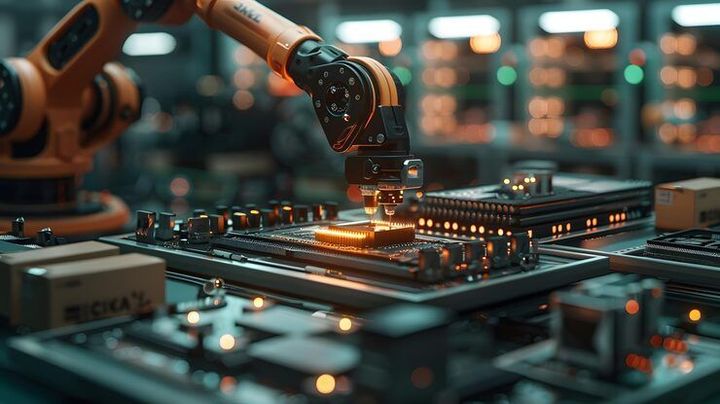
Growth of Microcontrollers in Industrial Automation: Insights Overview Guide
Microcontrollers are compact integrated circuits designed to control specific operations within machines and embedded systems. In industrial automation, they act as the “brain” behind equipment, enabling machines to sense, process, and respond to real-world inputs. These small yet powerful devices combine a processor, memory, and input/output peripherals into a single chip, making them ideal for controlling automated systems efficiently.
The growth of microcontrollers in industrial automation has been driven by the need for precision, reliability, and real-time processing. Industries such as manufacturing, energy, automotive, and logistics rely on automated systems to improve productivity and reduce human error. Microcontrollers enable machines to perform repetitive and complex tasks with consistency.
As industries move toward digital transformation, microcontrollers are becoming more advanced, supporting connectivity, low power consumption, and integration with modern technologies like sensors and communication networks.
Why Microcontrollers Matter in Today’s Industrial Systems
Microcontrollers play a crucial role in modern industrial environments due to their ability to enhance operational efficiency and system control. Their importance has increased significantly as industries adopt automation to remain competitive.
Key Reasons Microcontrollers Matter
- Improved Efficiency: Enable machines to operate continuously with minimal downtime
- Precision and Accuracy: Allow precise control over temperature, pressure, and motion
- Scalability: Systems can be expanded or modified easily
- Energy Optimization: Reduce energy consumption in automated systems
- Integration with IoT: Support connectivity for smart factories and real-time monitoring
Industries Affected
- Manufacturing and assembly lines
- Power and energy systems
- Automotive electronics
- Robotics and control systems
Problems Solved by Microcontrollers
| Challenge | Microcontroller Solution |
|---|---|
| Manual errors | Automated, consistent operations |
| High operational downtime | Predictive control and monitoring |
| Energy inefficiency | Smart power management |
| Complex system control | Integrated processing and control |
Recent Trends and Developments (2025–2026)
Over the past year, several trends have shaped microcontroller growth in industrial automation, reflecting the increasing demand for smarter and more connected systems.
Notable Developments
- Edge Computing Integration (2025): Processing data locally reduces dependence on centralized systems
- AI-Enabled Microcontrollers (2025–2026): Lightweight machine learning models enable predictive maintenance and anomaly detection
- Enhanced Connectivity (2026): Support for industrial protocols like Ethernet/IP and wireless connectivity
- Low-Power Designs (2025): Energy-efficient microcontrollers support sustainable industrial practices
- Security Improvements (2026): Features such as encryption and secure boot mechanisms
Trend Comparison Overview
| Feature | Earlier Systems | Modern Microcontrollers (2025–2026) |
|---|---|---|
| Processing Power | Limited | High-performance |
| Connectivity | Basic | Advanced IoT-enabled |
| Energy Efficiency | Moderate | Optimized low-power designs |
| Security | Minimal | Built-in security features |
| AI Capability | Not available | Integrated AI/ML support |
These advancements indicate a shift toward intelligent automation systems capable of adapting and responding in real time.
Laws, Regulations, and Policy Influence
Industrial automation and microcontroller usage are influenced by regulations and government initiatives, particularly in India.
Relevant Areas of Regulation
- Industrial Safety Standards: Ensure automated systems operate safely and reduce risks to workers
- Electronics Manufacturing Policies: Encourage domestic production of semiconductor components and embedded systems
- Data Protection Rules: Ensure compliance with data security regulations
- Energy Efficiency Standards: Promote the use of energy-efficient electronic components
Key Initiatives in India
- Make in India Program
- Digital India Initiative
- Production Linked Incentive (PLI) Scheme for Electronics
These programs support the growth of embedded systems and microcontroller adoption, strengthening domestic manufacturing capabilities and reducing reliance on imports.
Tools and Resources for Working with Microcontrollers
Various tools and platforms support the development and implementation of microcontroller-based systems in industrial automation.
Common Tools and Resources
- Integrated Development Environments (IDEs): Arduino IDE, MPLAB X, Keil uVision
- Simulation Software: Proteus Design Suite, MATLAB/Simulink
- Hardware Platforms: Arduino boards, STM32 kits, PIC microcontroller kits
- Communication Protocol Tools: Modbus testing tools, CAN bus analyzers
- Documentation and Learning Resources: Manufacturer datasheets, technical forums, open-source repositories
Example Comparison of Popular Platforms
| Platform | Key Feature | Use Case |
|---|---|---|
| Arduino | Easy to use | Prototyping and education |
| STM32 | High performance | Industrial applications |
| PIC | Reliable and cost-efficient | Embedded control systems |
These tools make it easier to design scalable and efficient automation systems.
Frequently Asked Questions
What is a microcontroller in industrial automation?
A microcontroller is a compact electronic device that controls automated processes by processing inputs and generating outputs in real time.
How are microcontrollers different from PLCs?
Microcontrollers are embedded within devices and offer flexibility, while PLCs (Programmable Logic Controllers) are specialized controllers for large-scale automation.
Why are microcontrollers important for smart factories?
They enable real-time data processing, connectivity, and control, which are essential for smart and connected manufacturing systems.
Are microcontrollers suitable for large industrial systems?
Yes, when combined with other systems or used in distributed architectures, they can effectively manage complex operations.
What skills are needed to work with microcontrollers?
Basic programming, electronics knowledge, and understanding of communication protocols are important for working with microcontrollers.
Conclusion
The growth of microcontrollers in industrial automation reflects a broader shift toward smarter, more efficient, and connected industrial systems. These compact devices are essential for controlling machinery, improving productivity, and enabling real-time decision-making.
Recent advancements—including AI integration, improved connectivity, and enhanced security—have expanded their capabilities significantly. Supportive government policies and readily available development tools have also made adoption easier.
As industries continue to evolve, microcontrollers will remain a key component of automation systems, supporting innovation and helping organizations adapt to changing technological demands.