Guide to DC Fast Chargers: Analysis, Research, and Emerging EV Charging Trends
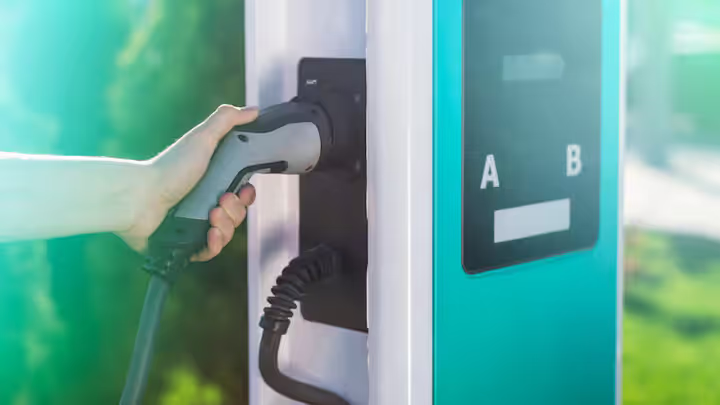
DC fast chargers are electric vehicle charging systems designed to transfer electrical energy to an EV battery at a relatively high power level. Unlike ordinary AC charging, where the vehicle's onboard charger converts alternating current into direct current, a DC fast charger performs much of that conversion within the charging station and sends DC power directly to the vehicle's battery system.
DC fast charging stations are commonly installed at highways, commercial locations, fleet facilities, parking areas, and other places where drivers may need to replenish battery energy during a relatively short stop. Charging speed depends on the charger, vehicle battery, battery temperature, state of charge, and other technical factors.
A high power DC fast charger may have a rated output ranging from several tens of kilowatts to several hundred kilowatts. Systems such as a 150kW DC fast charger and a 350kW EV fast charger are examples of higher-power charging equipment, although an EV does not necessarily receive the full rated output of the charger.
How DC Fast Charging Works
The basic charging process involves several electrical and communication stages. Electricity enters the charging station, where power electronics convert and regulate it into the DC voltage and current required by the vehicle.
The charger and vehicle communicate before and during charging. This communication allows the system to determine appropriate charging conditions and adjust power according to battery requirements.
A simplified process includes:
- Electrical power enters the charging station.
- Power electronics convert and regulate the electricity.
- The charging connector is connected to the vehicle.
- The charger and vehicle exchange charging information.
- Voltage and current are controlled during charging.
- Charging power changes as battery conditions change.
- The session ends when the required charging condition is reached or the user stops it.
The actual charging profile is determined by the vehicle and charging system rather than by charger power alone.
Main Components
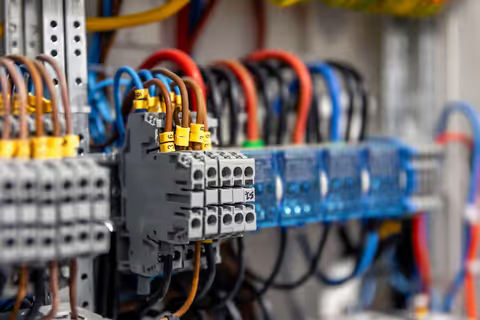
A DC fast charging system generally contains power conversion equipment, control electronics, safety components, communication hardware, cooling equipment, and a charging connector.
| Component | Main function |
|---|---|
| Power converter | Converts and regulates electrical power |
| Control system | Manages charging parameters |
| Charging connector | Transfers DC electricity to the vehicle |
| Communication system | Exchanges information with the EV |
| Cooling system | Controls heat generated during operation |
| Protection equipment | Helps manage electrical faults |
| User interface | Displays charging information |
| Metering equipment | Measures electrical energy transferred |
Different charger designs can use different internal architectures and cooling methods.
Importance
Supporting Electric Mobility
As electric vehicles become more common, charging infrastructure becomes an important part of transportation planning. DC fast chargers can support situations where drivers have limited time for charging or where vehicles travel significant distances between charging locations.
They are particularly relevant to highways, commercial vehicle operations, taxis, delivery fleets, and other applications involving regular vehicle movement.
Reducing Charging Time
Charging time depends on many variables, so the rated power of a charger should not be interpreted as a fixed charging duration. A 150kW DC fast charger can theoretically transfer energy at a higher rate than a 50kW unit under suitable conditions, but the vehicle may limit the actual power received.
Battery state of charge is another important factor. Many EV batteries accept higher charging power during part of the charging session and gradually reduce power as the battery approaches a high state of charge.
Commercial Charging Systems
Commercial DC charging systems are designed for environments where multiple vehicles may require regular access to charging infrastructure. These systems can be installed at fleet depots, workplaces, retail locations, transport facilities, and public charging areas.
Infrastructure planning may need to consider:
- Available electrical capacity
- Number of charging points
- Expected vehicle usage
- Charger power ratings
- Cable and connector requirements
- Space and accessibility
- Electrical protection
- Communication infrastructure
- Cooling requirements
- Local regulations
High-Power Charging
High-power systems can transfer substantial electrical energy over relatively short periods when the vehicle supports the required charging rate. A 350kW EV fast charger, for example, has a higher maximum output rating than a 150kW system.
However, the charger rating does not mean every compatible EV will accept 350kW. Vehicle battery architecture, charging voltage, thermal conditions, battery management controls, and charging state all influence the actual power level.
Recent Updates
Higher Charging Power
From 2024 through 2026, charging infrastructure has continued moving toward higher-power equipment and improved power management. Charging systems with outputs above 100kW are increasingly associated with highway and commercial applications.
Higher power introduces additional engineering requirements. Cables, connectors, cooling systems, electrical distribution equipment, and protection systems must be designed for the relevant voltage and current levels.
Improved Thermal Management
Heat is generated during high-power electrical conversion and charging. As charging power increases, thermal management becomes more important.
Some DC fast chargers use liquid-cooled cables or other thermal management approaches to control temperatures in high-current charging applications. The specific cooling arrangement varies by charger design and power level.
Better Charging Communication
Modern charging systems use communication protocols that allow the vehicle and charger to exchange information. This can include battery conditions, requested power, charging limits, and session information.
Improved communication can help coordinate charging power with vehicle requirements and station operating conditions.
Power Sharing
Some charging installations use dynamic power allocation. Instead of each charger always operating at its maximum rated output, the available electrical capacity can be distributed among several vehicles.
For example, if several EVs are charging simultaneously, a control system may adjust individual charging levels according to vehicle demand and the available electrical supply.
Integration With Energy Management
Charging stations are increasingly being integrated with broader energy management systems. These systems can monitor electrical demand, charging activity, and equipment status.
In larger facilities, charging infrastructure may interact with solar generation, stationary batteries, building electrical systems, or other energy assets. Such integration can help coordinate electrical loads within the facility.
Software and Remote Monitoring
Modern charging infrastructure commonly includes digital monitoring functions. Operators can track charger status, energy measurements, fault conditions, and charging activity through connected software.
Remote monitoring can also help identify communication or equipment problems without requiring every observation to be made directly at the charging station.
Laws or Policies
EV Charging Regulations in India
In India, electric vehicle charging infrastructure is influenced by national electricity regulations, technical standards, state-level requirements, and government programs supporting electric mobility. Requirements can vary according to the location, electrical connection, type of charging installation, and entity operating the infrastructure.
The Ministry of Power has issued guidelines and standards concerning EV charging infrastructure, while the Bureau of Indian Standards develops and maintains relevant technical standards.
Electrical Safety
DC fast charging involves significant electrical power and requires appropriate protection. Charging installations may need suitable earthing, circuit protection, isolation arrangements, enclosure protection, and emergency controls.
Installation requirements depend on the electrical characteristics of the site and the charging equipment. Qualified electrical professionals generally handle design and installation activities that fall under applicable electrical rules.
Charging Standards
EV charging equipment must be compatible with relevant charging and communication standards. Different vehicle markets use different connector and communication arrangements.
In India, charging infrastructure may involve standards and specifications associated with connectors, communication protocols, electrical safety, and charging performance. The applicable requirements should be checked against the particular equipment and installation.
Government Programs
India's electric mobility policies have included programs and measures intended to encourage EV adoption and charging infrastructure development. Government policy can change as transportation, electricity, and industrial priorities evolve.
Charging infrastructure may also be affected by state-level policies, electricity distribution requirements, building regulations, and local permissions.
Tools and Resources
Charging Calculators
EV charging calculators can estimate charging time based on battery capacity, starting state of charge, charger power, and vehicle charging limits. Such calculations provide estimates rather than exact results because charging power often changes during a session.
Electrical Load Calculators
Electrical load calculations help determine whether a site has sufficient electrical capacity for one or multiple chargers. Larger commercial installations may require an assessment of transformers, switchgear, cables, protection systems, and other electrical infrastructure.
Charging Standards and Documentation
Technical documentation is important when evaluating charging equipment. Useful resources include:
- Charger installation manuals
- Vehicle charging specifications
- Electrical single-line diagrams
- Connector specifications
- Applicable Indian standards
- Ministry of Power charging guidelines
- Electricity distribution requirements
- Equipment maintenance documentation
Monitoring Platforms
Charging management platforms can provide information about charger availability, energy consumption, session activity, equipment faults, and connected vehicles. Larger installations may integrate these platforms with facility or fleet management software.
FAQs
What are DC fast chargers used for?
DC fast chargers are used to provide relatively high-power charging to compatible electric vehicles. They are commonly used at highways, public charging locations, commercial facilities, fleet depots, and other locations where shorter charging periods may be useful.
How does a 150kW DC fast charger work?
A 150kW DC fast charger converts and regulates electrical power before delivering DC electricity directly to an EV battery. The vehicle determines how much power it can accept, so actual charging power may be below 150kW.
Is a 350kW EV fast charger suitable for every EV?
No. A 350kW EV fast charger can have a maximum output of 350kW, but an EV may have a lower charging limit. Battery voltage, temperature, state of charge, battery management controls, and vehicle specifications affect the actual charging rate.
What are commercial DC charging systems?
Commercial DC charging systems are charging installations designed for locations such as fleet facilities, workplaces, highways, parking areas, and other commercial environments. They can include multiple chargers, electrical distribution equipment, communication systems, and charging management software.
What should be considered when installing DC fast charging stations?
Important considerations include available electrical capacity, charger power, vehicle compatibility, connector standards, site layout, cooling, electrical protection, communication systems, accessibility, and applicable local regulations.
Conclusion
DC fast chargers use controlled DC power conversion to provide relatively high-power charging for compatible electric vehicles. Systems such as 150kW and 350kW chargers represent different maximum power levels, while actual charging performance depends on the vehicle and battery conditions. Recent developments include higher power ratings, improved thermal management, power sharing, digital monitoring, and integration with energy management systems. Safe deployment depends on suitable electrical infrastructure, compatible charging standards, appropriate protection, and compliance with applicable regulations.