Heavy Industrial Moving Guide: Understanding Equipment, Planning, and Safety
Heavy industrial moving is the planned movement of large machines, production equipment, plant components, and other oversized assets from one position or facility to another.
Unlike ordinary transportation, industrial machinery moving often involves equipment that is extremely heavy, unusually shaped, sensitive to vibration, or connected to complex production systems.
The need for industrial equipment moving developed alongside large-scale manufacturing, construction, energy production, mining, and infrastructure projects. As factories became larger and machinery became more specialized, moving equipment required careful engineering, lifting methods, transport planning, and coordination.
Heavy equipment relocation may take place within the same building, between nearby facilities, or across long distances. Some projects involve a single machine, while industrial plant relocation can involve production lines, storage systems, electrical equipment, and supporting infrastructure.
How the Moving Process Works
A typical heavy machinery relocation project begins with information gathering. Teams examine the machine dimensions, weight, center of gravity, lifting points, surrounding space, floor capacity, access routes, and destination requirements.
Planning may include:
- Measuring equipment and access openings
- Reviewing floor and ground conditions
- Identifying lifting and rigging points
- Selecting cranes, forklifts, gantries, or transport platforms
- Planning internal and external travel routes
- Coordinating equipment shutdown and disconnection
- Preparing the destination area
- Establishing communication and emergency procedures
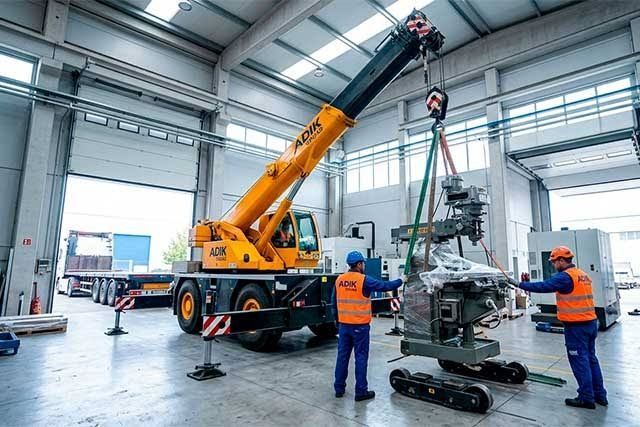
Heavy machinery movers may use several types of equipment depending on the load and environment. Heavy equipment rigging can include slings, shackles, spreader beams, hydraulic jacks, skates, gantry systems, and lifting frames.
Common Types of Industrial Relocation
Factory machinery moving can involve presses, CNC machines, injection molding equipment, printing systems, generators, transformers, boilers, compressors, and production line components. Factory equipment relocation may also include delicate machines that require controlled movement to protect alignment and internal parts.
Large scale equipment relocation can be more complex because multiple machines may need to move in a planned sequence. Machinery installation and relocation may therefore include positioning, leveling, alignment, connection coordination, and testing after the equipment reaches its destination.
| Moving Activity | Typical Equipment | Main Planning Focus |
|---|---|---|
| Internal machine movement | Skates, forklifts, jacks | Floor capacity and clearance |
| Heavy lifting | Cranes, gantries, rigging | Load control and lifting points |
| Long-distance relocation | Heavy transport vehicles | Route access and load security |
| Factory relocation | Multiple lifting systems | Sequence and coordination |
| Final positioning | Jacks, skates, alignment tools | Accuracy and stability |
Why Heavy Industrial Moving Matters
Modern factories depend on machinery that may be difficult to replace or move without careful preparation. Industrial equipment movers work around challenges involving weight, limited space, production schedules, structural limits, and worker safety.
A poorly planned movement can damage machinery, floors, walls, utilities, or nearby equipment. It can also create risks for workers and people in surrounding areas. For this reason, heavy industrial moving depends on preparation rather than simply lifting an object and transporting it.
Protecting People and Equipment
Safety is a central part of heavy machinery relocation. Large loads can shift, rotate, or become unstable if their weight distribution is misunderstood. Rigging equipment must also match the load and intended lifting method.
Important safety considerations include:
- Confirming the weight and dimensions of the machine
- Identifying the center of gravity
- Checking lifting equipment capacity
- Keeping unauthorized people outside controlled areas
- Maintaining clear communication between team members
- Inspecting routes for obstacles and weak surfaces
- Securing loads during transportation
- Preparing procedures for unexpected conditions
Heavy equipment rigging requires particular attention because lifting forces can change as a machine moves. A load that appears stable at ground level may behave differently when suspended or moved across an uneven surface.
Supporting Factory Changes
Industrial facilities change for many reasons. A factory may reorganize its production layout, introduce different equipment, expand into another building, or consolidate operations. Industrial machinery moving allows existing equipment to be repositioned as these changes occur.
Industrial plant relocation requires broader coordination because machinery is only one part of the facility. Electrical connections, piping, ventilation, foundations, access routes, storage areas, and production sequences may also need to be considered.
A machinery relocation company may coordinate with engineers, equipment operators, transport teams, electricians, and facility managers. The exact responsibilities depend on the size and technical requirements of the project.
Reducing Disruption Through Planning
Production interruptions can affect manufacturing schedules and supply chains. Detailed planning helps teams understand which machines must move first, which areas must remain accessible, and when different activities can take place.
Heavy industrial relocation systems may use digital schedules, equipment inventories, route maps, lifting plans, and communication procedures. These tools help organize complex movements involving many people and machines.
Recent Developments in Industrial Moving
From 2024 through 2026, the general direction of heavy industrial moving has involved greater use of digital planning, automation, sensors, and data-based equipment monitoring. These developments are changing how relocation teams study loads and organize movement.
Digital Planning and 3D Site Mapping
Digital facility models are increasingly used to examine possible routes before physical movement begins. Laser scanning and 3D mapping can help identify door dimensions, ceiling heights, structural obstacles, and equipment locations.
Digital models may also support factory equipment relocation by allowing planners to compare machine dimensions with available space. This can reduce uncertainty during route planning and final positioning.
Smarter Lifting and Transport Equipment
Modern industrial equipment moving increasingly uses electronically controlled lifting systems, synchronized hydraulic equipment, and monitoring devices. Sensors can provide information about load distribution, equipment position, and operating conditions.
Self-propelled modular transporters and remotely controlled movement platforms are also associated with large scale equipment relocation. These systems can support controlled movement of very heavy loads where conventional transport arrangements may be difficult.
Greater Focus on Energy and Infrastructure Projects
Industrial relocation activity is also connected with changes in manufacturing, renewable energy, data infrastructure, battery production, and advanced manufacturing facilities. These sectors may involve transformers, generators, production modules, processing equipment, and other large components.
The current trend is toward more detailed planning before physical movement begins. Digital records, equipment inventories, risk assessments, and route studies are becoming increasingly important parts of industrial equipment moving.
Rules and Policies Affecting Industrial Moving in India
In India, heavy industrial moving may be affected by workplace safety requirements, road transport rules, factory regulations, environmental requirements, and local permissions. The exact requirements depend on the type of equipment, location, route, vehicle, and industrial activity.
Workplace and Factory Safety
Industrial workplaces are expected to manage hazards associated with lifting, material handling, machinery, and worker movement. The Occupational Safety, Health and Working Conditions Code provides a broader legal framework for occupational safety, although implementation details can depend on applicable rules and notifications.
Factories may also operate under existing state-level requirements and other applicable safety provisions. Organizations involved in factory machinery moving generally need to consider equipment condition, worker competence, controlled work areas, and safe operating procedures.
Road Transport and Oversized Loads
Heavy equipment relocation on public roads may involve vehicle dimension and weight requirements under Indian motor vehicle rules. Oversized or unusually heavy loads can require route planning and coordination with relevant authorities.
Important considerations may include:
- Vehicle dimensions and axle loads
- Bridge and road capacity
- Height restrictions
- Traffic conditions
- Movement permissions where applicable
- Load securing arrangements
- Warning signs and escort arrangements where required
Transport requirements can vary according to the load and route. Local authorities may also apply conditions for movement through certain roads or urban areas.
Environmental and Site Requirements
Industrial plant relocation may involve dismantling activities, oils, old components, packaging materials, or other industrial waste. Applicable environmental rules can influence how certain materials are handled and transferred.
Site owners may also maintain internal safety procedures for lifting, vehicle movement, access control, electrical isolation, and emergency response. These internal requirements can work alongside national and state regulations.
Tools and Resources for Planning Industrial Moves
Heavy industrial moving relies on accurate information. A combination of physical measuring tools, engineering documents, digital platforms, and planning templates can support decision-making.
Measurement and Planning Tools
Laser distance meters can help measure machine dimensions and access routes. Digital levels and alignment instruments may support machinery installation and relocation when equipment requires accurate positioning.
Common planning resources include:
- Equipment inventory templates
- Load calculation worksheets
- Route survey checklists
- Lift planning documents
- Risk assessment templates
- Equipment inspection records
- Floor layout drawings
- 3D facility models
- Project scheduling platforms
Computer-aided design platforms can help planners review factory layouts and equipment positions. Building information modeling platforms may also support coordination when machinery movement interacts with structural or building systems.
Government and Technical Resources
The Ministry of Road Transport and Highways publishes information related to road transport rules in India. State transport departments may provide information about local movement requirements and permissions.
The Ministry of Labour and Employment provides information related to occupational safety frameworks. Technical standards, equipment manuals, engineering drawings, and manufacturer documentation can also provide important information about machine weight, lifting points, dimensions, and handling requirements.
Equipment Selection Resources
Load charts are important when selecting cranes and other lifting equipment. These charts show how lifting capacity can change according to factors such as boom length, working radius, and equipment configuration.
Rigging inspection records can help track the condition of slings, shackles, lifting beams, and related components. Equipment manuals may also explain operating limits and inspection requirements.
Frequently Asked Questions
What is involved in heavy industrial moving?
Heavy industrial moving generally includes assessment, measurement, route planning, equipment preparation, lifting, rigging, transportation, positioning, and final checks. The exact process depends on the machine size, weight, location, and destination.
What equipment is used for industrial machinery moving?
Industrial machinery moving may use cranes, forklifts, hydraulic gantries, machine skates, jacks, lifting beams, slings, shackles, and specialized transport platforms. Equipment selection depends on load characteristics and site conditions.
How is heavy equipment relocation planned?
Heavy equipment relocation usually begins with collecting information about the machine and its environment. Planners examine weight, dimensions, center of gravity, lifting points, route clearance, floor capacity, transport conditions, and destination requirements.
What is the difference between factory equipment relocation and industrial plant relocation?
Factory equipment relocation generally focuses on moving one or more machines. Industrial plant relocation can involve a wider range of activities, including production lines, utilities, storage systems, supporting equipment, and coordinated movement across an entire facility.
Why is heavy equipment rigging important during machinery relocation?
Heavy equipment rigging connects the load to lifting or movement equipment. Correct rigging helps control load balance, lifting forces, movement, and positioning during heavy machinery relocation.
Conclusion
Heavy industrial moving combines equipment handling, engineering information, route planning, coordination, and safety controls. Industrial equipment movers may work with lifting systems, transport equipment, digital planning tools, and detailed documentation to manage complex machinery movement. Modern heavy industrial relocation systems increasingly use digital mapping, monitoring technology, and structured planning. Regulations, equipment limits, site conditions, and load characteristics remain important factors throughout industrial machinery moving and relocation activities.