Labeling Machines Guide: Equipment Types, Processes, and Label Application
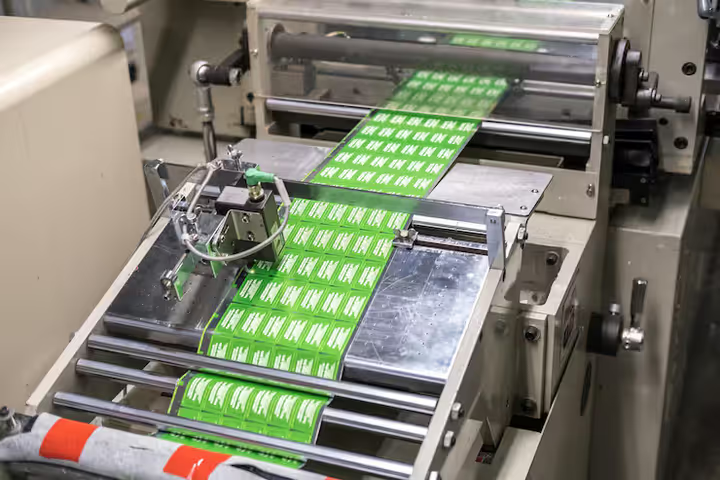
Labeling machines are automated or semi-automated systems used to apply labels to products, containers, packages, cartons, bottles, and other items.
They are widely used in food and beverage production, pharmaceuticals, cosmetics, chemicals, logistics, and general manufacturing. Depending on the application, a labeling machine may apply pressure-sensitive labels, wraparound labels, sleeve labels, or other formats with controlled positioning and repeatable movement.
Context
What Are Labeling Machines?
A labeling machine combines mechanical movement, sensors, label-handling components, and control systems to place a label onto a designated surface. The equipment can be designed for individual containers, continuous production lines, or specific packaging formats.
Manual labeling requires an operator to position each label. Semi-automatic equipment reduces some of this work, while fully automatic labeling machines can integrate with conveyors and other packaging equipment.
The basic process generally involves four stages: label feeding, product positioning, label application, and product movement. Sensors detect the product or label position, while rollers, belts, applicators, or other mechanisms place the label onto the intended area.
How Labeling Machines Developed
Early industrial labeling methods relied heavily on manual handling and mechanical equipment. As manufacturing lines became more automated, labeling equipment evolved to coordinate with filling, capping, packaging, inspection, and coding systems.
Electronic controls later allowed machines to manage timing, speed, sensor signals, and label positioning more precisely. Modern systems may also connect with programmable logic controllers and digital production controls.
Main Types of Labeling Machines
Different products require different labeling methods. Common categories include:
- Pressure-sensitive labeling machines that apply adhesive-backed labels.
- Wraparound labeling machines designed for cylindrical containers.
- Front-and-back labeling machines that place labels on multiple surfaces.
- Top labeling machines that apply labels to the upper surface of products.
- Sleeve labeling machines that place heat-shrinkable sleeves around containers.
- Roll-fed labeling machines that use continuous label material.
- Print-and-apply systems that print variable information before applying a label.
- Semi-automatic labeling machines used where production volumes or product formats vary.
The choice depends on container shape, label material, production speed, label dimensions, and the information required on the package.
Importance
Supporting Packaging Operations
Labeling is an important part of product packaging because labels can communicate information such as product identity, ingredients, handling instructions, batch references, barcodes, and regulatory information.
In a manufacturing line, labeling equipment must work in coordination with other packaging stages. If containers move at different speeds or arrive with inconsistent spacing, label placement can become irregular.
Improving Repeatability
Automated labeling machines are designed to repeat the same application process across a production run. Sensors can detect each container, while control systems coordinate the release and placement of individual labels.
Repeatability is particularly relevant when labels need to remain within a specified position on bottles, cartons, jars, boxes, or other packages.
Handling Different Product Formats
Modern production environments may process multiple container sizes and shapes. A labeling machine can sometimes be configured with adjustable guides, conveyors, applicators, and software settings to accommodate different formats.
Changeover procedures are therefore an important part of equipment operation. Operators may need to adjust product guides, label positions, sensor locations, or machine settings when switching between products.
Common Applications
| Industry | Typical products | Common labeling requirements |
|---|---|---|
| Food and beverage | Bottles, jars, cans, cartons | Product information, ingredients, barcodes |
| Pharmaceuticals | Bottles, boxes, containers | Identification, dosage information, tracking data |
| Cosmetics | Bottles, tubes, jars | Product details and regulatory information |
| Chemicals | Containers, drums, bottles | Identification and handling information |
| Logistics | Cartons and parcels | Tracking and routing information |
| Consumer goods | Boxes, containers, packages | Product identification and barcodes |
Recent Updates
Greater Use of Automated Controls
From 2024 through 2026, labeling equipment has continued to incorporate electronic controls, digital interfaces, and sensor-based monitoring. These features can make it easier to configure operating parameters such as conveyor speed, label spacing, and application timing.
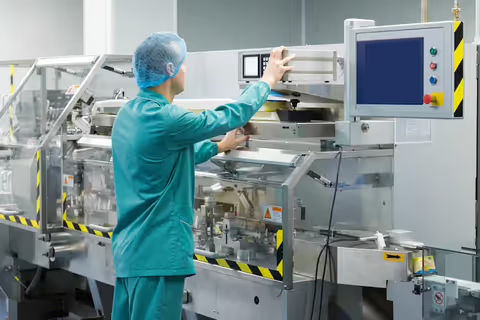
Many systems now use touchscreen interfaces that display operating information and machine conditions. The level of automation varies considerably between equipment types.
Vision-Based Inspection
Camera-based inspection has become more common in automated packaging environments. A vision system can examine whether a label is present, whether its position falls within a defined range, or whether printed information appears correctly.
These systems can work alongside barcode readers and other inspection devices. Their role is generally to identify deviations rather than replace all forms of quality control.
Flexible Production
Manufacturers increasingly handle multiple product formats on the same production line. This has encouraged the development of labeling systems with adjustable components and electronically stored machine settings.
Some systems can recall previously configured parameters for different products. The actual changeover process still depends on machine design, container geometry, label material, and the level of automation.
Digital Production Monitoring
Labeling machines can also be connected to broader manufacturing control systems. Data may include production counts, machine status, fault notifications, and other operating information.
Integration with manufacturing systems can help facilities understand equipment activity and identify recurring interruptions. Data quality depends on the sensors, software, network, and configuration used.
More Attention to Material Use
Labeling operations can generate waste when labels are incorrectly positioned, rejected, or interrupted during production. Equipment design increasingly considers accurate label feeding, controlled application, and material handling to reduce unnecessary waste.
Material selection also affects performance. Label adhesive, liner construction, surface texture, temperature, moisture, and container shape can influence how a label behaves during application.
Laws or Policies
Packaging and Labeling Rules
Labeling requirements vary according to the country, industry, and type of product. In the United States, federal agencies such as the Food and Drug Administration, Federal Trade Commission, and Department of Agriculture have responsibilities related to specific categories of product labeling.
For example, food, pharmaceutical, cosmetic, and agricultural products can have different labeling requirements. Information may include product identity, ingredients, quantity, manufacturer details, warnings, or other regulated information.
Barcode and Identification Standards
Barcodes are commonly used for product identification and logistics. Organizations such as GS1 maintain standards for product identification, barcode formats, and related data structures.
A labeling machine used for barcode applications must place the code in a way that allows appropriate scanning. Printing quality, contrast, positioning, and surface characteristics can influence readability.
Workplace Safety
Labeling equipment also falls within general workplace safety requirements. In the United States, OSHA requirements may apply to machine guarding, electrical safety, hazardous energy control, and other workplace conditions.
Operators should follow the equipment documentation and applicable workplace rules. Requirements can vary according to the machine, facility, materials, and operating environment.
Environmental and Material Rules
Packaging labels can also be affected by environmental regulations and material policies. Requirements may concern packaging materials, chemical substances, waste handling, or recycling practices.
Because these rules vary by jurisdiction, manufacturers generally need to evaluate the specific requirements that apply to their products and locations.
Tools and Resources
Label Design Software
Label design applications allow users to create layouts containing text, graphics, barcodes, variable information, and other elements. Some systems can connect directly with industrial printers and labeling equipment.
The selected software should match the label format, printer technology, barcode requirements, and production workflow.
Barcode Verification Tools
Barcode verification equipment can assess whether a printed barcode meets relevant technical requirements. These tools can examine characteristics such as contrast, dimensions, symbol structure, and readability.
Verification is different from simply scanning a barcode. A scanner determines whether it can read a code, while verification evaluates the printed symbol against defined criteria.
Machine Manuals and Technical Documentation
Equipment manuals provide information about machine settings, label threading, sensor adjustment, cleaning procedures, and routine inspection. Technical drawings may also show conveyor dimensions, mounting points, and component locations.
Production Monitoring Systems
Manufacturing control systems can collect information from labeling equipment and other packaging machinery. Common technologies include PLCs, human-machine interfaces, SCADA platforms, barcode readers, and industrial communication protocols.
These tools can help operators monitor production conditions and identify equipment interruptions.
FAQs
What are labeling machines used for?
Labeling machines apply labels to products, containers, cartons, packages, and other surfaces. They are used for product identification, regulatory information, barcodes, tracking data, and packaging information.
What are the main types of labeling machines?
Common types include pressure-sensitive, wraparound, front-and-back, top, sleeve, roll-fed, and print-and-apply labeling machines. Each type is designed around particular container shapes, label materials, and application methods.
How do automatic labeling machines work?
Automatic labeling machines typically use conveyors, sensors, label-feeding mechanisms, and applicators. A sensor detects the product, the control system coordinates label release, and an applicator places the label onto the designated surface.
Can labeling machines handle different product sizes?
Many labeling machines can accommodate multiple product sizes through adjustable guides, conveyors, applicators, or electronic settings. The practical range depends on the machine design and differences between the products.
How are labels checked after application?
Labels may be checked visually or with camera-based inspection systems. Automated inspection can detect issues such as missing labels, incorrect positioning, or certain printing errors, depending on the system configuration.
Conclusion
Labeling machines combine mechanical handling, sensors, controls, and application technologies to place labels onto products and packages. Their design varies according to container shape, label material, production requirements, and the information being applied. Recent developments have increased the use of digital controls, vision inspection, flexible changeover systems, and production monitoring. Regulatory requirements also influence labeling content, barcode use, workplace safety, and packaging practices across different industries.