Machine Vision Systems for Quality Inspection: Guide
Quality inspection plays a critical role in modern manufacturing.
Products must meet strict quality standards before reaching customers, and even small defects can affect performance, safety, and reliability.
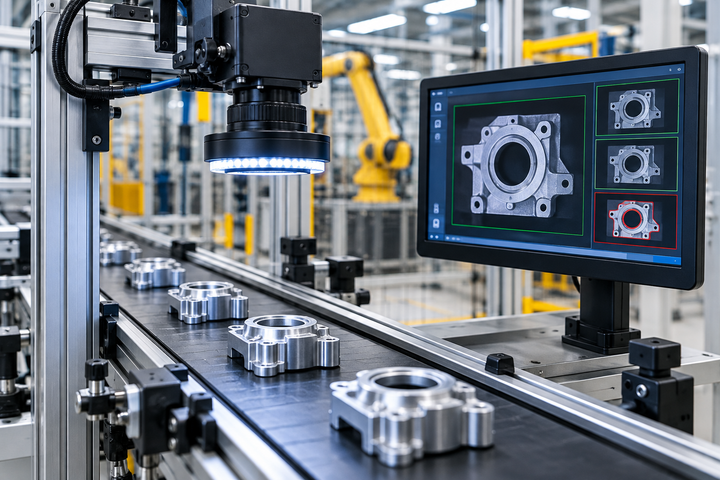
Traditional visual inspection often relies on human operators. While effective in some situations, manual inspection can become difficult in high-speed production environments. Machine vision systems help solve this challenge by using cameras, sensors, lighting, and intelligent image analysis to inspect products automatically. These systems can examine every item moving through a production line and identify defects in real time.
As manufacturing continues to embrace Industry 4.0 technologies, machine vision has become a key component of automated quality inspection.
Quick Facts About Machine Vision Systems
| Feature | Description |
|---|---|
| Primary Purpose | Automated quality inspection |
| Core Components | Cameras, lighting, optics, processing system |
| Inspection Speed | Real-time operation |
| Common Industries | Automotive, electronics, food processing, pharmaceuticals |
| Inspection Method | Image-based analysis |
| Key Advantage | Consistent inspection accuracy |
| Integration | Production lines and robotic systems |
| Technology Trend | AI-powered defect detection |
What Are Machine Vision Systems?
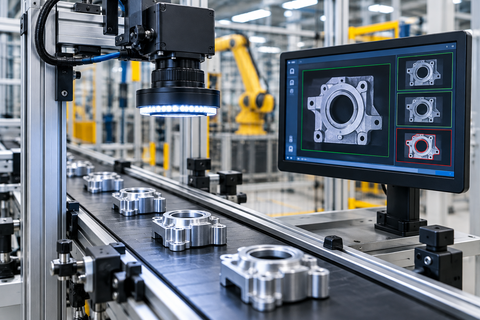
A machine vision system is an automated inspection solution that captures images of products and analyzes them to make quality decisions. The system determines whether a product passes inspection, requires further review, or should be rejected.
Unlike manual inspection, machine vision systems can continuously inspect products without fatigue. This makes them particularly useful for high-volume manufacturing environments where speed and consistency are essential.
For example, an electronics manufacturer may use machine vision to inspect circuit boards for missing components, alignment issues, or soldering defects before final assembly.
Understanding the Concept
Machine vision combines imaging technology and automated analysis.
The process involves:
- Capturing an image of a product.
- Processing the image.
- Comparing the image against predefined standards.
- Identifying defects or variations.
- Triggering an action based on inspection results.
Modern systems can inspect dimensions, colors, labels, shapes, assembly accuracy, and surface quality.
Machine Vision System Architecture
Understanding system architecture helps explain how automated inspection works.
Image Acquisition Layer
This layer captures images using industrial cameras.
Lighting Layer
Specialized lighting ensures defects are visible and images remain consistent.
Optics Layer
Lenses focus and direct images toward sensors.
Processing Layer
Computers or embedded processors analyze captured images.
Decision Layer
The system determines whether a product passes or fails inspection.
Communication Layer
Inspection results are sent to production equipment, control systems, or operators.
Main Components of a Machine Vision System
| Component | Function |
|---|---|
| Camera | Captures product images |
| Lens | Focuses image details |
| Lighting | Enhances visibility |
| Sensor | Converts images into data |
| Processor | Performs analysis |
| Inspection Algorithms | Detect defects |
| Communication Interface | Transfers inspection results |
Types of Machine Vision Systems
2D Vision Systems
These systems inspect flat images and are commonly used for labels, packaging, and printed materials.
Typical Applications
- Barcode verification
- Label inspection
- Surface inspection
- Dimensional checks
3D Vision Systems
3D systems capture depth information in addition to standard images.
Typical Applications
- Shape verification
- Volume measurement
- Surface profile analysis
AI-Powered Vision Systems
Artificial intelligence improves the system's ability to identify complex defect patterns.
Thermal Vision Systems
These systems detect heat-related abnormalities.
Hyperspectral Vision Systems
Used for advanced material inspection and identification.
Machine Vision Technology Comparison
| Vision Type | Primary Purpose | Common Application |
|---|---|---|
| 2D Vision | Surface inspection | Labels and packaging |
| 3D Vision | Depth analysis | Dimensional inspection |
| Thermal Vision | Heat monitoring | Equipment inspection |
| AI Vision | Complex defect detection | Advanced quality control |
| Hyperspectral Vision | Material identification | Specialized manufacturing |
How Machine Vision Systems Work
Step 1: Product Positioning
The product moves into the inspection area.
Step 2: Image Capture
Cameras capture images under controlled lighting.
Step 3: Image Processing
The system analyzes image data.
Step 4: Feature Extraction
Important characteristics are identified.
Step 5: Defect Detection
The system searches for abnormalities.
Step 6: Decision Making
Products are classified as acceptable or defective.
Step 7: Production Response
The production system responds according to inspection results.
Quality Inspection Tasks Performed by Machine Vision
| Inspection Task | Purpose |
|---|---|
| Surface Defect Detection | Identify scratches and marks |
| Dimensional Measurement | Verify dimensions |
| Presence Verification | Confirm required parts |
| Alignment Inspection | Check positioning |
| Barcode Reading | Verify product information |
| Label Inspection | Confirm accuracy |
| Color Verification | Detect inconsistencies |
| Assembly Validation | Ensure correct assembly |
Benefits and Advantages
Improved Inspection Consistency
Machine vision systems perform inspections using the same criteria every time.
Faster Inspection Speed
Automated systems can inspect products at production-line speeds.
Reduced Human Error
Automated analysis reduces variability caused by fatigue.
Enhanced Traceability
Inspection results can be stored for future analysis.
Better Production Efficiency
Defects can be detected before products move further through production.
Support for Industry 4.0
Machine vision systems integrate well with connected manufacturing environments.
Real-World Applications
Automotive Manufacturing
Inspection of welds, components, and assemblies.
Electronics Manufacturing
Detection of missing components and soldering defects.
Pharmaceutical Packaging
Verification of labels and packaging integrity.
Food Processing
Inspection of packaging quality and product appearance.
Consumer Goods Production
Monitoring product consistency and appearance.
Metal Fabrication
Inspection of dimensions and surface quality.
Industry Applications Overview
| Industry | Inspection Focus |
|---|---|
| Automotive | Components and assemblies |
| Electronics | Circuit boards and connectors |
| Food Processing | Packaging and labeling |
| Pharmaceuticals | Product verification |
| Packaging | Print and barcode quality |
| Manufacturing | Surface and dimensional inspection |
AI and Deep Learning in Quality Inspection
Artificial intelligence is transforming machine vision systems.
Traditional systems rely on predefined rules. AI-powered systems can learn from large image datasets and identify more complex defect patterns. This makes them useful for inspections involving subtle defects, variable products, and changing production conditions.
Common AI Applications
- Defect classification
- Surface anomaly detection
- Pattern recognition
- Predictive quality analysis
- Automated sorting
Environmental Considerations
Machine vision systems can contribute to more efficient manufacturing processes.
Reduced Material Waste
Early defect detection helps reduce scrap production.
Improved Resource Utilization
Manufacturers can identify process issues before they affect large batches.
Better Process Optimization
Continuous monitoring helps improve production efficiency.
Industry Standards and Safety
Machine vision systems are commonly deployed in industries with strict quality and compliance requirements.
Inspection Consistency
Automated systems help maintain repeatable inspection processes.
Production Documentation
Inspection records support traceability requirements.
Process Monitoring
Continuous monitoring helps identify production variations.
Safety Support
Automated inspection reduces the need for manual checks in hazardous areas.
Common Challenges and Solutions
| Challenge | Practical Solution |
|---|---|
| Lighting Variations | Use controlled illumination |
| Reflective Surfaces | Apply specialized lighting |
| Complex Defects | Utilize AI-based analysis |
| High Production Speed | Deploy faster processing systems |
| Product Variations | Train adaptive inspection models |
| Data Quality Issues | Improve image acquisition |
Maintenance Schedule
| Maintenance Task | Frequency |
|---|---|
| Camera Cleaning | Weekly |
| Lens Inspection | Weekly |
| Lighting Check | Monthly |
| Sensor Calibration | Monthly |
| System Diagnostics | Monthly |
| Performance Review | Quarterly |
Best Practices
Optimize Lighting Conditions
Proper lighting is essential for accurate inspection.
Maintain Clean Optics
Clean lenses help ensure image quality.
Regular Calibration
Periodic calibration maintains measurement accuracy.
Monitor Inspection Performance
Review inspection results regularly.
Update AI Models
Retrain models when production conditions change.
Expert Insights
Industry experts consider lighting one of the most important factors in machine vision performance. Even advanced cameras and AI systems can struggle if image quality is poor. Successful implementations typically focus on proper lighting, stable positioning, high-quality image acquisition, and reliable integration with manufacturing equipment.
Key Facts About Machine Vision Systems
- Machine vision systems inspect products using cameras and automated analysis.
- AI-powered inspection is becoming increasingly common in manufacturing.
- Machine vision supports real-time quality control.
- Modern systems can inspect every product rather than relying on sampling.
- Industries including automotive, electronics, food processing, and pharmaceuticals widely use machine vision technology.
Future Trends and Industry Insights
AI-Driven Inspection
Artificial intelligence will continue improving defect detection capabilities.
Edge Computing
More processing will occur directly at inspection stations.
Advanced 3D Imaging
Three-dimensional inspection technologies will become more common.
Robotic Integration
Machine vision and robotics will increasingly work together.
Smart Manufacturing Connectivity
Machine vision systems will play a larger role in connected production environments.
Frequently Asked Questions
What is a machine vision system?
An automated inspection system that uses cameras and image analysis to evaluate products.
How does machine vision improve quality inspection?
It enables fast, consistent, and automated inspection of products.
What industries use machine vision systems?
Automotive, electronics, food processing, pharmaceuticals, packaging, and manufacturing.
What is the difference between 2D and 3D vision?
2D systems analyze flat images, while 3D systems capture depth information.
Why is lighting important?
Lighting helps ensure defects are visible and inspection results remain consistent.
Can AI improve machine vision?
Yes. AI can identify complex defect patterns that are difficult to define with traditional rules.
What defects can machine vision detect?
Scratches, cracks, missing parts, alignment errors, label issues, dimensional variations, and surface defects.
What is real-time inspection?
Inspection performed immediately as products move through production.
What are the main system components?
Cameras, lenses, lighting, processors, sensors, and inspection algorithms.
What is the future of machine vision?
AI, edge computing, advanced imaging, and deeper Industry 4.0 integration.
Conclusion
Machine vision systems have become a vital part of modern quality inspection. By combining cameras, lighting, image processing, and intelligent analysis, these systems help manufacturers improve consistency, reduce defects, enhance traceability, and support efficient production.
As technologies such as artificial intelligence, deep learning, edge computing, and 3D imaging continue to advance, machine vision systems are expected to play an even larger role in automated quality assurance across a wide range of industries.