Production Tech: An Informative Guide to Types, Features, and Industrial Applications
Production Tech refers to the technologies, equipment, software, and processes used to plan, control, monitor, and improve the production of physical goods.
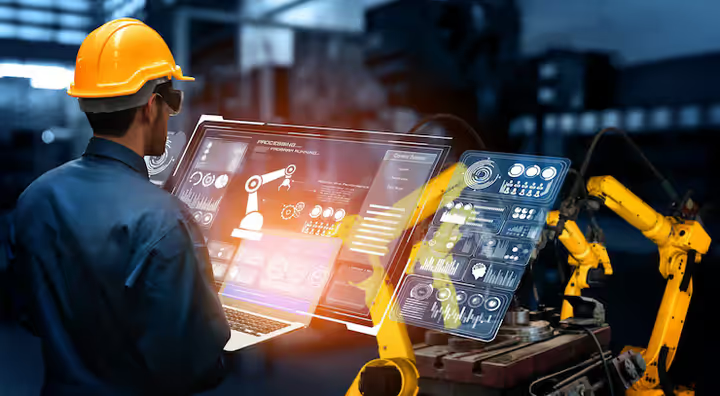
It includes manufacturing machinery, industrial automation, robotics, sensors, production software, data systems, and digital tools that connect different stages of an industrial process.
The idea developed from the long history of manufacturing technology. Early production relied heavily on manual work and simple mechanical tools. Over time, machines, electrical systems, programmable controls, computers, and digital networks changed how factories organized and monitored production.
How Production Tech Developed
The Industrial Revolution introduced mechanized production and changed the scale at which goods could be manufactured. Later developments in electrical motors, assembly lines, numerical control, and programmable logic controllers introduced greater levels of automation.
The arrival of computers brought digital planning, computer-aided design, manufacturing software, and computerized monitoring. Today, Production Tech increasingly combines physical machinery with connected sensors, software, data analytics, artificial intelligence, and cloud or edge computing.
Main Elements of Production Tech
Production Tech is not one specific machine or software platform. It is a broad category that can include:
- Automated production machinery
- Robotics and industrial manipulators
- Programmable logic controllers
- Sensors and measurement systems
- Manufacturing execution systems
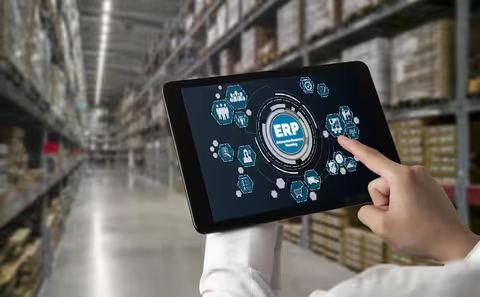
- Enterprise resource planning systems
- Industrial communication networks
- Machine vision
- Artificial intelligence and machine learning
- Digital twins and simulation
- Additive manufacturing equipment
- Energy and environmental monitoring systems
These technologies can work independently or as connected parts of a larger production environment.
How a Modern Production System Works
A modern production system usually begins with a product specification and production plan. Materials move through different stages while machines and sensors collect information about quantities, quality, operating conditions, and production status.
Controllers can manage machine actions, while software records and analyzes production information. Operators and engineers can use this information to understand what is happening on the production floor and compare actual results with planned conditions.
Importance
Production Tech is important because manufacturing processes involve many interconnected activities. A change in machine speed, material quality, temperature, tooling condition, or production sequence can affect the final product.
Digital technologies provide ways to measure these conditions and coordinate production activities. This can be particularly relevant to manufacturers working with complex machinery, large production volumes, strict quality requirements, or multiple production stages.
Improving Production Visibility
Traditional production environments may depend on manual records and periodic inspections. Connected systems can collect information continuously from machines and production equipment.
This information can help identify patterns in machine operation, production output, energy use, and quality measurements. Better visibility can also help personnel understand where delays or process variations occur.
Supporting Quality Control
Quality control is another important area of Production Tech. Sensors, measurement instruments, and machine vision systems can examine products or process conditions during manufacturing.
Machine vision, for example, uses cameras and image-processing software to identify specific visual characteristics. Other systems can measure dimensions, temperature, pressure, weight, electrical properties, or surface conditions.
Production Tech and Resource Management
Production requires materials, electricity, water, compressed air, labor, machinery, and other resources. Digital production systems can record how these resources are used across different processes.
| Production technology | Main function | Typical information |
|---|---|---|
| PLC | Machine control | Inputs, outputs, operating states |
| Industrial robot | Automated movement | Position, speed, task sequence |
| Machine vision | Visual inspection | Images, dimensions, classifications |
| MES | Production coordination | Work orders, production status, quality data |
| ERP | Business planning | Materials, inventory, production planning |
| IoT sensors | Data collection | Temperature, vibration, pressure |
| Digital twin | Virtual representation | Process and equipment behavior |
| AI analytics | Pattern analysis | Predictions, anomalies, trends |
Challenges in Production Technology
Modernization also introduces challenges. Different machines may use different communication protocols, data formats, and control architectures. Older equipment may not have built-in connectivity and may require additional measurement or communication components.
Cybersecurity is another consideration because connected production equipment can become part of a larger digital network. Data quality, employee training, system integration, maintenance, and appropriate human oversight also influence how production technologies perform in practice.
Recent Updates
Current Production Tech trends are centered around connected manufacturing, intelligent automation, data analysis, energy monitoring, and flexible production systems. Technologies that were previously used separately are increasingly being connected through industrial networks and software platforms.
Artificial Intelligence in Production
Artificial intelligence is being applied to areas such as quality inspection, equipment monitoring, production analysis, demand forecasting, and process analysis. Machine learning models can examine historical and real-time data to identify patterns.
AI can also be combined with computer vision to classify images or identify defined visual characteristics. The accuracy of an AI application depends on factors such as training data, environmental conditions, model design, and validation.
Industrial Internet of Things
The Industrial Internet of Things connects machines, sensors, controllers, and software systems so that operational information can be collected and exchanged. Sensors may measure vibration, temperature, pressure, current, flow, humidity, or other variables.
Edge computing is increasingly used alongside industrial connectivity. Instead of transferring every measurement to a remote computing environment, some information can be processed close to the equipment where it is generated.
Digital Twins and Simulation
Digital twins use digital models and operational information to represent physical equipment or processes. Engineers can use simulations to examine process behavior and evaluate potential changes in a controlled digital environment.
A digital twin is dependent on the quality of its underlying data and mathematical models. It should therefore be treated as a representation rather than an exact copy of every physical condition.
Flexible and Connected Manufacturing
Production environments are also becoming more adaptable through programmable machinery, robotics, modular equipment, and digital production planning. These technologies can help manufacturers manage different product configurations without relying entirely on fixed mechanical arrangements.
Cloud and edge technologies are also being combined with manufacturing systems. The choice between local and remote processing depends on data requirements, network conditions, cybersecurity considerations, and operational needs.
Energy and Environmental Monitoring
Energy monitoring has become an important part of modern production management. Sensors and digital meters can track electricity, gas, compressed air, water, and other resource usage.
Production teams can compare resource consumption with machine activity and production output. This creates data that can be used for operational analysis and environmental reporting.
Laws or Policies
In India, Production Tech is influenced by industrial safety rules, electrical requirements, environmental regulations, data-related laws, and technical standards. The specific requirements depend on the type of factory, machinery, materials, workplace conditions, and production activity.
Industrial and Workplace Requirements
Factories are subject to applicable occupational safety and working-condition requirements. The Occupational Safety, Health and Working Conditions Code, 2020 forms part of India's framework for workplace health and safety, while implementation and applicable requirements depend on the relevant legal framework and authorities.
Machinery can also be subject to technical standards concerning electrical safety, machine protection, electromagnetic compatibility, and control systems. The Bureau of Indian Standards publishes standards relevant to many industrial technologies.
Environmental Requirements
Production facilities may need to comply with environmental requirements concerning emissions, wastewater, hazardous materials, waste handling, and resource use. The Ministry of Environment, Forest and Climate Change, Central Pollution Control Board, and State Pollution Control Boards have roles within India's environmental regulatory framework.
The requirements vary by industry and facility. Manufacturing organizations therefore need to identify the rules applicable to their specific processes and location.
Digital and Data Considerations
Connected Production Tech may involve digital records, employee information, equipment information, or other data. Where personal data is processed digitally, India's Digital Personal Data Protection Act, 2023 may become relevant.
Cybersecurity considerations also apply to connected industrial systems. Technical frameworks such as IEC 62443 can be used as references for industrial automation and control-system cybersecurity.
Tools and Resources
Production Tech involves a combination of physical equipment, software, measurement systems, and technical references. The appropriate tools depend on the production process and the type of information being collected.
Production and Engineering Tools
Common tools include:
- CAD software for product and component design
- CAM software for computer-controlled manufacturing
- PLC programming environments
- SCADA systems for industrial monitoring
- MES platforms for production coordination
- ERP platforms for planning and inventory records
- Industrial IoT gateways for data collection
- Machine vision software for image analysis
- Simulation software for process modeling
- Digital dashboards for production data visualization
Measurement instruments such as calipers, coordinate measuring machines, temperature sensors, pressure gauges, vibration analyzers, and electrical meters can also contribute to production data collection.
Technical References
Useful reference sources include:
- Bureau of Indian Standards
- Ministry of Electronics and Information Technology
- Ministry of Labour and Employment
- Central Pollution Control Board
- State Pollution Control Boards
- International Organization for Standardization
- International Electrotechnical Commission
- National Institute of Standards and Technology
Production teams can also use equipment manuals, process documentation, maintenance records, control-system diagrams, data dictionaries, and risk-assessment templates when evaluating a technology.
Evaluating Production Technology
A structured evaluation can examine several factors:
- Production requirements
- Machine compatibility
- Data availability
- Measurement accuracy
- System integration
- Cybersecurity
- Operator interaction
- Maintenance requirements
- Environmental conditions
- Regulatory requirements
- Scalability and future system changes
These factors help establish whether a particular technology is technically appropriate for a defined production environment.
FAQs
What is Production Tech?
Production Tech is the broad group of machines, software, automation systems, sensors, robotics, data platforms, and digital technologies used to manage and monitor production processes. It connects physical manufacturing activities with measurement and digital information.
What are the main applications of Production Tech?
Production Tech is used for machine control, quality inspection, production planning, equipment monitoring, inventory coordination, process analysis, robotics, energy monitoring, and production data management.
How does artificial intelligence fit into Production Tech?
Artificial intelligence can analyze production data, identify patterns, classify images, detect unusual equipment behavior, and support process analysis. Its role depends on data quality, model validation, operating conditions, and the specific production task.
What is the role of IoT in Production Tech?
Industrial IoT connects sensors, machines, controllers, and software systems so that operational data can be collected and analyzed. It can provide information about machine conditions, production activity, energy use, and environmental measurements.
What are the challenges of implementing Production Tech?
Common challenges include integrating older equipment with newer systems, maintaining data quality, protecting connected systems, training personnel, managing system complexity, and meeting applicable safety and regulatory requirements.
Conclusion
Production Tech combines manufacturing equipment, automation, software, sensors, robotics, and digital analysis to manage modern production environments. Its development has moved from mechanical and electrical automation toward connected systems that can collect, analyze, and exchange operational information. Current trends include artificial intelligence, industrial IoT, digital twins, edge computing, machine vision, and energy monitoring. Effective industrial technology depends on suitable system design, reliable data, cybersecurity, appropriate human oversight, and compliance with applicable requirements.