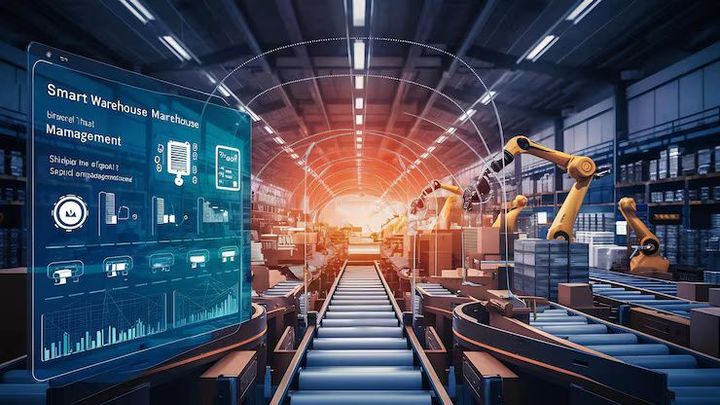
Smart Factory Growth Guide: Explore Automation, IoT, Data, AI, and Planning Factors
A smart factory is a manufacturing environment that combines automation, connected equipment, sensors, software, data analytics, and artificial intelligence (AI) to monitor and manage production activities. A smart factory growth guide helps explain how these technologies work together and what planning factors organizations consider when moving from conventional production systems toward more connected operations.
The concept developed from earlier stages of industrial automation and became closely associated with Industry 4.0. Traditional factories often operated machines, production systems, and business software as separate systems. Smart manufacturing connects more of these layers so that information can move between equipment, production processes, quality systems, supply chains, and management platforms.
Main Technologies in a Smart Factory
A smart factory can contain several interconnected technologies:
- Industrial automation controls machines and repetitive production activities.
- Industrial Internet of Things (IIoT) connects machines, sensors, and other equipment.
- Data platforms collect and organize information from production systems.
- Cloud and edge computing provide different ways to process and store industrial data.
- AI and machine learning analyze data and identify patterns.
- Robotics can perform repetitive, precise, or physically demanding activities.
- Digital twins represent physical equipment or processes in a digital environment.
These technologies do not necessarily need to be introduced simultaneously. A factory may begin with machine monitoring or data collection and gradually add analytics, automation, robotics, and AI.
From Automation to Intelligent Manufacturing
Automation generally focuses on executing predefined tasks with limited human intervention. Smart manufacturing expands this concept by connecting automated equipment with data and analytical systems.
For example, sensors can collect information about temperature, vibration, pressure, energy consumption, or production conditions. That information can then be analyzed to identify unusual patterns or support production planning. The exact capabilities depend on the equipment, software, data quality, and factory configuration.
Importance
Smart factory development matters because manufacturing operations generate large quantities of information while production systems are becoming more interconnected. Organizations need ways to understand this information and coordinate machines, people, materials, and processes.
Smart manufacturing can also address challenges associated with aging equipment, fragmented data, changing production requirements, quality monitoring, energy management, and supply-chain uncertainty. However, technology alone does not resolve these challenges. Successful implementation also depends on planning, workforce capabilities, cybersecurity, data governance, and compatibility between systems.
Why Data Matters
Data is one of the central elements of a smart factory. Machines and sensors can generate information continuously, but raw data has limited value if it is inaccurate, incomplete, poorly organized, or difficult to access.
Useful manufacturing data may include:
- Machine operating conditions
- Production quantities
- Quality measurements
- Equipment alarms
- Energy consumption
- Maintenance records
- Material movement
- Inventory information
- Environmental measurements
Organizing this information can help production teams understand what is happening across different parts of a facility.
Role of Automation and IoT
Automation provides the physical and control foundation for many smart factories. Programmable logic controllers, industrial robots, variable-speed drives, sensors, machine vision systems, and automated material-handling equipment can all form part of an automated production environment.
IoT adds connectivity by allowing equipment and sensors to exchange information with monitoring and analytical platforms. This creates greater visibility into production conditions and can provide data for analytics and AI applications.
Role of Artificial Intelligence
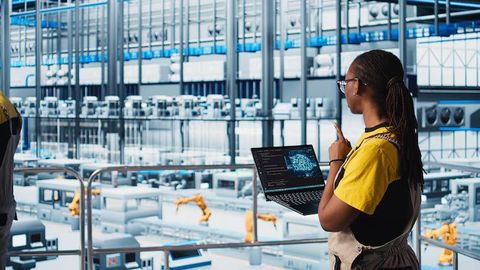
AI can analyze large datasets and support tasks such as anomaly detection, quality analysis, demand forecasting, predictive maintenance, production scheduling, and process optimization.
The 2026 NIST roadmap for AI and machine learning in smart manufacturing identifies industrial big-data analytics, advanced sensing, autonomous systems, digital twins, robotics, supply-chain optimization, and sustainable manufacturing among important application areas. It also identifies data management, system integration, reliability, explainability, and trustworthy operation as continuing challenges.
Recent Updates
From 2024 through 2026, smart factory development has increasingly shifted from isolated technology experiments toward integrated platforms combining automation, IoT, data, cloud or edge computing, and AI. Current industry research also shows growing attention to digital twins, robotics, cybersecurity, and human-machine collaboration.
The 2026 NIST roadmap describes generative AI, agentic AI, industrial large language models, foundation models, advanced digital twins, explainable AI, and physics-informed AI as emerging areas for manufacturing.
AI and Data Integration
Recent manufacturing strategies increasingly treat data infrastructure as a foundation for AI. AI systems depend on reliable information from machines, sensors, production software, and other sources.
A 2026 KPMG report on industrial manufacturing found that organizations are expanding AI use while also identifying unreliable data as an important AI risk. The report also highlights interoperability, data foundations, cybersecurity, and workforce skills as major considerations for scaling advanced technologies.
Digital Twins and Connected Operations
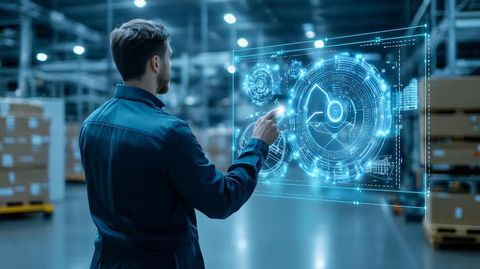
Digital twins are becoming more closely connected with production data. A digital twin can represent equipment, production processes, or other physical assets in a digital environment and can be updated using operational information.
Current manufacturing discussions also emphasize connecting engineering, production, quality, supply-chain, and operational information. This can provide a more complete view of how changes in one part of the manufacturing system affect other areas.
Human and AI Collaboration
Smart factories are not necessarily designed around removing people from production. Current approaches increasingly focus on combining human expertise with automation, analytical tools, robotics, and AI assistants.
Workforce training is therefore an important planning factor. Employees may need knowledge of industrial data, automated equipment, cybersecurity, software systems, and AI-assisted workflows as manufacturing environments become more connected.
Laws or Policies
In India, smart factory development is influenced by industrial, technology, cybersecurity, environmental, workplace-safety, and data-related requirements. The specific rules that apply depend on the industry, type of facility, information being processed, machinery involved, and location of the operation.
The Occupational Safety, Health and Working Conditions Code provides a broader framework for occupational safety and working conditions. Manufacturing organizations must also consider applicable state-level requirements, factory rules, environmental requirements, and machinery-safety provisions.
For digital systems, organizations operating connected factories should also consider India's Information Technology Act and the Digital Personal Data Protection Act, 2023 where applicable. The relevance of data-protection requirements depends on whether personal data is collected or processed.
Cybersecurity is another important consideration because connected industrial systems can create additional digital access points. Factories may need controls covering network access, authentication, system monitoring, software updates, backups, and incident response.
Government initiatives related to manufacturing and digital transformation can also influence technology adoption. Programs associated with Make in India, industrial digitization, electronics manufacturing, and production-linked incentives have contributed to broader investment in manufacturing capabilities, although eligibility and requirements vary by program.
Regulatory requirements can change, so organizations should verify the rules applicable to their specific facility and industry rather than relying only on general information.
Tools and Resources
Several types of tools can help organizations understand and plan smart factory development.
Industrial Monitoring Platforms
Manufacturing execution systems, supervisory control and data acquisition platforms, industrial IoT platforms, and computerized maintenance systems can collect and organize operational information. Their functions vary, but they can provide information about production, equipment, maintenance, and process conditions.
Data and Analytics Tools
Data historians, dashboards, databases, cloud platforms, edge-computing systems, and analytics software can help transform machine information into usable reports and analysis.
Analytics projects commonly examine measurements such as production output, equipment status, quality indicators, energy use, downtime patterns, and process conditions.
Planning Frameworks
A smart factory planning framework can examine several areas before technology is introduced:
| Planning area | Key considerations |
|---|---|
| Automation | Existing controls, robotics, machine capabilities |
| Connectivity | Industrial networks, protocols, IoT architecture |
| Data | Quality, storage, access, ownership, governance |
| AI | Use case, data requirements, validation, monitoring |
| Cybersecurity | Access controls, segmentation, detection, recovery |
| Workforce | Training, technical skills, human-machine interaction |
| Infrastructure | Edge computing, cloud systems, servers, networks |
| Integration | Compatibility between production and business systems |
| Sustainability | Energy monitoring, resource use, waste management |
| Measurement | Operational indicators and implementation progress |
Standards and Industry Resources
Technical standards, government portals, manufacturing research organizations, and equipment documentation can provide additional information. Standards can help organizations understand terminology, interoperability, safety, cybersecurity, and industrial communication requirements.
Machine and software documentation is also important because different equipment may use different communication protocols, data structures, interfaces, and security features.
FAQs
What is a smart factory?
A smart factory is a connected manufacturing environment that combines automation, sensors, industrial IoT, data systems, analytics, and other digital technologies to monitor and manage production activities.
How does IoT support smart factory growth?
IoT connects machines, sensors, equipment, and other assets so they can generate and exchange operational information. This data can support monitoring, analytics, maintenance planning, quality analysis, and production management.
What role does AI play in a smart factory?
AI can analyze manufacturing data to identify patterns, detect anomalies, support forecasting, assist quality analysis, and help with planning or optimization. Its usefulness depends heavily on data quality, system integration, and appropriate validation.
What factors should be considered when planning a smart factory?
Important factors include existing automation, data quality, connectivity, cybersecurity, system compatibility, workforce skills, infrastructure, production objectives, regulatory requirements, and methods for measuring progress.
Are smart factories fully automated?
No. A smart factory does not necessarily operate without people. Human workers can remain responsible for supervision, decision-making, maintenance, engineering, quality management, safety, and other activities while automated systems handle selected processes.
Conclusion
Smart factory growth involves connecting automation, IoT, data, AI, software, and physical production systems into a more integrated manufacturing environment. Current developments are placing greater emphasis on reliable data, digital twins, AI, cybersecurity, interoperability, and human-machine collaboration. Planning should consider technology capabilities as well as workforce requirements, safety, regulatory obligations, infrastructure, and data governance. The transition can occur through different stages depending on the existing equipment, production processes, and operational objectives.