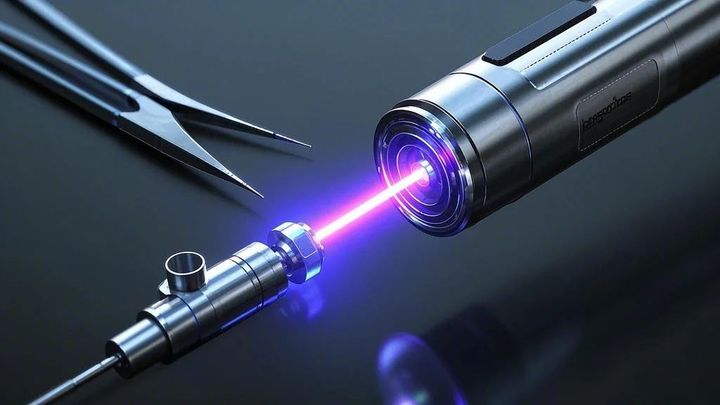
UV Laser Technology Explained: Working, Applications, Types, and Benefits
UV laser technology is a precision laser-processing method that uses ultraviolet light to interact with materials in a highly controlled area.
UV lasers are widely associated with applications that require fine features, limited thermal impact, accurate marking, and precise material processing.
Unlike many infrared laser processes, ultraviolet wavelengths can be strongly absorbed by numerous materials. This allows energy to be concentrated close to the material surface and can reduce unwanted heat transfer into surrounding areas. For this reason, UV laser systems are commonly used in electronics, semiconductor processing, medical-device manufacturing, plastics, glass processing, packaging, and precision industrial applications.
This guide explains what a UV laser is, how UV laser technology works, its major types, applications, benefits, limitations, and important technical considerations.
What Is a UV Laser?
A UV laser, or ultraviolet laser, is a laser system that produces light within the ultraviolet portion of the electromagnetic spectrum. In industrial laser processing, wavelengths such as 355 nm are commonly encountered, although other ultraviolet wavelengths are also used depending on the laser technology and application.
The shorter wavelength can produce a smaller focused spot and is readily absorbed by many materials. These characteristics make UV lasers useful for applications involving:
- Fine marking
- Micro-machining
- Precision cutting
- Drilling
- Engraving
- Surface modification
- Thin-film processing
- Electronic component processing
UV laser processing is sometimes described as a “cold processing” approach. However, this term does not mean that absolutely no heat is generated. It generally refers to the ability of certain UV laser processes to limit the heat-affected region compared with some longer-wavelength laser methods.
How Does a UV Laser Work?
A UV laser works by generating laser energy and delivering ultraviolet light to a precisely controlled point on a material.
In many industrial solid-state UV laser systems, the process can be summarized in several stages:
- A laser source initially generates light at a longer wavelength.
- Nonlinear optical crystals convert the original wavelength to shorter wavelengths.
- Frequency conversion can produce ultraviolet output, such as 355 nm.
- Optical components guide the UV beam toward the workpiece.
- Focusing optics concentrate the energy into a small spot.
- The beam interacts with the material according to programmed processing parameters.
For example, a 355 nm solid-state UV laser can be produced through frequency conversion of a 1064 nm fundamental laser wavelength.
The exact architecture differs according to the type of UV laser.
Why Is UV Laser Processing Highly Precise?
UV lasers combine short wavelengths with tightly controlled laser pulses. The shorter wavelength can be focused into a relatively small spot, allowing very small features to be processed.
Many materials also absorb ultraviolet radiation effectively. This can concentrate the interaction closer to the processing area rather than allowing excessive energy to spread into surrounding material.
Important factors affecting precision include:
- Laser wavelength
- Pulse duration
- Pulse energy
- Repetition rate
- Beam quality
- Focus position
- Scanning speed
- Material absorption characteristics
Optimizing these parameters is essential because different materials respond differently to ultraviolet energy.
What Are the Main Types of UV Lasers?
UV laser systems can be classified according to their laser medium, wavelength-generation method, and pulse characteristics.
Solid-State UV Lasers
Frequency-converted solid-state lasers are commonly used in industrial applications.
A solid-state laser may initially generate infrared light, which is converted through nonlinear optical processes to create ultraviolet wavelengths.
A widely used example is the 355 nm UV laser, created as the third harmonic of a 1064 nm laser source.
Excimer Lasers
Excimer lasers generate ultraviolet light using excited molecular combinations involving noble gases and halogens.
Common excimer wavelengths include:
- 193 nm
- 248 nm
- 308 nm
- 351 nm
Different wavelengths are associated with different scientific, industrial, and precision-processing applications.
Ultrafast UV Lasers
Ultrafast lasers generate extremely short pulses, commonly in picosecond or femtosecond ranges.
When combined with ultraviolet wavelengths, ultrashort pulses can support highly controlled micro-processing with limited heat diffusion into nearby material.
These systems are particularly relevant to advanced electronics, semiconductor structures, glass, ceramics, and precision manufacturing.
What Materials Can UV Lasers Process?
One major advantage of UV laser technology is its compatibility with a broad range of materials.
Depending on wavelength and processing parameters, UV lasers may interact with:
- Plastics
- Glass
- Ceramics
- Silicon
- Semiconductor materials
- Electronic substrates
- Polymers
- Thin films
- Coated metals
- Composite materials
- Packaging materials
- Certain biological and medical materials
Material compatibility should always be evaluated for the specific wavelength and process because absorption behavior can vary substantially.
What Are the Major Applications of UV Lasers?
UV lasers are particularly useful where precision and controlled material interaction are important.
UV Laser Marking
UV laser marking creates identifiers, symbols, text, codes, or patterns on a material surface.
Common examples include:
- Serial numbers
- Data Matrix codes
- QR codes
- Component identification
- Traceability markings
- Product information
- Electronic identifiers
Because UV wavelengths are strongly absorbed by many plastics and polymers, they can create detailed markings while limiting excessive thermal deformation.
Electronics Manufacturing
Electronics manufacturing involves increasingly small components and dense circuitry, making precision processing important.
UV laser applications can include:
- Printed circuit board processing
- Flexible circuit processing
- Micro-hole drilling
- Component marking
- Thin-film removal
- Insulation processing
- Connector marking
- Precision material removal
Small focused spots allow detailed features to be created in restricted areas.
Semiconductor Processing
Semiconductor manufacturing requires precise control at microscopic scales.
UV lasers may be used for selected processes involving:
- Wafer marking
- Thin-film patterning
- Micromachining
- Surface modification
- Material removal
- Component identification
The specific laser architecture depends heavily on the semiconductor process involved.
Glass Processing
Glass can be challenging to process because excessive thermal stress may contribute to cracking or unwanted structural changes.
UV lasers can support controlled processing applications such as:
- Glass marking
- Micro-drilling
- Surface structuring
- Precision cutting
- Pattern generation
Process parameters must be carefully controlled according to glass composition and thickness.
Medical Device Manufacturing
Medical devices frequently require small, precise components and permanent identification.
UV laser technology can support applications involving:
- Device marking
- Polymer processing
- Micro-machining
- Component identification
- Fine feature creation
Suitability depends on the device material, manufacturing requirements, and applicable regulatory standards.
Packaging and Identification
UV lasers can also be integrated into industrial identification processes.
Applications can include marking:
- Barcodes
- Batch information
- Traceability codes
- Symbols
- Machine-readable identifiers
The effectiveness of the process depends on the packaging substrate and production environment.
What Are the Benefits of UV Laser Technology?
High Processing Precision
The short wavelength enables small focused spots and detailed processing, making UV lasers useful for micro-scale applications.
Limited Heat-Affected Area
UV laser processes can often reduce unwanted thermal influence compared with certain longer-wavelength methods.
This is especially important for heat-sensitive polymers, thin materials, electronic components, and delicate structures.
Fine Feature Creation
UV laser systems can create small markings, holes, patterns, and structures when properly configured.
Broad Material Compatibility
Many polymers, glasses, semiconductor materials, coatings, and electronic substrates absorb ultraviolet wavelengths effectively.
Non-Contact Processing
Laser processing generally does not require physical cutting or marking tools to touch the workpiece.
This can reduce problems associated with mechanical tool wear and direct mechanical force.
Digital Process Control
Modern laser systems can use computer-controlled positioning, scanning, and parameter adjustment.
Digital control makes it possible to modify patterns without requiring a physical marking or cutting tool for every design.
UV Laser vs Fiber Laser: What Is the Difference?
UV and fiber lasers can both be used in industrial processing, but their characteristics differ substantially.
| Feature | UV Laser | Fiber Laser |
|---|---|---|
| Typical wavelength | Often 355 nm | Commonly around 1064 nm |
| Spectrum | Ultraviolet | Near-infrared |
| Focus capability | Very fine | Fine |
| Thermal influence | Can be relatively limited | Depends strongly on process |
| Plastics | Suitable for many polymers | Material dependent |
| Metals | Selected applications | Widely used |
| Micro-processing | Strong capability | Application dependent |
| Electronics | Common precision applications | Also widely used |
Neither technology is universally superior. Appropriate selection depends on material properties, required feature size, processing depth, production conditions, and desired results.
What Components Are Found in a UV Laser System?
A complete UV laser processing system can contain several interconnected components.
Typical elements include:
- Laser source
- Beam-delivery optics
- Frequency-conversion components
- Focusing lens
- Galvanometer scanner
- Motion-control system
- Workholding system
- Cooling system
- Control electronics
- Process-monitoring equipment
- Protective enclosure
- Laser safety systems
Industrial configurations can also incorporate machine vision for automated positioning and inspection.
How Does Machine Vision Support UV Laser Processing?
Machine vision can help identify the position and orientation of components before processing begins.
A vision-assisted laser system may:
- Capture an image of the workpiece.
- Identify reference points or features.
- Determine component position.
- Adjust the laser-processing coordinates.
- Perform the programmed operation.
- Inspect the processed area where applicable.
This approach is particularly useful when components have small positional variations.
What Factors Affect UV Laser Processing Quality?
UV laser performance depends on more than wavelength alone.
Important variables include:
Pulse Energy
Pulse energy determines how much laser energy reaches the processing area during each pulse.
Repetition Rate
The repetition rate describes how frequently laser pulses are generated.
Scanning Speed
Beam movement affects how much energy accumulates within a particular area.
Focus Position
Incorrect focus can increase spot size and reduce processing precision.
Pulse Duration
Shorter pulses can reduce the amount of time available for heat to spread into surrounding material.
Material Properties
Absorption, thickness, composition, thermal conductivity, surface condition, and coatings can all influence laser-material interaction.
What Are the Limitations of UV Laser Technology?
UV lasers offer significant precision capabilities, but they also have technical limitations.
Potential considerations include:
- Optical components must be compatible with UV wavelengths.
- Some UV optical materials can degrade with extended exposure.
- Processing speed varies according to material and required depth.
- Not every material absorbs every UV wavelength equally.
- Precise focusing and alignment are important.
- Deep material removal may require different laser approaches.
- Process parameters generally need material-specific optimization.
Therefore, wavelength alone should not determine laser selection.
Why Is Laser Safety Important?
Industrial UV lasers can present hazards to eyes and skin, and laser processing may also generate fumes, particles, or material-specific emissions.
Appropriate systems can incorporate:
- Protective enclosures
- Interlocks
- Beam containment
- Suitable protective eyewear where required
- Warning indicators
- Fume extraction
- Controlled access
- Operator training
Laser systems are classified according to applicable laser-safety standards, and operating procedures should follow the relevant regulatory and workplace requirements.
How Is UV Laser Technology Evolving?
UV laser development continues to focus on greater precision, improved reliability, automation, and process monitoring.
Important technology directions include:
- Ultrafast UV laser processing
- Improved beam quality
- Advanced scanning systems
- Automated focus control
- Machine-vision integration
- Real-time process monitoring
- Precision motion systems
- Intelligent parameter control
- High-density micro-processing
These developments are particularly relevant as electronics, semiconductor components, and precision devices continue to become smaller and more complex.
Key Takeaways
- A UV laser operates within the ultraviolet portion of the electromagnetic spectrum.
- 355 nm is a commonly used wavelength in industrial solid-state UV laser systems.
- UV wavelengths are strongly absorbed by many materials.
- UV lasers are useful for precision marking, drilling, cutting, micromachining, and surface processing.
- Major application areas include electronics, semiconductors, glass, polymers, packaging, and medical-device manufacturing.
- Short wavelengths allow fine focusing and detailed feature creation.
- UV processing can limit thermal influence in suitable applications.
- Material properties and laser parameters determine processing results.
- Modern UV laser systems increasingly integrate automation, machine vision, and process monitoring.
Frequently Asked Questions About UV Lasers
What does UV laser mean?
UV laser means ultraviolet laser, referring to a laser that produces light in the ultraviolet region of the electromagnetic spectrum.
What wavelength does a UV laser use?
UV laser wavelengths vary by technology. 355 nm is common in frequency-converted solid-state industrial systems, while excimer lasers can operate at wavelengths such as 193 nm, 248 nm, and 308 nm.
Why are UV lasers used for precision processing?
Their short wavelengths can be focused into small spots and are strongly absorbed by many materials, supporting detailed processing with controlled material interaction.
Can UV lasers mark plastic?
Yes. Many plastics and polymers absorb ultraviolet wavelengths effectively, making UV laser marking useful for selected plastic components.
Can UV lasers process glass?
Yes. UV lasers are used in selected glass marking, drilling, structuring, and precision-processing applications.
What industries use UV laser technology?
Applications can be found in electronics, semiconductor manufacturing, medical-device production, packaging, precision engineering, glass processing, and other advanced manufacturing fields.
Is UV laser processing completely cold?
No. The term cold processing is commonly used to describe relatively limited thermal influence, but laser-material interactions can still generate heat. The actual thermal effect depends on the laser and material parameters.
What is the difference between UV and infrared lasers?
The primary difference is wavelength. UV lasers operate at shorter wavelengths, while many common industrial lasers operate in the infrared region. This difference influences absorption, focusing behavior, and material interaction.
Conclusion
UV laser technology provides a highly controlled method for marking, micromachining, drilling, cutting, and modifying a wide range of materials. Its shorter wavelength, fine focusing capability, and strong absorption in many materials make it particularly useful for precision manufacturing.
From electronics and semiconductor processing to glass, polymers, medical devices, and industrial identification, UV lasers support applications where small features and controlled material interaction are important. Continued advances in ultrafast lasers, automation, machine vision, and process monitoring are further expanding the capabilities of UV laser systems.