Vibrating Screen: Working Principle, Types and Applications
A vibrating screen is an industrial screening machine that separates materials into different sizes using controlled mechanical vibrations.
It uses a vibrating screen deck, screening media, and a drive mechanism to classify particles according to their dimensions. Vibrating screens are widely used in mining, construction, aggregate processing, recycling, and mineral industries.
These machines handle materials such as sand, gravel, crushed stone, minerals, coal, and industrial powders. Their performance depends on screen design, vibration characteristics, material properties, and operating conditions.
Quick Facts About Vibrating Screens
The following table provides an overview of vibrating screen technology and its main industrial characteristics.
Feature | Details |
|---|---|
Equipment Name | Vibrating Screen |
Equipment Category | Industrial Screening Machinery |
Primary Function | Separation and classification of materials |
Working Principle | Mechanical vibration and particle movement |
Main Components | Screen deck, drive mechanism, frame, springs, and screening media |
Common Motion Types | Circular, linear, and elliptical |
Screening Methods | Dry screening and wet screening |
Deck Configuration | Single-deck and multi-deck |
Common Materials | Sand, gravel, coal, minerals, aggregates, and powders |
Main Industries | Mining, construction, recycling, and manufacturing |
Important Parameters | Frequency, amplitude, inclination, and screen aperture |
Main Performance Factors | Feed rate, particle size, moisture, and screening efficiency |
What Is a Vibrating Screen?
A vibrating screen is a mechanical separation device used to classify bulk materials according to particle size. It consists of a screen surface that moves through controlled vibration, allowing smaller particles to pass through openings while larger particles travel toward the discharge end.
The machine generally uses an electric motor connected to an eccentric mechanism, mechanical exciter, or vibrating motor. This arrangement generates the movement required to distribute and separate the incoming material.
Vibrating screens can be configured with different screen openings, deck arrangements, and motion patterns depending on the required separation process.
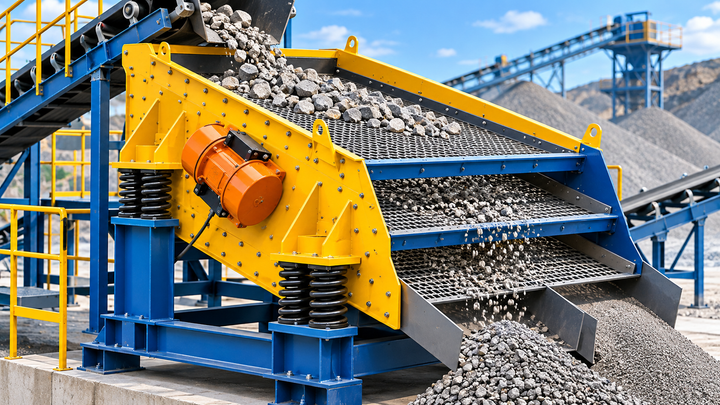
For example, a stone processing plant may use a vibrating screen to separate crushed rock into several aggregate sizes. Larger stones remain on the upper deck, while smaller particles pass through the openings and move to lower decks or collection conveyors.
Unlike manual screening, industrial vibrating screens provide continuous material processing and can be integrated into automated production lines.
Why Vibrating Screens Are Important in Material Processing
Material size directly affects the quality and suitability of many industrial products. Mining operations require mineral classification, construction plants need properly graded aggregates, and recycling facilities must separate recovered materials into different size groups.
Vibrating screens perform these separation tasks before or after other processing operations.
Their importance comes from several operational functions:
Particle classification: Separates materials into different size fractions.
Production consistency: Helps maintain uniform material grading.
Process optimization: Removes oversized or undersized particles at selected production stages.
Equipment protection: Removes unwanted large objects before materials enter certain downstream machines.
Material recovery: Helps recover reusable particles during recycling operations.
Continuous processing: Supports high-volume material handling in industrial plants.
A properly selected vibrating screen also helps balance the workload between crushers, conveyors, washing equipment, and other processing machinery.
How Does a Vibrating Screen Work?
A vibrating screen works by generating controlled movement across a screening surface. This movement causes incoming material to travel along the deck while particles smaller than the screen openings pass through.
The separation process involves several mechanical and material-handling stages.
1. Material Feeding
Bulk material enters the vibrating screen through a feed chute or distribution system. The material should be distributed across the available screen width to avoid uneven loading.
Consistent feeding helps maintain effective separation throughout the screening area.
2. Vibration Generation
An electric motor drives a vibrating mechanism containing eccentric weights or another excitation arrangement.
The rotating mechanism generates forces that move the screen body according to its designed vibration pattern.
3. Particle Stratification
As the screen vibrates, particles move relative to one another. Larger particles tend to remain closer to the upper surface, while smaller particles move through the material bed toward the screening openings.
This process is called stratification.
4. Particle Separation
Particles smaller than the screen apertures can pass through the screening media. Oversized particles remain on the surface and continue moving toward the discharge area.
The size of the openings determines the nominal separation size.
5. Material Discharge
Separated materials leave the machine through different discharge points. In a multi-deck vibrating screen, several particle size fractions can be produced from one feed stream.
6. Continuous Screening
The process continues as new material enters the machine. The separated fractions are transported to conveyors, storage areas, crushers, or other processing equipment.
The following table summarizes the typical screening workflow.
Process Stage | Machine Activity | Result |
|---|---|---|
Feeding | Material enters the screen | Initial material distribution |
Vibration | Drive mechanism moves the screen | Particle movement begins |
Stratification | Particles separate within the material bed | Smaller particles move downward |
Screening | Particles interact with screen openings | Size classification |
Discharge | Different fractions leave the machine | Separated material streams |
Collection | Conveyors or storage systems receive output | Material ready for further processing |
The actual separation performance depends on particle shape, moisture content, feed distribution, aperture dimensions, vibration settings, and screen surface condition.
Main Types of Vibrating Screens
Vibrating screens are classified according to their movement pattern, deck orientation, and application requirements. The following are common industrial screen designs.
1. Inclined Vibrating Screen
An inclined vibrating screen has a screening surface positioned at an angle to the horizontal plane. It commonly uses circular or elliptical movement to transport material along the deck.
Gravity assists material movement toward the discharge end, while vibration helps particles separate according to size.
Main characteristics:
Sloped screening surface.
Commonly uses circular vibration.
Suitable for high-volume material classification.
Available in single-deck and multi-deck configurations.
Typical applications: Quarry operations, crushed stone production, sand processing, and mining.
2. Horizontal Vibrating Screen
A horizontal vibrating screen uses a screening surface positioned horizontally or close to horizontal. It commonly uses linear or elliptical vibration to move material across the deck.
Because gravity provides less assistance for material transportation, the machine relies more heavily on its vibration pattern.
Main characteristics:
Horizontal or near-horizontal deck.
Controlled material transportation.
Suitable for applications requiring accurate size separation.
Often used in washing and dewatering circuits.
Typical applications: Aggregate processing, mineral preparation, and industrial material classification.
3. Linear Vibrating Screen
A linear vibrating screen produces straight-line movement through a mechanical excitation arrangement. Many industrial designs use two synchronized eccentric shafts or vibrating motors operating in opposite directions.
The resulting motion transports material along the screen surface while allowing smaller particles to pass through the openings.
Main characteristics:
Straight-line vibration pattern.
Controlled material movement.
Suitable for horizontal or inclined installations.
Available for dry and wet screening applications.
Typical applications: Coal processing, mineral separation, industrial powders, and dewatering operations.
4. Circular Motion Vibrating Screen
A circular motion vibrating screen moves its screening body along a circular or approximately circular trajectory.
An eccentric shaft or unbalanced rotating weights typically generate the required movement. The combination of vibration and deck inclination helps transport material toward the discharge end.
Main characteristics:
Circular vibration trajectory.
Commonly installed with an inclined deck.
Suitable for coarse and medium particle separation.
Available with multiple screening decks.
Typical applications: Mining, quarrying, aggregate production, and stone crushing plants.
5. Elliptical Motion Vibrating Screen
An elliptical motion vibrating screen produces an elliptical movement pattern. This combines characteristics of circular and linear motion depending on the machine design.
The movement can support particle stratification and material transportation while providing flexibility for different screening conditions.
Main characteristics:
Elliptical vibration trajectory.
Combines vertical and horizontal movement.
Suitable for selected high-capacity screening operations.
Can be configured for different material characteristics.
Typical applications: Mineral processing, aggregate classification, and industrial screening plants.
6. High-Frequency Vibrating Screen
A high-frequency vibrating screen operates with relatively rapid vibration and is commonly designed for fine particle separation.
Its screening surface and excitation system are selected to promote the movement of smaller particles through the screen openings.
Main characteristics:
High vibration frequency.
Designed for fine material classification.
Often uses relatively small screen apertures.
Available for wet and dry screening configurations.
Typical applications: Fine mineral processing, silica sand classification, and selected industrial powder applications.
7. Vibrating Grizzly Screen
A vibrating grizzly screen uses heavy-duty bars or grizzly sections instead of conventional fine screening mesh. The spaces between the bars allow smaller material to pass through while larger rocks continue toward the discharge area.
It is commonly installed before primary crushing equipment.
Main characteristics:
Heavy-duty screening structure.
Large openings between screening bars.
Suitable for coarse material separation.
Designed to handle large and irregular feed particles.
Typical applications: Mining, quarrying, primary crushing, and bulk material handling.
Vibrating Screen Type Comparison
Different vibrating screen designs provide different separation characteristics. The following table compares their movement patterns and common industrial uses.
Screen Type | Movement Pattern | Typical Deck Position | Main Application |
|---|---|---|---|
Inclined Screen | Circular or elliptical | Inclined | Aggregate classification |
Horizontal Screen | Linear or elliptical | Horizontal | Accurate material separation |
Linear Screen | Straight-line | Horizontal or inclined | Coal and mineral processing |
Circular Motion Screen | Circular | Usually inclined | Quarrying and crushing |
Elliptical Screen | Elliptical | Horizontal or inclined | Mineral processing |
High-Frequency Screen | High-frequency vibration | Varies by design | Fine particle separation |
Vibrating Grizzly | Heavy-duty vibratory movement | Usually inclined | Coarse material separation |
These categories are not mutually exclusive. For example, an inclined screen can also use circular motion, while a horizontal screen can use linear or elliptical movement.
Main Components of a Vibrating Screen
A vibrating screen contains several mechanical components that work together to generate vibration, support the screening surface, and transport materials.
Component | Primary Function | Importance |
|---|---|---|
Screen Frame | Supports the screening assembly | Maintains structural stability |
Screen Deck | Holds the screening media | Provides the separation surface |
Screening Media | Contains openings for particle separation | Determines nominal separation size |
Electric Motor | Supplies mechanical power | Drives the vibration mechanism |
Vibrating Exciter | Generates controlled vibration | Creates the required movement |
Eccentric Weights | Produce unbalanced forces | Influence vibration characteristics |
Springs | Support the vibrating assembly | Isolate vibration from the support structure |
Bearings | Support rotating components | Enable smooth mechanical movement |
Feed Box | Distributes incoming material | Helps maintain uniform loading |
Discharge Chute | Directs separated material | Transfers output to downstream equipment |
Side Plates | Provide structural support | Help maintain machine rigidity |
Screen Frame
The screen frame is the main structural assembly that supports the vibrating components. It is generally manufactured using fabricated steel sections and plates designed to withstand repeated dynamic loading.
Its structural design must account for vibration forces, material weight, and operating conditions.
Screen Deck
The screen deck provides the surface on which material travels during separation. Depending on the machine configuration, it can contain one or multiple screening levels.
Multi-deck arrangements allow a single machine to produce several material size fractions.
Screening Media
Screening media refers to the actual surface containing openings through which undersized material passes.
Common options include:
Woven wire mesh.
Perforated metal plates.
Polyurethane screen panels.
Rubber screening panels.
Heavy-duty grizzly bars.
The appropriate media depends on aperture size, material abrasiveness, moisture, impact loading, and required separation accuracy.
Vibrating Exciter
The vibrating exciter generates the mechanical forces required to move the screen body. It may use eccentric shafts, rotating unbalanced weights, or specialized mechanical arrangements.
Its design influences vibration amplitude, frequency, and movement direction.
Springs and Bearings
Springs support the vibrating assembly while helping reduce the transmission of vibration to the stationary support structure.
Bearings support rotating shafts and other moving components. They must be suitable for the machine's operating loads, rotational speed, lubrication requirements, and vibration environment.
Important Operating Parameters of Vibrating Screens
Screening performance is influenced by several operating and design parameters. Adjusting one parameter can affect material transportation, separation efficiency, equipment loading, and component wear.
1. Vibration Frequency
Vibration frequency describes how many vibration cycles occur within a specified period. It is commonly expressed in hertz (Hz) or cycles per minute.
Frequency influences how frequently particles are lifted, moved, and presented to the screening openings.
Higher frequency may support fine screening applications, but excessive frequency can reduce effective particle contact time or increase mechanical stress.
2. Vibration Amplitude
Amplitude describes the displacement of the vibrating screen from its central position. In technical specifications, it is important to distinguish between single-sided amplitude and total peak-to-peak displacement.
Amplitude influences how strongly material is moved across the screen surface.
Greater amplitude can help move coarse or heavy material.
Lower amplitude may be appropriate for certain fine-screening applications.
Excessive amplitude can increase structural and component loading.
3. Screen Inclination
Screen inclination refers to the angle of the screening deck relative to the horizontal plane.
A steeper deck generally increases material transportation speed, while a flatter deck can provide more time for particles to interact with the screening openings.
The appropriate angle depends on material properties, required capacity, and separation accuracy.
4. Screen Aperture Size
Screen aperture is the size of the opening in the screening media.
For example, a screen with smaller openings separates finer particles than one with larger openings, assuming other conditions are comparable.
Aperture selection should consider the desired product size, particle shape, and the possibility of screen blockage.
5. Feed Rate
Feed rate describes the quantity of material entering the screen during a specified period.
An excessive feed rate can create a deep material bed, reducing the opportunity for smaller particles to reach the screening surface.
Uniform feeding helps improve the use of available screen area.
6. Material Moisture Content
Moisture affects particle movement and the interaction between material and screening media.
Wet, sticky materials can accumulate around the openings, causing blinding and reducing effective screening area.
For these applications, wet screening, suitable screen media, and appropriate material conditioning may be necessary.
Dry Screening vs Wet Screening
Vibrating screens can operate using dry or wet screening methods. The selection depends on material characteristics, separation requirements, and downstream processing conditions.
Comparison Factor | Dry Screening | Wet Screening |
|---|---|---|
Operating Method | Material passes over a dry screen surface | Water is introduced during screening |
Main Purpose | Size classification | Classification and washing |
Water Requirement | Generally not required | Requires water supply |
Common Materials | Dry aggregates, coal, and minerals | Wet minerals, sand, and aggregates |
Main Challenge | Dust and particle adhesion | Water management and slurry handling |
Typical Equipment | Dry vibrating screen | Wet vibrating screen with suitable drainage |
Dry Screening
Dry screening separates particles without adding water during the screening process. It is commonly used for dry aggregates, coal, minerals, and industrial materials.
Its performance depends on particle size distribution, moisture content, feed rate, and screen media condition.
Wet Screening
Wet screening introduces water to assist particle separation and remove fine contaminants or unwanted materials.
Water can help reduce material adhesion and improve the separation of selected fine particles. However, the process requires suitable drainage arrangements and management of the resulting slurry.
Applications of Vibrating Screens Across Industries
Vibrating screens are used in industries that require continuous classification, grading, washing, or separation of bulk materials.
1. Mining and Mineral Processing
Mining operations use vibrating screens to classify extracted materials according to particle size.
They are installed at different stages of mineral processing, including after crushing, during screening circuits, and before selected grinding or separation operations.
Common applications include:
Iron ore screening.
Gold ore classification.
Copper ore processing.
Coal preparation.
Mineral recovery operations.
2. Construction and Aggregate Production
Construction material plants use vibrating screens to produce different grades of sand, gravel, and crushed stone.
After crushing, materials pass through screening equipment to separate particles into specified size categories.
Typical applications include:
Crushed stone grading.
Sand classification.
Gravel separation.
Road construction aggregates.
Concrete and asphalt aggregate preparation.
3. Recycling and Waste Management
Recycling facilities use vibrating screens to separate recovered materials according to size.
They can be integrated into systems processing construction and demolition waste, compost, biomass, and other recyclable materials.
Typical applications include:
Construction waste classification.
Compost screening.
Biomass separation.
Recovered aggregate processing.
Municipal solid waste screening.
4. Chemical and Fertilizer Manufacturing
Chemical and fertilizer plants use vibrating screens to classify granular products and remove oversized particles.
Screening can take place after granulation, drying, or other material processing operations.
Typical applications include:
Fertilizer granule grading.
Chemical powder classification.
Industrial salt screening.
Granular product separation.
5. Food Processing
Food processing facilities use specialized screening equipment to classify selected dry ingredients and remove unwanted particles.
Depending on hygiene requirements and equipment construction, vibrating screens can process materials such as flour, grains, sugar, and food powders.
Typical applications include:
Grain separation.
Flour screening.
Sugar classification.
Powder processing.
Ingredient quality control.
6. Pharmaceutical Manufacturing
Pharmaceutical production uses specialized screening equipment for particle classification and powder processing.
Screening requirements depend on product characteristics, process validation, equipment materials, and contamination-control procedures.
Typical applications include:
Pharmaceutical powder classification.
Granule sizing.
Removal of oversized particles.
Selected intermediate material processing.
7. Steel and Foundry Industries
Steel plants and foundries use vibrating screens to classify bulk materials such as coke, foundry sand, and selected mineral inputs.
They can also be used in systems handling reclaimed foundry sand and other process materials.
Typical applications include:
Foundry sand classification.
Coke screening.
Raw material grading.
Recycled material separation.
Vibrating Screen vs Trommel Screen vs Static Screen
Vibrating screens are not the only equipment used for material classification. Trommel screens and static screens are also used in industrial processing, but their operating mechanisms differ.
The following table explains their main differences.
Comparison Factor | Vibrating Screen | Trommel Screen | Static Screen |
|---|---|---|---|
Working Principle | Mechanical vibration | Rotating cylindrical drum | Stationary inclined screening surface |
Main Movement | Vibrating deck | Rotating drum | No powered screen movement |
Material Transportation | Vibration and gravity | Drum rotation and inclination | Gravity and material flow |
Common Materials | Aggregates, minerals, and powders | Waste, compost, and aggregates | Selected bulk and wet materials |
Screening Accuracy | Depends on design and operating conditions | Depends on drum design and material | Depends on screen geometry and feed |
Mechanical Complexity | Moderate to high | Moderate | Generally lower |
Common Application | Industrial sizing and classification | Waste and bulk material screening | Preliminary or specialized separation |
A vibrating screen is generally appropriate when controlled vibration and continuous particle classification are required. A trommel screen may be suitable for rotating-drum applications, while a static screen can be used where a stationary screening surface meets the process requirements.
Benefits and Advantages of Vibrating Screens
Vibrating screens provide several operational advantages in bulk material processing.
Continuous operation: Supports ongoing material separation in industrial production lines.
Multiple size classifications: Multi-deck designs can produce several material fractions simultaneously.
Flexible configurations: Available in different sizes, motion patterns, and deck arrangements.
High material handling capability: Heavy-duty models can process substantial volumes of bulk material.
Integration with automation: Can operate alongside crushers, conveyors, feeders, and washing equipment.
Application versatility: Handles a wide range of materials, depending on the selected screening media and machine design.
Process consistency: Helps maintain more consistent particle-size distribution in downstream production.
These advantages are not automatic. Actual performance depends on proper equipment selection, installation, feed distribution, and maintenance.
Common Vibrating Screen Problems and Solutions
Vibrating screens operate under repeated mechanical loading and continuous material contact. Over time, operating conditions, incorrect adjustments, and component wear can affect screening performance.
The following table explains common problems and practical corrective approaches.
Common Problem | Possible Cause | Recommended Solution |
|---|---|---|
Screen Blinding | Fine or sticky particles block openings | Select suitable screen media and consider wet screening |
Screen Pegging | Oversized particles become trapped in openings | Review aperture geometry and screening media |
Uneven Material Distribution | Poor feed arrangement | Improve feed chute and material distribution |
Excessive Vibration | Incorrect settings or mechanical imbalance | Inspect the exciter and verify operating parameters |
Bearing Overheating | Lubrication problems or excessive loading | Inspect bearings and follow manufacturer lubrication requirements |
Screen Media Damage | Abrasion, impact, or incorrect tension | Inspect and replace unsuitable or damaged media |
Reduced Screening Efficiency | Incorrect feed rate or operating settings | Review feed conditions and vibration parameters |
Unusual Noise | Loose fasteners or worn components | Inspect structural joints and moving components |
Excessive Dust | Dry material movement and inadequate dust control | Use suitable dust extraction or suppression systems |
Understanding Blinding and Pegging
Blinding and pegging are two common screening problems, but they have different causes.
Blinding: Fine or sticky material accumulates on the screening surface and blocks the openings.
Pegging: Particles become physically lodged inside the screen apertures.
Selecting appropriate screening media is often more effective than simply increasing vibration intensity. Excessive adjustments can increase mechanical stress without resolving the underlying material problem.
How to Choose the Right Vibrating Screen
Selecting an industrial vibrating screen requires evaluating the material, required separation size, processing capacity, and operating environment.
A machine designed for coarse rock classification may not be suitable for fine powder screening. Therefore, equipment selection should begin with the actual process requirements.
The following table provides important selection criteria.
Selection Factor | What to Evaluate | Why It Matters |
|---|---|---|
Material Type | Sand, gravel, coal, minerals, or powders | Determines suitable machine construction |
Feed Particle Size | Minimum and maximum particle dimensions | Influences screen design |
Required Separation Size | Desired aperture dimensions | Determines screening media |
Processing Capacity | Required material throughput | Helps determine screen dimensions |
Moisture Content | Dry, damp, or wet material | Influences screening method |
Screen Motion | Circular, linear, or elliptical | Affects particle transportation |
Deck Configuration | Single or multiple decks | Determines the number of output fractions |
Screening Media | Wire mesh, rubber, polyurethane, or perforated plate | Influences wear and separation behavior |
Installation Space | Available plant area and height | Determines equipment configuration |
Maintenance Access | Bearing, drive, and screen media accessibility | Supports routine maintenance |
Environmental Conditions | Dust, temperature, and moisture | Influences equipment protection |
Match the Screen to the Material
Material characteristics should be evaluated before choosing the machine.
For example, abrasive crushed stone requires wear-resistant screening surfaces, while sticky materials may require specialized media or wet screening arrangements.
Evaluate the Required Capacity
The required throughput should be considered alongside screen width, deck length, feed distribution, and material bed depth.
A machine that is too small may experience excessive loading, while an unnecessarily large machine may increase installation and operating complexity.
Select Suitable Screening Media
Screening media should match the material's particle size, shape, abrasiveness, and moisture conditions.
Woven wire mesh provides open screening area, while polyurethane and rubber panels may be appropriate for selected abrasive or impact-intensive applications.
Check Drive and Vibration Requirements
The drive system should generate the movement required for the intended screening operation. Frequency, amplitude, and vibration direction must be compatible with the machine's structural design.
Operating adjustments should follow the equipment manufacturer's specifications rather than relying on arbitrary increases in speed or vibration.
Vibrating Screen Maintenance Best Practices
Preventive maintenance helps reduce unexpected equipment interruptions and supports consistent screening performance.
Because vibrating screens operate under repeated dynamic forces, their structural components and rotating mechanisms require regular inspection.
Inspect Screen Media
Check screening panels, wire mesh, and mounting arrangements for wear, cracks, damage, and blocked openings.
Damaged screening surfaces can affect product quality and allow unwanted particles to enter the separated material stream.
Monitor Bearings
Bearings experience significant mechanical loading during vibrating screen operation.
Inspect bearing temperature, noise, lubrication condition, and signs of abnormal movement. Use only lubricants and lubrication intervals specified by the equipment manufacturer.
Check Springs and Support Structures
Inspect support springs for cracks, corrosion, deformation, and uneven compression.
Also examine the support frame and mounting arrangements for loose connections or signs of structural fatigue.
Inspect Bolts and Fasteners
Repeated vibration can affect mechanical joints and fastening arrangements.
Check screen media fasteners, structural bolts, motor mounts, and other critical connections according to the maintenance schedule.
Monitor Vibration Characteristics
Record the machine's normal vibration behavior and compare it with operating conditions.
Changes in stroke, movement direction, or vibration intensity may indicate mechanical imbalance, component wear, or other equipment problems.
Maintain the Drive Mechanism
Inspect the motor, belts, pulleys, exciter, and associated components.
Abnormal noise, excessive heating, unusual movement, or visible damage should be investigated before the equipment returns to normal operation.
Safety consideration: Inspection and maintenance work should follow appropriate isolation and lockout procedures. Personnel should never reach into a moving screen or attempt to clear blocked material while the equipment is operating.
Vibrating Screen Industry Standards and Safety Considerations
Industrial vibrating screens must be designed and operated with attention to mechanical strength, moving components, electrical systems, and workplace safety.
Several recognized standards are relevant to screening equipment and industrial machinery.
ISO 9045: Industrial Screens and Screening — Vocabulary
ISO 9045 establishes terminology used in industrial screening. It provides definitions that support consistent technical communication about screens, screening operations, and related equipment.
ISO 12100: Safety of Machinery — General Principles for Design — Risk Assessment and Risk Reduction
ISO 12100 provides a framework for identifying machinery hazards, assessing risks, and implementing appropriate risk-reduction measures.
It is relevant when evaluating mechanical hazards associated with vibrating screens, including moving components, access points, and maintenance activities.
EN 1009-4: Safety of Machinery — Safety Requirements for Mineral Processing Machinery
EN 1009-4 addresses safety requirements for screening machinery used in mineral processing applications.
It covers hazards associated with screening equipment and provides requirements relevant to machine design and protection.
Important safety considerations include:
Guarding of rotating shafts and drive components.
Protection against access to moving mechanical parts.
Safe access for inspection and maintenance.
Suitable electrical protection.
Structural stability and appropriate machine mounting.
Emergency stopping arrangements where required.
Appropriate dust control and workplace protection.
The applicable requirements depend on the equipment design, installation, operating environment, and relevant jurisdiction.
Future Trends in Vibrating Screen Technology
Vibrating screen technology continues to develop through improvements in mechanical design, screening media, monitoring systems, and material-processing methods.
Several developments are influencing modern screening equipment.
Advanced Screening Media
Newer screening media designs focus on improving wear resistance, maintaining open screening area, and reducing material blockage.
Polyurethane panels, specialized rubber surfaces, and optimized aperture designs are used for applications with demanding material characteristics.
Intelligent Condition Monitoring
Condition monitoring systems can track vibration behavior, bearing temperature, and other operating parameters.
These measurements can help maintenance teams identify unusual equipment conditions and investigate developing mechanical problems.
Digital Process Optimization
Industrial monitoring and analytical systems can help evaluate feed rates, screening performance, and equipment operating conditions.
Combining process information with maintenance records can support more informed equipment adjustments.
Improved Mechanical Efficiency
Manufacturers continue to develop drive arrangements, structural designs, and vibration systems intended to improve machine performance and manage mechanical loading.
The appropriate design depends on the application rather than a single configuration being suitable for every screening process.
Sustainable Material Processing
Recycling and resource recovery operations are creating additional applications for industrial screening equipment.
Vibrating screens can help classify recovered aggregates, compost, minerals, and other reusable materials, supporting material recovery and waste-processing operations.
Frequently Asked Questions About Vibrating Screens
1. What is a vibrating screen used for?
A vibrating screen is used to separate bulk materials into different particle-size categories. It is commonly used in mining, quarrying, construction, recycling, and industrial manufacturing to classify materials such as sand, gravel, crushed stone, coal, and minerals.
2. What is the working principle of a vibrating screen?
A vibrating screen works by generating controlled mechanical movement across a screening surface. This movement distributes and separates particles, allowing smaller materials to pass through the openings while larger particles move toward the discharge area.
3. What are the main types of vibrating screens?
Common types include inclined vibrating screens, horizontal vibrating screens, linear vibrating screens, circular motion screens, elliptical motion screens, high-frequency screens, and vibrating grizzly screens. Their designs differ according to movement pattern, screening arrangement, and application.
4. What are the main components of a vibrating screen?
The main components include the screen frame, screen deck, screening media, electric motor, vibrating exciter, eccentric weights, springs, bearings, feed box, and discharge chute. These components work together to generate vibration and separate materials.
5. What is the difference between a linear and circular vibrating screen?
A linear vibrating screen produces straight-line movement, while a circular vibrating screen follows a circular or approximately circular trajectory. Linear screens are commonly used in coal and mineral processing, whereas circular motion screens are widely used in aggregate and quarry operations.
6. What is the difference between dry and wet screening?
Dry screening separates materials without adding water during the screening process. Wet screening introduces water to assist particle separation, remove fine contaminants, or process damp and sticky materials.
7. What factors affect vibrating screen efficiency?
Important factors include vibration frequency, amplitude, screen inclination, aperture size, material moisture, feed rate, particle shape, and material distribution. Screen media condition and machine maintenance also influence screening performance.
8. What is screen blinding in a vibrating screen?
Screen blinding occurs when fine or sticky particles accumulate on the screening surface and block its openings. This reduces the available screening area and can lower separation efficiency. Suitable screen media and appropriate wet screening arrangements can help address the problem.
9. How is a vibrating screen maintained?
Maintenance includes inspecting screening media, checking bearings, monitoring vibration characteristics, examining support springs, tightening mechanical connections, and maintaining the drive mechanism. All maintenance should follow the manufacturer's instructions and appropriate equipment isolation procedures.
10. Which industries use vibrating screens?
Vibrating screens are widely used in mining, quarrying, construction, recycling, chemical manufacturing, food processing, pharmaceuticals, steel production, and foundry operations. Each industry uses different screen configurations according to its material and separation requirements.
Conclusion
Vibrating screens are essential industrial machines for separating and classifying bulk materials according to particle size. Their operation combines mechanical vibration, particle stratification, and screening media to produce different material fractions. Inclined, horizontal, linear, circular, elliptical, high-frequency, and grizzly designs serve different processing requirements. Selecting the right vibrating screen requires evaluating material characteristics, processing capacity, aperture size, vibration parameters, and operating conditions. Proper maintenance and suitable screening media also help maintain reliable separation performance across mining, construction, recycling, and manufacturing operations.