AI-Powered Medical Imaging Systems: Technology, Applications and Future Healthcare Trends
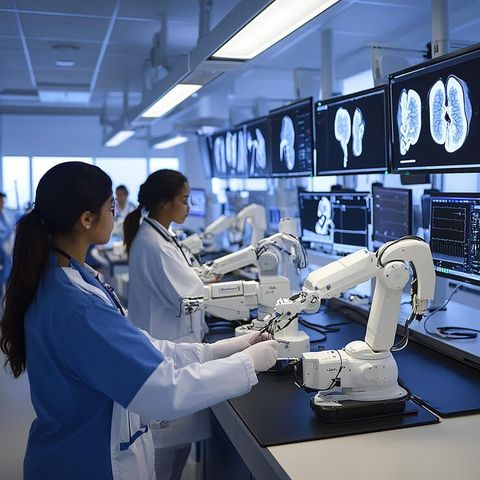
Medical imaging is an important part of modern healthcare. It helps doctors examine the internal structures of the human body without relying only on physical examinations. Technologies such as X-rays, magnetic resonance imaging (MRI), computed tomography (CT), and ultrasound help identify injuries, diseases, and other medical conditions.
Medical imaging plays an important role in modern healthcare. Technologies such as X-rays, magnetic resonance imaging (MRI), computed tomography (CT), ultrasound, and mammography allow doctors to examine internal body structures without traditional surgical procedures. However, interpreting large numbers of images can require considerable time and specialized knowledge.
AI technology introduces automated image analysis into this process. It can identify patterns, highlight unusual areas, measure anatomical structures, and organize imaging information for further examination. These capabilities support medical professionals while maintaining the importance of human clinical judgment.
As healthcare systems increasingly adopt digital technologies, AI medical imaging is becoming an important area of healthcare innovation.
Understanding AI-Powered Medical Imaging Systems
AI-powered medical imaging systems are computer-based technologies that analyze medical images using algorithms trained on relevant datasets. These systems learn to recognize patterns associated with different anatomical structures and medical conditions.
For example, an AI imaging application may examine a chest X-ray and highlight an area that requires additional attention. A radiologist can then review the highlighted region alongside the complete image and the patient's clinical information.
The technology generally combines several components:
Medical imaging equipment: Captures images using CT, MRI, ultrasound, X-ray, or other imaging methods.
Machine learning algorithms: Identify patterns in medical image datasets.
Deep learning models: Analyze complex image features through multiple computational layers.
Image processing software: Improves image quality and supports detailed examination.
Data management systems: Organize, store, and retrieve medical imaging information.
Clinical review interfaces: Present AI-generated findings to qualified healthcare professionals.
The primary purpose is to support image interpretation and improve the organization of diagnostic workflows rather than independently replace medical professionals.
Importance of AI Medical Imaging Technology
Medical imaging departments handle growing volumes of digital information. Hospitals and diagnostic centers need reliable methods to organize images, identify important findings, and maintain consistent examination procedures.
AI-powered diagnostic imaging addresses several important challenges.
Supporting Early Detection
AI algorithms can identify image patterns associated with certain medical conditions. In applications such as breast imaging, lung examination, and retinal analysis, these systems can highlight suspicious findings for professional review.
Earlier identification may support timely clinical investigation, although results depend on the medical application, image quality, patient characteristics, and algorithm performance.
Improving Radiology Workflows
Radiologists often examine hundreds of images during complex imaging procedures. AI tools can help prioritize examinations, highlight relevant regions, and automate selected measurement tasks.
This can help organize clinical workflows and allow professionals to concentrate on detailed image interpretation.
Supporting Consistent Image Analysis
Manual interpretation may vary between professionals because of differences in experience, workload, and examination conditions.
Validated AI algorithms can apply standardized image-analysis methods. However, consistent output does not automatically guarantee correct results. Clinical validation remains important.
Supporting Healthcare Research
Researchers can use AI to examine large collections of medical images and identify patterns that may be difficult to recognize through traditional methods.
These findings can contribute to research in cancer imaging, neurological disorders, cardiovascular conditions, and other medical fields.
Helping Remote Healthcare Networks
Digital imaging and AI-supported analysis can assist healthcare networks that connect smaller facilities with specialist centers.
This approach may support the review of medical images in areas where access to experienced imaging professionals is limited. Reliable internet infrastructure, appropriate equipment, and trained personnel remain necessary.
Major Applications of AI-Powered Medical Imaging
AI technology is being developed for different imaging techniques and medical specialties.
AI in X-Ray Imaging
AI-based X-ray analysis can identify and highlight findings associated with certain chest and bone conditions.
Potential applications include:
Identifying suspicious lung abnormalities.
Highlighting possible fractures.
Measuring selected anatomical structures.
Prioritizing examinations requiring urgent review.
Supporting image quality assessment.
These applications help organize image interpretation, but clinical decisions require professional assessment.
AI in MRI Systems
Magnetic resonance imaging produces detailed images of soft tissues, organs, and other internal structures.
AI applications in MRI include image reconstruction, noise reduction, anatomical segmentation, and automated measurements.
These capabilities can help improve image processing and support the examination of neurological, musculoskeletal, and cardiovascular conditions.
AI in CT Scanning
Computed tomography produces cross-sectional images of the body. AI systems can analyze these images to identify patterns associated with lung abnormalities, internal bleeding, and other findings.
Some applications also support image reconstruction and examination prioritization.
AI in Ultrasound Imaging
Ultrasound is widely used in abdominal, cardiac, pregnancy-related, and vascular examinations.
AI-assisted ultrasound systems can help identify anatomical structures, guide image acquisition, calculate measurements, and standardize selected examination procedures.
AI in Mammography
Mammography is an important imaging method for breast examination.
AI systems can analyze mammographic images, highlight suspicious regions, and support radiologists during screening and diagnostic assessments.
Their performance must be evaluated across different patient populations and imaging conditions.
AI in Digital Pathology
Digital pathology involves examining scanned tissue samples using specialized imaging systems.
AI algorithms can assist with cell identification, tissue classification, and the measurement of selected biological structures. This technology supports research and pathology workflows.
Recent Updates and Healthcare Technology Trends in 2025–2026
AI medical imaging continues to develop through advances in machine learning, imaging hardware, data infrastructure, and medical regulation.
Greater Adoption of AI-Enabled Medical Devices
During 2025 and 2026, AI applications continued expanding across radiology, ultrasound, cardiovascular imaging, and other healthcare areas.
A November 2025 systematic review published in JAMA Network Open examined FDA-authorized AI and machine learning medical devices. It identified 950 authorized devices, including 723 radiology devices. The findings demonstrate the growing role of AI in medical imaging, while also highlighting the importance of clinical testing and evidence quality.
AI-Assisted Ultrasound Development
In June 2026, an AI-enhanced ultrasound development received US FDA 510(k) clearance for specified ultrasound systems. The technology included image acquisition and workflow automation capabilities designed to support more standardized examinations.
This development reflects increasing attention to AI applications during image acquisition, rather than focusing only on image interpretation.
New International Risk Management Guidance
In June 2026, the International Organization for Standardization published ISO/TS 24971-2:2026.
This technical specification provides guidance on applying medical device risk management principles to machine learning-enabled medical devices. It addresses risks associated with machine learning and complements the ISO 14971 framework.
Increased Attention to Generative AI
In August 2026, the US FDA published a discussion paper seeking feedback on generative AI-enabled medical devices.
The paper examines risk assessment, premarket evaluation, and post-market monitoring. It reflects growing regulatory interest in the safety and reliability of more advanced AI technologies.
Emerging Technology Trends
Important developments include:
Multimodal AI combining imaging with other clinical information.
Automated image reconstruction and enhancement.
AI-supported three-dimensional medical visualization.
Cloud-based medical image analysis.
Improved imaging workflow integration.
Greater attention to cybersecurity and patient data protection.
Research into explainable AI and transparent diagnostic algorithms.
These developments indicate that medical imaging technology is moving toward more connected, data-driven, and intelligent clinical environments.
Challenges and Limitations
Despite its potential, AI-powered medical imaging faces several challenges.
Data quality: AI models depend on suitable training datasets. Poor-quality or incomplete images can affect their performance.
Algorithmic bias: Models trained using limited patient populations may perform differently across age groups, demographic backgrounds, and healthcare environments.
Privacy and security: Medical images contain sensitive patient information. Hospitals must protect these records against unauthorized access and data misuse.
Clinical reliability: AI systems can produce incorrect findings or overlook important abnormalities. Human review remains essential.
Integration difficulties: Connecting new AI software with existing imaging equipment and hospital information systems can require technical adjustments.
Training requirements: Healthcare professionals need appropriate training to understand AI-generated results and recognize system limitations.
Responsible implementation requires technical testing, clinical validation, cybersecurity measures, and ongoing performance monitoring.
Laws and Policies Affecting AI Medical Imaging
AI medical imaging is influenced by medical device regulations, patient privacy laws, clinical safety requirements, and emerging artificial intelligence governance frameworks. Requirements differ between countries.
Regulations in India
In India, medical devices are regulated under the Drugs and Cosmetics Act, 1940, and the Medical Devices Rules, 2017.
Software intended for medical purposes may fall within the medical device framework, depending on its intended use and regulatory classification.
The Central Drugs Standard Control Organization (CDSCO) oversees relevant regulatory requirements. AI-enabled medical imaging products may need appropriate regulatory authorization, technical documentation, and evidence supporting safety and performance.
India also introduced the Digital Personal Data Protection Act, 2023, establishing a framework for protecting digital personal data. Healthcare organizations must consider applicable privacy, security, and data-handling requirements.
In March 2026, India's Secure AI in Health Initiative (SAHI) and BODH framework were announced to support responsible, evidence-based AI adoption in healthcare.
Regulations in the United States
The US Food and Drug Administration regulates AI-enabled medical devices according to their intended medical purpose and associated risks.
Depending on the product, regulatory pathways may include 510(k) clearance, De Novo classification, or Premarket Approval.
Manufacturers and healthcare organizations must also consider relevant quality management, cybersecurity, performance validation, and post-market monitoring requirements.
Regulations in the European Union
The European Union has introduced the AI Act, which establishes requirements for different categories of AI systems.
Many provisions began applying on August 2, 2026. Under the revised implementation timeline, high-risk AI systems embedded in regulated products, including relevant medical devices, have an application date of August 2, 2028.
Medical device requirements under applicable European regulations continue to remain important.
Across all regions, compliance depends on intended use, product classification, clinical risk, and applicable national laws.
Tools and Resources for AI Medical Imaging
Healthcare professionals, researchers, and technology developers can use different categories of tools to understand and evaluate AI imaging systems.
| Tool Category | Main Purpose |
|---|---|
| DICOM viewers | Display and examine medical images |
| PACS platforms | Store and organize imaging records |
| AI image analysis software | Identify patterns and highlight image regions |
| Image annotation tools | Label images for research and model development |
| Machine learning frameworks | Develop and evaluate AI algorithms |
| Statistical calculators | Measure diagnostic performance |
| Clinical validation templates | Document testing and evaluation |
| Cybersecurity assessment tools | Identify digital security risks |
| Medical data management systems | Organize clinical imaging information |
Important Evaluation Measurements
Healthcare organizations should consider several measurements when evaluating AI imaging performance.
| Measurement | What It Indicates |
|---|---|
| Sensitivity | Ability to identify actual positive findings |
| Specificity | Ability to identify actual negative findings |
| Accuracy | Overall proportion of correct predictions |
| Precision | Proportion of positive predictions that are correct |
| False-positive rate | Frequency of incorrect positive findings |
| False-negative rate | Frequency of missed positive findings |
These measurements should be interpreted together because a strong result in one category does not necessarily indicate reliable performance overall.
Frequently Asked Questions
1. What Are AI-Powered Medical Imaging Systems?
They are technologies that use artificial intelligence and machine learning to analyze medical images, identify patterns, highlight unusual findings, and support healthcare professionals during image interpretation.
2. Which Medical Imaging Technologies Use AI?
AI is used in several imaging areas, including X-rays, MRI, CT scans, ultrasound, mammography, and digital pathology. Applications vary according to the technology and its clinical validation.
3. Can AI Replace Radiologists?
No. AI is primarily used to support image analysis, examination prioritization, and selected workflow tasks. Radiologists remain responsible for interpreting findings within the patient's clinical context and making appropriate diagnostic decisions.
4. How Does AI Improve Medical Image Analysis?
AI can identify image patterns, highlight regions of interest, automate selected measurements, and assist with image reconstruction. Its effectiveness depends on image quality, algorithm design, and clinical validation.
5. What Are the Main Risks of AI Medical Imaging?
Important risks include inaccurate predictions, algorithmic bias, patient data exposure, cybersecurity threats, and insufficient clinical validation. Proper oversight and continuous monitoring are necessary.
Conclusion
AI-powered medical imaging systems represent an important development in modern healthcare technology. By combining machine learning, medical imaging equipment, and digital data analysis, these systems can support image interpretation, improve selected clinical workflows, and contribute to medical research.