Automatic Blister Packing Machines: An Overview of Systems, Processes and Controls
Automatic blister packing machines are automated packaging systems used to place products into formed cavities and seal them with a backing material.
They are widely used in pharmaceutical, medical, food, electronics, hardware, and consumer-product packaging. The equipment combines forming, product feeding, sealing, cutting, and inspection stages into a coordinated production process.
Blister packaging is designed to hold individual products in shaped pockets while providing a protective cover. Depending on the application, the cavity may be formed from plastic film or aluminum-based material, while the lidding material can include foil, paper-based structures, or other compatible packaging layers. Automatic blister packing machines are designed to repeat these operations with controlled timing and alignment.
Context
What Are Automatic Blister Packing Machines?
Automatic blister packing machines are production systems that form cavities in a packaging material, place products into those cavities, seal the package, and separate finished units. Automation reduces the amount of direct manual handling required between individual stages.
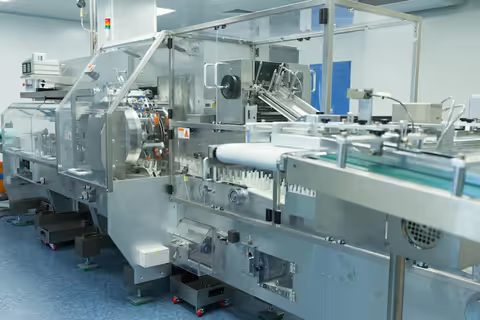
A typical machine can contain several connected sections:
Material unwinding and feeding
Heating and forming
Product feeding
Vision or presence inspection
Lidding-material feeding
Heat or pressure sealing
Printing or coding
Cutting and perforation
Finished-pack collection
The exact configuration depends on the packaged product, cavity design, packaging materials, and required production arrangement.
Development of Blister Packaging
Blister packaging developed as a way to hold individual products in formed pockets while allowing the contents to remain visible or protected. It became particularly important in pharmaceutical packaging, where individual doses can be separated and identified.
As packaging requirements became more complex, mechanical systems evolved from manually loaded equipment toward automated lines. Modern machines can coordinate product feeding, cavity formation, sealing, coding, cutting, and inspection through programmable controls.
Main Types of Blister Packing Machines
Automatic blister packing machines can be classified according to their forming method, packaging material, product type, and machine configuration.
Common categories include:
Thermoforming blister machines, which heat a suitable film before forming cavities
Cold-form blister machines, which shape aluminum-based laminate through controlled mechanical forming
Rotary blister machines, which use rotating stations for continuous processing
Plate-type blister machines, which use indexed forming and sealing stations
Pharmaceutical blister machines designed for tablets, capsules, and related products
Medical-device blister machines configured for sterile or controlled packaging environments
The appropriate configuration depends on the product dimensions, material characteristics, cavity shape, sealing requirements, and applicable packaging standards.
Importance
Product Protection
Blister packaging creates an individual compartment around each product. This can help separate products from one another and provide a physical barrier against handling, dust, moisture, and other environmental factors when the packaging structure is designed for those conditions.
Protection depends on the material combination, seal integrity, storage environment, and package design. A blister pack should therefore be evaluated as a complete packaging system rather than by the forming machine alone.
Accurate Product Placement
Automatic product feeding systems are designed to place products into predefined cavities. Sensors may check whether cavities contain products before the sealing stage.
Accurate placement is particularly important when each cavity represents a separate dose, component, or unit. Feeding mechanisms vary according to product shape, size, weight, surface characteristics, and orientation.
Production Consistency
Automated forming, sealing, cutting, and indexing systems can maintain repeatable machine cycles. Electronic controls coordinate the movement of different stations so that the packaging material and products remain synchronized.
Production consistency can be influenced by material thickness, forming temperature, sealing pressure, machine speed, product dimensions, and equipment adjustment.
Packaging Applications
Blister packaging is used across several industries.
| Industry | Common packaged items | Important considerations |
|---|---|---|
| Pharmaceutical | Tablets and capsules | Dose separation and package integrity |
| Medical | Small devices and components | Hygiene and material compatibility |
| Electronics | Small components | Protection and visibility |
| Hardware | Fasteners and small parts | Size, organization, and handling |
| Consumer products | Small personal or household items | Appearance and product identification |
| Food | Selected individual portions | Food-contact material requirements |
The packaging requirements vary considerably between industries. Pharmaceutical and medical applications may have additional controls related to cleanliness, traceability, validation, and regulatory compliance.
Packaging Materials
Several material combinations can be used in blister packaging. Thermoformed structures may use plastic films such as PVC, PET, or other materials selected according to the application. Cold-form structures commonly use aluminum-based laminates.
Lidding materials can include aluminum foil, paper-based structures, or compatible films. Material selection depends on barrier properties, forming characteristics, sealing behavior, product compatibility, and applicable regulations.
Recent Updates
Increased Automation
Recent developments in automatic blister packing machines increasingly involve integrated automation. Programmable logic controllers, servo drives, sensors, and touchscreen interfaces can coordinate forming, feeding, sealing, cutting, and inspection.
Automated recipe management can also allow operators to record selected machine parameters for particular packaging formats. The available functions vary between equipment designs.
Vision Inspection
Machine-vision systems are increasingly integrated into packaging lines. Cameras can inspect aspects such as product presence, cavity position, printed information, seal appearance, and selected package characteristics.
Vision inspection can help identify certain visible deviations during production. It does not replace laboratory testing or other quality-control procedures where those are required.
Digital Production Monitoring
Industrial packaging equipment increasingly connects machine controls with production-monitoring systems. Information may include cycle counts, machine status, alarms, material usage, and production interruptions.
These records can support process analysis and equipment maintenance planning. Data systems also make it possible to identify recurring machine events when appropriate sensors and software are installed.
Flexible Packaging Formats
Packaging facilities increasingly handle multiple product sizes and formats. Automatic blister packing machines may therefore incorporate adjustable forming stations, interchangeable tooling, programmable settings, and format-change mechanisms.
Tooling remains an important factor because cavity dimensions and package geometry are determined by the forming components. Changes between formats may require mechanical adjustments in addition to software settings.
Resource and Energy Management
Machine designers are also examining energy use, compressed-air requirements, heating efficiency, material utilization, and packaging waste. Servo-controlled drives and improved heating systems can change how energy is distributed across different machine sections.
Material efficiency is another consideration because forming and cutting can generate trim waste. Recycling or disposal arrangements depend on the material composition and local environmental requirements.
Data Integrity and Traceability
In regulated manufacturing environments, digital records are increasingly connected with packaging and batch information. Systems may record production parameters, inspection results, equipment status, and product identification information.
Traceability requirements are particularly relevant in pharmaceutical and medical packaging, where production records may need to be retained according to applicable regulations and quality systems.
Laws or Policies
Pharmaceutical Packaging in India
In India, pharmaceutical packaging is regulated within the broader framework administered by the Central Drugs Standard Control Organisation (CDSCO) and related authorities. Requirements can cover packaging materials, labeling, batch identification, product information, and manufacturing controls.
Specific requirements depend on the product category and applicable rules. Packaging facilities should consult current regulatory requirements for the particular pharmaceutical product being packaged.
Food Packaging
When blister packaging is used for food products, food-contact material requirements become relevant. The Food Safety and Standards Authority of India (FSSAI) establishes requirements concerning food safety, packaging materials, hygiene, labeling, and related matters.
Materials that come into direct contact with food need to comply with applicable requirements for their intended use.
Medical Devices
Medical-device packaging may involve additional requirements related to product protection, cleanliness, sterility, labeling, and traceability. In India, medical devices are regulated under the Medical Devices Rules, 2017 and related regulatory provisions.
The packaging system must be appropriate for the device and its intended use. Sterile products can require additional validation and packaging-integrity controls.
Workplace Safety
Automatic blister packing machines contain heated sections, moving mechanisms, cutting components, electrical systems, and pneumatic equipment. Appropriate machine guarding, emergency controls, operator training, and maintenance procedures are therefore important.
Indian workplace requirements can include provisions under the Occupational Safety, Health and Working Conditions Code, 2020, along with applicable rules and state-level requirements.
Environmental Considerations
Blister packaging can generate plastic film, aluminum, paper, rejected packs, and production trim. Facilities need to manage these materials according to their composition and applicable waste-management requirements.
Environmental obligations may involve waste segregation, storage, recycling arrangements, emissions, and disposal procedures. Requirements depend on the facility and materials being processed.
Tools and Resources
Packaging Material Testing
Packaging facilities may use instruments to examine material and package characteristics. Common equipment includes:
Thickness gauges
Seal-strength testing equipment
Leak or package-integrity testing systems
Temperature measurement instruments
Pressure gauges
Dimensional measuring tools
Vision inspection equipment
Moisture measurement instruments where applicable
The specific tests depend on the product and packaging specification.
Production Monitoring
Digital production records can track batch identification, machine settings, production counts, rejected packs, material changes, and inspection results. Such records can be maintained through manufacturing software or structured spreadsheets.
Packaging Design Tools
Computer-aided design software can be used to develop cavity dimensions, tooling concepts, package layouts, and artwork placement. Packaging engineers may use dimensional drawings and material specifications to confirm that the package fits the intended product.
Technical and Regulatory Resources
Useful resources include CDSCO publications, FSSAI regulations, the Bureau of Indian Standards, relevant medical-device regulations, environmental authorities, and machine technical manuals.
For regulated packaging, current official regulatory documents should be consulted because requirements can change according to product category and jurisdiction.
FAQs
What are automatic blister packing machines used for?
Automatic blister packing machines are used to form cavities, place products into those cavities, seal them with a lidding material, and cut or separate the finished packs. They are commonly used for pharmaceutical, medical, electronics, hardware, food, and consumer products.
How do automatic blister packing machines work?
The machine feeds a packaging material into a forming section, where cavities are created. Products are placed into the cavities, a lidding material is applied and sealed, and the finished web is then inspected, coded, cut, and collected.
What materials are used in automatic blister packing machines?
Common packaging materials include thermoformable plastic films, aluminum-based laminates, aluminum foil, paper-based structures, and compatible sealing layers. The material depends on the product, barrier requirements, forming method, and regulatory conditions.
What is the difference between thermoforming and cold-form blister packaging?
Thermoforming uses heat to soften a suitable plastic material before forming cavities. Cold-form packaging shapes an aluminum-based laminate through mechanical pressure without relying on the same heating process. Each approach has different material and barrier characteristics.
What quality checks are used with automatic blister packing machines?
Checks can include product presence, cavity dimensions, seal integrity, package appearance, printed information, coding accuracy, and material condition. Pharmaceutical and medical applications may require additional validated testing and documentation.
Conclusion
Automatic blister packing machines combine material forming, product feeding, sealing, inspection, coding, and cutting into coordinated packaging processes. Their applications extend across pharmaceutical, medical, food, electronics, hardware, and consumer-product industries, with machine configurations varying according to product and packaging requirements. Recent developments have emphasized automation, machine vision, digital monitoring, flexible formats, resource management, and traceability. In India, applicable requirements can involve CDSCO, FSSAI, medical-device regulations, workplace safety rules, and environmental provisions depending on the packaged product.