Discover the Basics of Modern Cable Manufacturing and Production Systems
Modern cable manufacturing combines electrical engineering, materials science, automated machinery, and quality testing.
From copper or aluminium conductors to insulation and protective layers, every stage of production affects the cable's electrical performance, durability, and safety.
Cable manufacturing and production systems are used for many applications, including power distribution, buildings, industrial equipment, telecommunications, renewable-energy installations, and transportation. Understanding the basic cable manufacturing process helps readers see how raw materials are transformed into finished cable products that meet defined technical requirements.
Context
Cable manufacturing is the controlled process of producing electrical or communication cables from conductive materials and protective materials. A typical cable contains a conductor, insulation, and, depending on its application, additional layers such as screens, fillers, armour, inner sheaths, and outer sheaths.
Copper and aluminium are common conductor materials because they provide suitable electrical conductivity and mechanical characteristics. The conductor may be produced as a solid wire or as multiple smaller wires that are stranded together. IEC 60228:2023 establishes standardized conductor sizes, wire arrangements, and resistance requirements for many types of electric power cables and cords.
The basic cable manufacturing process generally includes:
- Wire drawing to reduce conductor diameter.
- Annealing to improve the flexibility of certain metal conductors.
- Stranding to combine individual wires.
- Insulation extrusion around the conductor.
- Core identification and inspection.
- Laying up multiple insulated cores where required.
- Application of screens, fillers, armour, or protective layers.
- Outer sheath extrusion.
- Final electrical and mechanical testing.
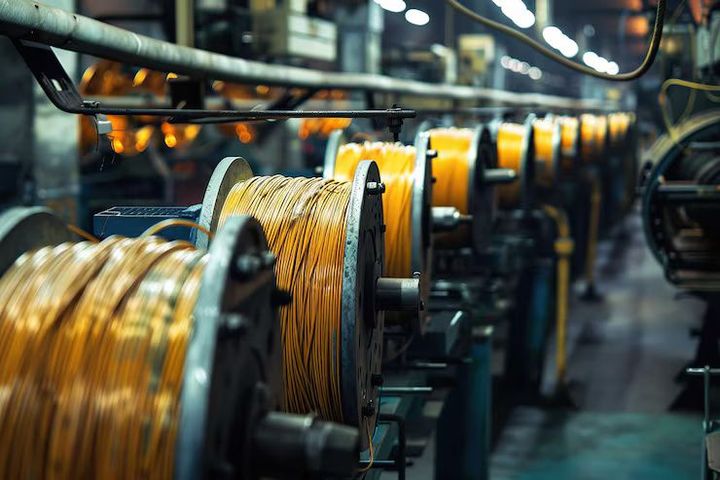
Production systems may use individual machines or integrated production lines. Modern facilities increasingly connect machines with sensors and control systems so that production parameters can be monitored throughout the process.
Importance
Cable manufacturing matters because cables are essential components of electrical and communication infrastructure. Their performance can affect electrical efficiency, system reliability, fire behavior, mechanical protection, and long-term operation.
A cable must be designed for its intended voltage, current, temperature, environment, installation method, and mechanical conditions. For example, an underground power cable may require stronger protection against moisture and mechanical forces than a cable designed for an indoor application.
The production system also affects consistency. Controlled extrusion temperature, conductor dimensions, insulation thickness, line speed, and cooling conditions can influence the final cable's characteristics.
Quality control commonly examines factors such as:
- Conductor resistance.
- Conductor dimensions.
- Insulation thickness.
- Insulation resistance.
- Sheath dimensions.
- Tensile strength and elongation.
- High-voltage performance.
- Flame-related characteristics where applicable.
- Dimensional and visual conformity.
These checks can involve both routine production tests and more detailed type or qualification tests, depending on the applicable standard.
Recent Updates
Cable manufacturing technology has been developing alongside renewable energy, electric transportation, data infrastructure, automation, and higher-voltage power networks. Manufacturers are increasingly using automated measurement, digital monitoring, and process-control systems to maintain consistent production conditions.
One important standards development is IEC 60228:2023. This edition covers conductor nominal cross-sectional areas from 0.5 mm² to 3,500 mm² and includes requirements related to conductor construction and resistance. It applies to copper, aluminium, aluminium-alloy, solid, stranded, and certain flexible conductors used in relevant electric cables.
Another area of development is the increasing use of halogen-free and low-smoke materials for applications where smoke and corrosive emissions during fire are important considerations. Standards and product specifications vary according to the application and jurisdiction.
In India, the Bureau of Indian Standards has also updated or reviewed several cable-related standards. Current BIS information identifies IS 7098 (Part 1):2025 for crosslinked polyethylene insulated thermoplastic sheathed cables for working voltages up to and including 1,100 V. BIS laboratory information also shows implementation and testing activity associated with this newer standard during 2026.
Modern production systems may also incorporate:
- Automated diameter measurement.
- Online spark testing.
- Digital temperature controls.
- Computerized production records.
- Automated tension control.
- Machine-condition monitoring.
- Data collection for quality analysis.
These technologies help production teams identify variations earlier and maintain process records.
Laws or Policies
Cable manufacturing is regulated differently across countries. Requirements can include electrical safety rules, product standards, environmental regulations, fire-performance requirements, labeling provisions, and conformity-assessment procedures.
Internationally, IEC standards are widely used as technical references. However, an IEC standard does not automatically represent the legal requirement in every country. Local authorities, national standards organizations, and regulatory agencies determine which requirements apply to a particular cable and market.
In India, several cable categories are covered by Indian Standards and the applicable conformity-assessment framework. BIS documentation identifies standards including IS 694 for PVC insulated cables, IS 1554 for PVC insulated heavy-duty cables, and IS 7098 for crosslinked polyethylene insulated cables under the relevant cable quality-control framework.
BIS documentation also provides product-specific testing and certification information. For example, IS 7098 Part 2 addresses XLPE insulated thermoplastic sheathed cables for working voltages from 3.3 kV up to and including 33 kV.
Organizations producing or installing cables should verify the latest applicable national requirements before selecting a standard. Regulations may change, and the correct requirement depends on cable type, voltage rating, application, and location.
Environmental rules may also affect material selection. Depending on the market, manufacturers may need to consider restrictions on hazardous substances, chemical requirements, waste management, and recycling obligations.
Tools and Resources
Reliable technical resources can help students, engineers, production teams, and researchers understand cable manufacturing more accurately.
Useful resources include:
- IEC standards databases for international technical standards.
- BIS publications and standards information for Indian requirements.
- Cable manufacturer technical datasheets for construction terminology and specification examples.
- Electrical engineering handbooks for conductor, insulation, and voltage concepts.
- Engineering calculators for voltage drop, conductor resistance, current capacity, and electrical loading.
- Laboratory testing procedures for understanding cable qualification and routine tests.
- Production-management software for tracking manufacturing parameters and quality records.
IEC 60228 is particularly useful when learning about conductor sizes, construction, and resistance requirements.
For India-specific research, the BIS standards and laboratory information systems provide references for applicable standards and testing arrangements. BIS laboratory records currently include testing information associated with IS 7098 Part 1:2025.
FAQs
What is cable manufacturing?
Cable manufacturing is the industrial process of producing cables by combining conductors with insulation and, when required, protective layers such as screens, armour, fillers, and outer sheaths.
What materials are commonly used in cable production?
Copper and aluminium are widely used for conductors. Common insulation and sheath materials include PVC, polyethylene, crosslinked polyethylene, elastomers, and halogen-free compounds, depending on the cable's application and required performance.
What are the main stages in the cable manufacturing process?
The main stages can include wire drawing, annealing, stranding, insulation extrusion, core identification, laying up, protective-layer application, outer sheathing, and final testing.
Why is cable testing important?
Testing verifies whether important characteristics such as conductor resistance, insulation performance, dimensions, mechanical strength, and electrical integrity meet the applicable specification.
Which standards are used for cable manufacturing?
Standards depend on the cable type and market. IEC standards are widely referenced internationally, while national standards such as BIS standards apply in India. IEC 60228:2023 is an important reference for conductors used in many electric cables.
Conclusion
Modern cable manufacturing is a structured process that combines conductor preparation, insulation, protective layers, automated production equipment, and quality testing. Each stage contributes to the electrical, mechanical, and environmental performance expected from the finished cable.
Understanding cable manufacturing and production systems is useful for engineers, students, infrastructure planners, technical researchers, and other readers who want to understand how electrical cables are produced and evaluated.
As production technology develops, digital monitoring, automated inspection, improved materials, and updated technical standards are becoming increasingly important. At the same time, manufacturers must continue to follow the relevant national regulations and technical specifications for each application.