Fluorescent Lights Overview: How They Work, Types, Features, and Common Uses
Fluorescent lights are electric light sources that produce illumination through a gas-discharge process.
Unlike traditional incandescent bulbs, fluorescent lighting uses an electric current to excite mercury vapor inside a sealed glass tube. This process creates ultraviolet energy, which interacts with a phosphor coating on the inner surface of the tube to produce visible light.
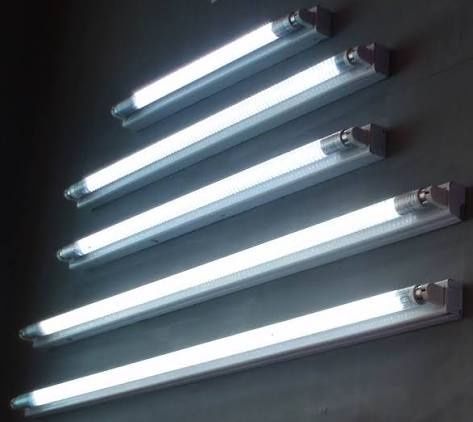
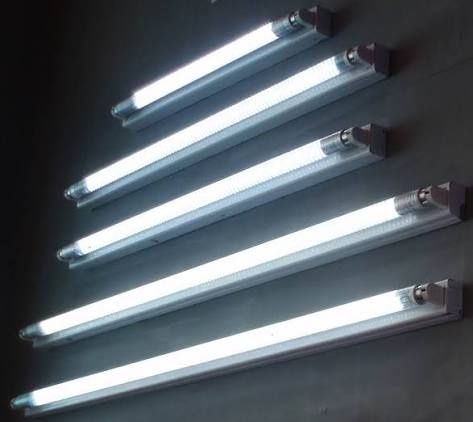
Fluorescent tube lights became widely used in offices, factories, schools, warehouses, and public buildings because they could illuminate large areas with relatively low electricity consumption. Over time, different fluorescent light fixtures were developed for ceilings, walls, work areas, and industrial environments.
How Fluorescent Lighting Works
A fluorescent lamp requires electrical control equipment known as a ballast. The ballast regulates the electrical current flowing through the lamp. Some older systems also use starters, while many modern fluorescent ceiling lights use electronic ballasts.
The main components generally include:
- Glass tube containing a small amount of mercury vapor and inert gas
- Phosphor coating that converts ultraviolet energy into visible light
- Electrodes positioned at each end of the tube
- Ballast that controls electrical current
- Fixture that supports and connects the lamp
| Fluorescent Type | Common Shape | Typical Application |
|---|---|---|
| T5 | Narrow linear tube | Offices and modern buildings |
| T8 | Standard linear tube | Schools, offices, and retail spaces |
| T12 | Larger linear tube | Older lighting installations |
| CFL | Compact curved tube | Small indoor fixtures |
| Circular | Round tube | Decorative and ceiling fixtures |
Importance
Fluorescent lighting remains relevant because many existing buildings still contain fluorescent light fixtures. Commercial fluorescent lighting can provide broad and consistent illumination across large indoor areas, while industrial fluorescent lights have traditionally been used where long operating periods are common.
Office fluorescent lighting systems are designed to provide general illumination across desks, corridors, meeting areas, and shared spaces. Warehouse fluorescent lighting and industrial ceiling lighting are commonly arranged in rows to distribute light across large floor areas.
Lighting quality can affect visibility, workplace comfort, and the ability to perform detailed tasks. Aging lamps may flicker, become dim, or change color, making fluorescent light replacement an important part of building maintenance.
Recent Updates
The current trend in commercial and industrial lighting is a gradual transition from traditional fluorescent systems toward LED technology. Many organizations are reviewing energy efficient commercial lighting options because LEDs can reduce electricity use and require different maintenance patterns.
An industrial lighting retrofit may involve replacing entire fixtures or adapting existing systems for compatible LED tubes. Similar changes are occurring in offices, schools, warehouses, and other buildings with older fluorescent ceiling lights.
At the same time, fluorescent lighting installation remains relevant in buildings where compatible fixtures are already operating. Decisions about replacement often consider fixture condition, ballast compatibility, lighting requirements, electrical safety, and local rules for handling used lamps.
Laws or Policies
In India, lighting products and electrical equipment may be affected by standards and requirements developed by the Bureau of Indian Standards and energy-efficiency programs associated with the Bureau of Energy Efficiency. Applicable requirements can vary according to the product type, building use, and electrical installation.
Fluorescent lamps also require careful disposal because they contain a small amount of mercury. Waste-handling rules may apply to discarded lamps and other electrical materials. Large commercial and industrial facilities may use approved collection and recycling channels to manage used fluorescent tube lights.
Commercial lighting installation and industrial lighting systems must also follow relevant electrical safety requirements. Wiring, fixtures, protective equipment, and installation practices should be appropriate for the building and operating environment.
Tools and Resources
Several resources can help people understand and manage fluorescent lighting systems. Lighting calculators can estimate the approximate number of fixtures needed for a room based on floor area and desired illumination levels.
Useful resources include:
- Lux calculators for estimating illumination levels
- Energy-use calculators for comparing lighting technologies
- Lighting layout software for planning fixture placement
- Lamp identification charts for T5, T8, T12, and other tube formats
- Manufacturer compatibility charts for lamps, ballasts, and fixtures
- Government and standards websites for electrical and environmental guidance
For commercial lighting fixtures, technical labels can provide information about lamp type, wattage, voltage, ballast requirements, and compatibility. These details are particularly useful during fluorescent light replacement or an industrial lighting retrofit.
FAQs
What are fluorescent lights used for?
Fluorescent lights are commonly used in offices, schools, warehouses, workshops, retail buildings, corridors, and other indoor spaces that require broad illumination.
How do fluorescent tube lights produce light?
Fluorescent tube lights use an electrical current to excite mercury vapor inside a glass tube. The resulting ultraviolet energy interacts with a phosphor coating to create visible light.
What is the difference between commercial fluorescent lighting and industrial fluorescent lights?
Commercial fluorescent lighting is commonly designed for offices, shops, schools, and similar buildings. Industrial fluorescent lights may use fixtures designed for larger spaces, longer operating periods, dust exposure, or demanding working environments.
When is fluorescent light replacement needed?
Replacement may be considered when a lamp no longer starts, becomes noticeably dim, flickers repeatedly, changes color, or reaches the end of its operating life. Ballast condition and fixture compatibility may also affect performance.
What is involved in a fluorescent lighting installation?
Fluorescent lighting installation generally involves selecting compatible lamps, fixtures, ballasts, wiring, and mounting positions. The installation must match the electrical system and applicable safety requirements.
Conclusion
Fluorescent lighting has played an important role in illuminating commercial, industrial, educational, and public buildings. Different lamp types and fluorescent light fixtures are designed for varied spaces and lighting requirements. Current trends increasingly involve LED replacement and industrial lighting retrofit projects, while many existing fluorescent systems remain in operation. Understanding lamp types, components, compatibility, and disposal requirements helps explain how these lighting systems are managed.