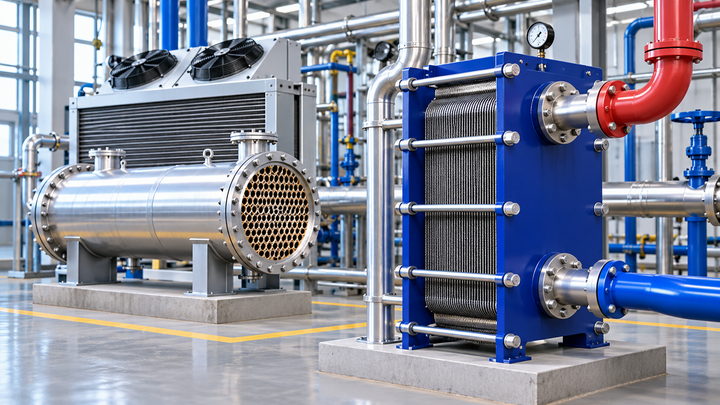
Heat Exchanger Systems Explained: Types, Working and Applications
A heat exchanger is a thermal energy transfer device that moves heat between two fluids at different temperatures without necessarily allowing them to mix.
Heat exchanger systems are used for heating, cooling, condensation, and heat recovery across industrial processes, power generation, refrigeration, chemical manufacturing, and building systems.
Different designs use tubes, plates, coils, or specialized channels to transfer thermal energy. Their selection depends on operating temperature, pressure, fluid properties, heat transfer requirements, and maintenance conditions.
Quick Facts About Heat Exchanger Systems
The following table summarizes the essential characteristics of industrial heat exchanger systems.
Feature | Details |
|---|---|
Equipment Name | Heat Exchanger |
Primary Function | Transfer thermal energy between fluids |
Operating Principle | Temperature difference and heat transfer |
Main Heat Transfer Methods | Conduction and convection |
Common Fluid Types | Water, steam, oil, refrigerants, gases, and process liquids |
Main Configurations | Shell-and-tube, plate, double-pipe, spiral, and air-cooled |
Flow Arrangements | Parallel flow, counterflow, and crossflow |
Common Materials | Stainless steel, carbon steel, copper, titanium, and nickel alloys |
Main Applications | Heating, cooling, condensation, evaporation, and heat recovery |
Common Industries | Oil and gas, chemical processing, power generation, HVAC, and food processing |
Key Performance Factors | Heat transfer area, temperature difference, flow rate, and fouling resistance |
What Is a Heat Exchanger System?
A heat exchanger system is a piece of thermal equipment designed to transfer energy from a hotter medium to a colder medium. The two fluids generally flow through separate passages, allowing heat to move between them while maintaining physical separation.
In most industrial applications, heat exchangers use a solid metal surface between the two fluids. Heat travels from the hot fluid through the separating material and into the colder fluid.
For example, in an industrial cooling process, hot oil may circulate through a heat exchanger while cooling water flows through separate passages. Thermal energy moves from the oil to the water, reducing the oil temperature without directly mixing the two fluids.
Heat exchangers can operate continuously and are commonly integrated into larger thermal systems. Depending on their design, they can transfer heat between liquids, gases, steam, and refrigerants.
Their main functions include:
Heating industrial process fluids.
Cooling machinery and circulating liquids.
Condensing vapor into liquid.
Evaporating liquids into vapor.
Recovering thermal energy from exhaust streams.
Maintaining operating temperatures in industrial equipment.
Why Heat Exchanger Systems Matter in Industrial Operations
Industrial processes frequently generate heat that must be removed, transferred, or reused. Without appropriate thermal management, equipment temperatures can move outside their intended operating ranges, affecting process stability and equipment performance.
Heat exchanger systems help manage these thermal requirements by transferring energy between different process streams.
Several operational functions explain their importance.
Temperature regulation: Heat exchangers maintain required process temperatures by heating or cooling circulating fluids.
Energy recovery: Waste heat from industrial processes can be transferred to another stream for preheating or other useful applications.
Equipment protection: Cooling systems help control temperatures in machinery, compressors, turbines, and other equipment.
Process continuity: Controlled heat transfer supports consistent conditions in manufacturing and chemical processing.
Thermal efficiency: Reusing available heat can reduce the need for additional heating or cooling energy.
Process separation: Indirect heat exchangers allow thermal energy transfer while keeping two process fluids physically separated.
The actual performance depends on equipment design, operating conditions, insulation, fluid characteristics, and maintenance practices.
How Does a Heat Exchanger Work?
A heat exchanger operates through the movement of thermal energy from a higher-temperature medium toward a lower-temperature medium. The transfer continues as long as a temperature difference exists between the two streams.
In an indirect heat exchanger, the fluids remain separated by a heat-conducting surface.
1. Hot Fluid Enters the Heat Exchanger
The hotter fluid enters through an inlet connection and moves through the designated passage. Its temperature is higher than that of the cooling or receiving fluid.
2. Cold Fluid Enters Through a Separate Passage
The colder fluid enters through another connection. Depending on the exchanger design, it may travel through tubes, plates, channels, or the space surrounding a tube bundle.
3. Thermal Energy Transfers Across the Surface
Heat moves from the hot fluid to the separating wall through convection. It then travels through the wall by conduction before transferring into the colder fluid through convection.
4. Fluid Temperatures Change
As thermal energy moves between the streams, the hot fluid loses heat and the colder fluid gains heat.
The resulting outlet temperatures depend on flow rates, inlet temperatures, heat transfer area, material properties, and exchanger configuration.
5. Both Fluids Leave Through Their Respective Outlets
The heated and cooled streams leave through separate outlet connections and continue toward their intended process equipment.
The following table summarizes this operating sequence.
Operating Stage | Process Activity | Result |
|---|---|---|
Fluid Entry | Hot and cold streams enter separate passages | Two thermal streams are established |
Heat Transfer | Energy moves across the separating surface | Temperature difference drives heat flow |
Temperature Change | One stream loses energy while the other gains it | Fluid temperatures move toward each other |
Fluid Exit | Both streams leave through separate outlets | Heating or cooling objective is achieved |
Heat Transfer Principles Used in Heat Exchanger Systems
Understanding heat transfer principles helps explain why exchanger designs differ in size, construction, and thermal performance.
Conduction
Conduction is the transfer of heat through a solid material. In an indirect heat exchanger, thermal energy passes through the metal wall separating the two fluids.
Materials with suitable thermal conductivity help transfer heat effectively. However, material selection must also account for corrosion resistance, mechanical strength, and operating temperature.
Convection
Convection occurs when thermal energy moves between a fluid and a surface. It takes place on both sides of the separating wall.
Fluid velocity, viscosity, flow conditions, and channel geometry influence convective heat transfer.
Temperature Difference
A temperature difference provides the driving force for heat transfer. A larger temperature difference generally supports greater thermal transfer under otherwise comparable conditions.
However, actual performance also depends on heat transfer resistance, flow arrangement, and available surface area.
Heat Transfer Equation
A commonly used heat exchanger design relationship is:
Where:
\(Q\) = Heat transfer rate.
\(U\) = Overall heat transfer coefficient.
\(A\) = Effective heat transfer surface area.
\(F\) = Temperature difference correction factor, where applicable.
\(\Delta T_{LM}\) = Logarithmic mean temperature difference (LMTD).
This relationship helps engineers estimate the heat transfer capacity required for a particular process. Detailed design also considers pressure drop, fouling resistance, material limitations, and operating conditions.
Main Types of Heat Exchanger Systems
Heat exchangers are classified primarily by their physical construction and heat transfer arrangement. Each design addresses different thermal, mechanical, and maintenance requirements.
1. Shell-and-Tube Heat Exchanger
A shell-and-tube heat exchanger consists of a cylindrical outer shell containing a bundle of tubes. One fluid travels through the tubes, while the other flows through the surrounding shell space.
Baffles direct the shell-side fluid across the tube bundle and help support the tubes.
This construction is widely used in industrial processes requiring robust equipment and adaptable operating configurations.
Main characteristics:
Suitable for many high-temperature and high-pressure applications, subject to design specifications.
Available in multiple tube and shell arrangements.
Can accommodate liquid-to-liquid and two-phase heat transfer.
Some configurations allow mechanical tube cleaning and bundle removal.
Typical applications: Oil refineries, chemical processing plants, power stations, condensers, and industrial boilers.
2. Plate Heat Exchanger
A plate heat exchanger uses a series of thin metal plates assembled into a frame or permanently bonded structure. The plates create alternating channels for hot and cold fluids.
The corrugated plate surfaces increase turbulence and provide a large heat transfer area within a compact arrangement.
Main characteristics:
Compact construction.
Large heat transfer area relative to equipment volume.
Suitable for many liquid-to-liquid applications.
Gasketed models can be opened for inspection and cleaning.
Typical applications: HVAC systems, food processing, district heating, pharmaceutical production, and industrial water heating.
3. Double-Pipe Heat Exchanger
A double-pipe heat exchanger consists of two concentric pipes. One fluid flows through the inner pipe, while the second fluid travels through the surrounding annular passage.
The fluids may flow in the same direction or opposite directions.
Main characteristics:
Simple mechanical construction.
Suitable for relatively small heat transfer duties.
Can be arranged in modular sections.
Useful for applications requiring straightforward inspection and maintenance.
Typical applications: Small industrial processes, oil cooling, chemical production, and laboratory thermal systems.
4. Air-Cooled Heat Exchanger
An air-cooled heat exchanger transfers heat from a process fluid to surrounding air. The process fluid typically travels through finned tubes while fans move air across the external surfaces.
Fins increase the effective heat transfer area exposed to the air.
Main characteristics:
Uses ambient air as the cooling medium.
Reduces dependence on industrial cooling water.
Suitable for outdoor installations.
Performance is influenced by ambient temperature and airflow.
Typical applications: Refineries, natural gas processing, petrochemical facilities, and remote industrial installations.
5. Spiral Heat Exchanger
A spiral heat exchanger uses two metal plates formed into spiral passages. The two fluids flow through separate channels arranged around a central region.
Its flow arrangement and passage geometry can support applications involving viscous fluids and certain fouling-prone streams.
Main characteristics:
Compact spiral construction.
Can accommodate selected viscous process fluids.
Provides continuous flow passages.
Requires consideration of cleaning access and pressure limitations.
Typical applications: Wastewater treatment, chemical processing, pulp and paper manufacturing, and sludge handling.
6. Plate-Fin Heat Exchanger
A plate-fin heat exchanger contains alternating layers of thin plates and fin structures. The fins increase the heat transfer surface area while maintaining separate flow passages.
This design is particularly useful in applications involving gases and multiple process streams.
Main characteristics:
High heat transfer surface area relative to volume.
Compact and lightweight construction.
Can support multiple-stream heat transfer.
Requires careful control of cleanliness and operating conditions.
Typical applications: Air separation plants, cryogenic processing, natural gas treatment, and aerospace thermal systems.
Heat Exchanger Type Comparison
The following comparison highlights the main differences between commonly used exchanger constructions.
Heat Exchanger Type | Construction | Main Advantage | Common Application |
|---|---|---|---|
Shell-and-Tube | Tube bundle inside a shell | Versatile industrial construction | Oil and gas processing |
Plate | Stacked or bonded metal plates | Compact thermal arrangement | HVAC and food processing |
Double-Pipe | Two concentric pipes | Simple configuration | Small process systems |
Air-Cooled | Finned tubes with airflow | Uses ambient air for cooling | Refineries and gas plants |
Spiral | Spiral-shaped flow channels | Handles selected difficult fluid streams | Chemical processing |
Plate-Fin | Plates with finned passages | High surface area in a compact structure | Cryogenic processing |
The appropriate design depends on the process fluid, required heat transfer duty, operating pressure, temperature, available space, and cleaning requirements.
Heat Exchanger Flow Arrangements
Apart from construction type, heat exchangers are also classified by the direction in which the two fluids travel.
Parallel Flow
In parallel-flow arrangements, both fluids enter from the same end and move in the same direction.
Their temperature difference is generally greatest near the inlet and decreases as they move toward the outlet.
Counterflow
In counterflow arrangements, the fluids enter from opposite ends and travel in opposite directions.
This arrangement can maintain a more uniform temperature difference along the heat transfer surface and often supports greater thermal effectiveness than parallel flow under comparable conditions.
Crossflow
In crossflow arrangements, the two fluids move approximately perpendicular to each other.
This configuration is common in air-cooled equipment, radiators, and HVAC coils.
Flow Arrangement Comparison
Flow Arrangement | Fluid Direction | Main Characteristics | Common Applications |
|---|---|---|---|
Parallel Flow | Same direction | Temperature difference decreases along the flow path | Selected heating applications |
Counterflow | Opposite directions | Often supports effective temperature exchange | Industrial process exchangers |
Crossflow | Perpendicular directions | Suitable for air-to-liquid heat transfer | Radiators and air coolers |
These arrangements are separate from construction classifications. For example, a shell-and-tube exchanger may use counterflow or multipass arrangements depending on its design.
Heat Exchanger vs Boiler vs Cooling Tower
Heat exchangers, boilers, and cooling towers are related thermal technologies, but they have different functions.
Equipment | Primary Function | Operating Principle | Typical Application |
|---|---|---|---|
Heat Exchanger | Transfers heat between streams | Thermal energy moves between fluids | Industrial heating and cooling |
Boiler | Generates steam or heated fluid | Adds energy through a heat source | Power generation and industrial heating |
Cooling Tower | Rejects heat into the atmosphere | Evaporative cooling and air contact | Industrial cooling water systems |
Chiller | Produces chilled fluid | Refrigeration cycle removes heat | HVAC and process cooling |
A boiler may supply steam to a heat exchanger, while a cooling tower may provide cooling water to another exchanger. A chiller can also use heat exchangers as part of its refrigeration circuit.
Therefore, these systems can work together within a larger thermal management installation.
Main Components of an Industrial Heat Exchanger
The physical components vary according to the exchanger design. The following table describes common parts found in industrial shell-and-tube and plate-based systems.
Component | Function | Application |
|---|---|---|
Shell | Contains shell-side fluid | Shell-and-tube exchangers |
Tubes | Provide a passage for one fluid | Shell-and-tube exchangers |
Tube Sheets | Secure and separate tube ends | Shell-and-tube exchangers |
Baffles | Direct fluid movement across tubes | Shell-and-tube exchangers |
Channel Head | Distributes tube-side fluid | Shell-and-tube exchangers |
Plates | Separate fluid channels and transfer heat | Plate exchangers |
Gaskets | Seal connections between plates | Gasketed plate exchangers |
Frame | Holds the plate assembly together | Plate-and-frame exchangers |
Fins | Increase external heat transfer area | Air-cooled and plate-fin exchangers |
Inlet and Outlet Connections | Direct fluid entry and discharge | Most exchanger designs |
Each component must be suitable for the operating pressure, temperature, fluid chemistry, and mechanical conditions of the application.
Applications of Heat Exchanger Systems Across Industries
Heat exchangers support numerous industrial and commercial processes. Their functions range from basic temperature control to complex energy recovery and phase-change operations.
1. Oil and Gas Industry
Oil and gas facilities use heat exchangers to cool hydrocarbons, heat process streams, condense vapors, and recover thermal energy.
Common applications include:
Crude oil preheating.
Natural gas cooling.
Hydrocarbon condensation.
Refinery process heating.
Compressor intercooling.
Shell-and-tube and air-cooled exchangers are frequently used in these environments.
2. Chemical and Petrochemical Processing
Chemical manufacturing involves reactions and separation processes that require controlled temperatures.
Heat exchangers are used in:
Reactor temperature control.
Chemical fluid heating.
Solvent condensation.
Process stream cooling.
Evaporation and reboiling.
Material compatibility is especially important because some chemicals can cause corrosion or damage unsuitable construction materials.
3. Power Generation
Power plants use heat exchangers in steam cycles, cooling systems, condensers, and heat recovery processes.
They transfer thermal energy between steam, water, oil, and other working fluids. Their operation helps maintain required temperatures across different stages of power generation.
4. HVAC and Refrigeration
Heating, ventilation, and air-conditioning systems use heat exchangers to regulate indoor temperatures and transfer thermal energy between air and circulating fluids.
Typical applications include:
Chilled-water systems.
Heating coils.
Air-conditioning equipment.
Refrigeration condensers.
Evaporator assemblies.
Plate heat exchangers and finned-tube coils are common in these applications.
5. Food and Beverage Processing
Food processing facilities use heat exchangers for controlled heating and cooling of liquids and other process materials.
Applications include:
Milk pasteurization.
Beverage cooling.
Liquid food heating.
Process water temperature control.
Product cooling after thermal treatment.
Hygienic construction, cleanability, and contamination prevention are important design considerations.
6. Pharmaceutical Manufacturing
Pharmaceutical production uses heat exchangers in temperature-controlled processing, purified water systems, and selected cleaning and sterilization processes.
Equipment selection must account for product-contact requirements, surface cleanliness, material compatibility, and process validation requirements.
7. Marine and Transportation
Ships and transportation equipment use heat exchangers to manage engine temperatures and cool lubricating oil, hydraulic fluids, and other operating media.
Marine applications may use seawater as a cooling medium, making corrosion resistance and protection against marine deposits important considerations.
8. Renewable Energy Systems
Renewable energy installations use heat exchangers in geothermal systems, solar thermal applications, and selected biomass energy processes.
For example, geothermal installations transfer heat from underground fluids to another working fluid or heating circuit. Material selection must account for the chemical composition and scaling potential of geothermal fluids.
Benefits and Advantages of Heat Exchanger Systems
Heat exchanger systems provide several operational advantages when correctly designed and integrated.
Energy recovery: Thermal energy from one process stream can be transferred to another, reducing the need for additional heating.
Temperature control: Exchangers help maintain operating conditions required by industrial processes.
Equipment cooling: They remove excess heat from machinery, engines, compressors, and production equipment.
Process separation: Indirect designs allow heat transfer without requiring the two fluids to mix.
Flexible configurations: Different constructions support a wide range of flow rates, pressures, temperatures, and fluid properties.
Process integration: Multiple exchangers can be connected into thermal networks to transfer and reuse energy across production stages.
However, the actual benefits depend on operating conditions, equipment selection, and the quality of maintenance.
Common Heat Exchanger Challenges and Solutions
Heat exchangers can experience performance problems due to operating conditions, fluid characteristics, mechanical deterioration, and maintenance limitations.
Common Challenge | Potential Effect | Recommended Approach |
|---|---|---|
Fouling | Reduced heat transfer performance | Establish appropriate cleaning procedures |
Scaling | Restricted flow and reduced thermal performance | Monitor water chemistry and scaling conditions |
Corrosion | Material deterioration and leakage | Select compatible materials and monitor corrosion |
Tube Leakage | Fluid contamination or mixing | Conduct appropriate inspection and pressure testing |
Pressure Drop | Increased pumping requirements | Review flow conditions and passage design |
Thermal Expansion | Mechanical stress | Account for thermal movement during design |
Vibration | Tube damage and mechanical wear | Evaluate flow-induced vibration and supports |
Gasket Failure | Leakage between fluid passages | Inspect and replace compatible gaskets |
Air Entrapment | Reduced effective heat transfer | Provide suitable venting and filling arrangements |
Fouling is particularly important because deposits can form on heat transfer surfaces and increase thermal resistance. Monitoring inlet and outlet temperatures, flow rates, and pressure drops can help identify performance changes.
How to Choose an Industrial Heat Exchanger
Selecting a heat exchanger requires a technical assessment of the process requirements. A suitable design must meet the required thermal duty while operating within mechanical and material limitations.
The following factors provide a practical selection framework.
Selection Factor | What to Evaluate | Why It Matters |
|---|---|---|
Heat Transfer Duty | Required thermal energy transfer | Determines equipment capacity |
Operating Temperature | Inlet and outlet temperatures | Influences design and material selection |
Operating Pressure | Pressure on both fluid sides | Determines mechanical construction |
Fluid Properties | Viscosity, density, and thermal conductivity | Affects heat transfer and flow behavior |
Chemical Compatibility | Corrosion and material compatibility | Helps prevent material deterioration |
Fouling Potential | Scaling, deposits, and suspended solids | Determines cleaning requirements |
Flow Arrangement | Parallel, counterflow, or crossflow | Influences thermal performance |
Available Space | Installation area and equipment dimensions | Affects construction selection |
Maintenance Access | Inspection and cleaning requirements | Supports long-term operation |
Energy Requirements | Heating, cooling, and pumping needs | Helps evaluate overall system performance |
For example, a shell-and-tube exchanger may be appropriate for demanding industrial process conditions, while a gasketed plate exchanger may suit applications requiring compact construction and frequent cleaning access.
An air-cooled exchanger may be considered where cooling water availability is limited. The final selection should be based on detailed thermal and mechanical engineering calculations.
Limitations of Heat Exchanger Systems
Although heat exchangers support a wide range of industrial applications, they have limitations that should be considered during equipment selection.
Fouling and scaling: Deposits can reduce heat transfer performance and restrict fluid passages.
Corrosion: Aggressive fluids can damage tubes, plates, and other wetted components.
Pressure drop: Fluid movement through narrow passages requires pumping or fan energy.
Space requirements: Large industrial exchangers may require substantial installation and maintenance space.
Maintenance requirements: Some designs require periodic disassembly, cleaning, inspection, or component replacement.
Temperature limitations: Materials, gaskets, and construction methods restrict permissible operating conditions.
Leakage risks: Mechanical deterioration can cause fluid leakage or cross-contamination.
Environmental dependence: Air-cooled exchanger performance can change with ambient temperature and airflow conditions.
No single exchanger design is suitable for every process. Equipment selection must balance thermal performance, mechanical reliability, operating requirements, and maintenance access.
Heat Exchanger Industry Standards and Safety Considerations
Industrial heat exchangers may operate under significant pressure and temperature conditions. Their design, fabrication, inspection, and testing must follow the applicable engineering requirements.
Several recognized standards are relevant to industrial heat exchanger applications.
ASME Boiler and Pressure Vessel Code, Section VIII
This code addresses the design and construction of pressure vessels. Its requirements may apply to pressure-containing heat exchanger components, depending on the equipment classification and applicable design rules.
TEMA Standards
The Tubular Exchanger Manufacturers Association standards cover shell-and-tube heat exchanger construction, mechanical design, nomenclature, and related engineering requirements.
API Standard 660
API Standard 660 addresses shell-and-tube heat exchangers used in petroleum, petrochemical, and natural gas industries.
API Standard 661
API Standard 661 covers air-cooled heat exchangers for petroleum, petrochemical, and natural gas applications.
ISO 16812:2019
ISO 16812:2019 addresses shell-and-tube heat exchangers used in petroleum, petrochemical, and natural gas industries, including mechanical design, material selection, fabrication, inspection, and testing.
The applicable requirements depend on the equipment type, industry, operating conditions, and project specifications. Qualified engineers should determine the appropriate design codes and safety requirements.
Heat Exchanger Maintenance Best Practices
Regular maintenance helps identify deterioration, preserve thermal performance, and reduce unexpected equipment interruptions.
Monitor Thermal Performance
Review inlet and outlet temperatures, flow rates, and heat transfer performance. Changes from established operating conditions may indicate fouling, leakage, or other problems.
Inspect Heat Transfer Surfaces
Examine tubes, plates, fins, and other heat transfer surfaces for deposits, corrosion, erosion, and physical damage.
Check Pressure Drop
Monitor pressure differences across the exchanger. Unexpected increases may indicate restricted flow passages or accumulated deposits.
Perform Appropriate Cleaning
Use cleaning methods compatible with the exchanger construction and process fluids. Chemical cleaning and mechanical cleaning should follow approved technical procedures.
Inspect Seals and Connections
Check gaskets, flanges, joints, and connections for leakage or deterioration. Replace damaged sealing components with compatible materials.
Monitor Corrosion and Leakage
Use appropriate inspection and testing methods to identify material deterioration, tube defects, and possible fluid leakage.
Maintain Operating Records
Document maintenance activities, operating conditions, inspection findings, and performance changes. Historical records support troubleshooting and maintenance planning.
Future Trends in Heat Exchanger Technology
Heat exchanger development continues to focus on improving thermal performance, reducing equipment size, supporting energy recovery, and addressing demanding operating environments.
Advanced Heat Transfer Materials
Research and engineering developments are exploring improved alloys, surface treatments, and corrosion-resistant materials. These technologies can support specialized applications involving aggressive fluids and demanding thermal conditions.
Compact Heat Exchanger Designs
Compact plate, plate-fin, and diffusion-bonded heat exchanger technologies are being used in applications where high heat transfer capacity and reduced equipment volume are important.
Improved Thermal Monitoring
Modern industrial monitoring systems can track temperature differences, pressure drops, flow conditions, and other performance indicators. These measurements support condition assessment and maintenance planning.
Waste Heat Recovery Integration
Industrial facilities are increasingly evaluating opportunities to reuse thermal energy from exhaust streams, process liquids, and other sources. Heat exchangers provide the physical connection needed to transfer recovered heat into useful process applications.
Advanced Surface Engineering
Surface coatings and modifications are being investigated to address fouling, scaling, and corrosion. Their suitability depends on fluid chemistry, operating conditions, and long-term material performance.
These developments are expanding the range of heat exchanger applications, although conventional designs remain important across many industrial facilities.
Frequently Asked Questions About Heat Exchanger Systems
1. What is the main purpose of a heat exchanger?
The main purpose of a heat exchanger is to transfer thermal energy between two fluids at different temperatures. It is commonly used for industrial heating, cooling, condensation, evaporation, and energy recovery.
2. What are the main types of heat exchangers?
The main construction types include shell-and-tube, plate, double-pipe, air-cooled, spiral, and plate-fin heat exchangers. Each design has different thermal, mechanical, and maintenance characteristics.
3. How does a heat exchanger work?
A heat exchanger transfers heat from a hotter fluid to a colder fluid through a separating surface or direct contact, depending on its design. In indirect systems, heat travels through a solid wall while the fluids remain in separate passages.
4. What is the difference between parallel flow and counterflow?
In parallel flow, both fluids travel in the same direction. In counterflow, they travel in opposite directions, which can maintain a more effective temperature difference across the exchanger.
5. Which industries use heat exchanger systems?
Heat exchangers are used in oil and gas, chemical manufacturing, power generation, HVAC, food processing, pharmaceuticals, marine engineering, and renewable energy installations.
6. What materials are commonly used in heat exchangers?
Common materials include carbon steel, stainless steel, copper, titanium, and nickel alloys. The appropriate material depends on operating temperature, pressure, corrosion resistance, fluid chemistry, and thermal conductivity.
7. What causes heat exchanger fouling?
Fouling occurs when unwanted deposits accumulate on heat transfer surfaces. Common causes include mineral scaling, corrosion products, suspended solids, biological growth, and process fluid deposits.
8. What is the difference between a heat exchanger and a condenser?
A heat exchanger transfers thermal energy between fluids and can support several heating and cooling processes. A condenser is a specialized heat exchanger that removes heat from vapor to convert it into liquid.
9. How often should a heat exchanger be maintained?
Maintenance frequency depends on fluid cleanliness, operating conditions, fouling potential, equipment design, and manufacturer requirements. Regular performance monitoring and condition-based inspections help determine appropriate maintenance intervals.
10. What factors affect heat exchanger efficiency?
Important factors include temperature difference, heat transfer surface area, fluid flow rates, material conductivity, flow arrangement, fouling resistance, and pressure drop. Proper design and maintenance help preserve thermal performance.
Conclusion
Heat exchanger systems are essential components of industrial thermal management, providing controlled heat transfer for heating, cooling, condensation, evaporation, and energy recovery. Shell-and-tube, plate, double-pipe, air-cooled, spiral, and plate-fin designs address different process requirements. Their performance depends on thermal properties, fluid characteristics, operating conditions, and mechanical construction. Understanding their working principles, applications, limitations, and maintenance requirements helps engineers select suitable equipment and maintain reliable industrial operations.