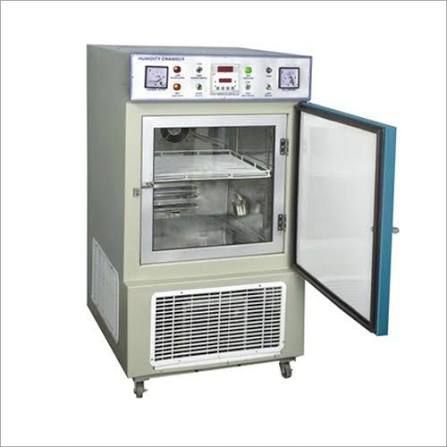
Humidity Chamber Guide: Learn How It Works, Types, Advantages, Testing Methods & Expert Advice
A Humidity Chamber is specialized laboratory equipment designed to create controlled environmental conditions by regulating temperature and humidity.
It helps researchers, engineers, manufacturers, and quality professionals evaluate how products, materials, and components perform when exposed to different climatic conditions.
Modern industries depend on reliable testing because products often experience changing weather, transportation conditions, storage environments, and operating temperatures throughout their lifecycle. A controlled Environmental Chamber allows these conditions to be reproduced consistently inside a laboratory instead of waiting months or years for natural exposure.
Many industries use a Temperature and Humidity Chamber to verify durability, identify weaknesses, improve product reliability, and ensure compliance with recognized testing standards. These chambers simulate rainforests, deserts, freezing climates, hot warehouses, and many other environmental conditions.
Common types of environmental testing equipment include:
| Chamber Type | Primary Purpose | Typical Applications |
|---|---|---|
| Humidity Chamber | Controlled humidity testing | Plastics, textiles, packaging |
| Temperature and Humidity Chamber | Combined climate simulation | Electronics, pharmaceuticals |
| Climatic Test Chamber | Environmental simulation | Industrial components |
| Stability Test Chamber | Long-term storage testing | Medicines, cosmetics |
| Temperature Test Chamber | Temperature-only testing | Automotive parts |
| Walk In Environmental Chamber | Large product testing | Vehicles, machinery |
| Thermal Cycling Chamber | Repeated heating and cooling | Electronic assemblies |
| Thermal Shock Chamber | Rapid temperature transitions | Aerospace components |
| Accelerated Aging Chamber | Simulated long-term aging | Polymers, coatings |
| Electronics Testing Chamber | Device reliability testing | Consumer electronics |
| Material Testing Chamber | Material performance analysis | Metals, composites |
Environmental testing has become increasingly important because manufacturers must demonstrate product reliability before products reach consumers or industrial users.
Why Environmental Testing Matters Today
Environmental conditions can significantly affect product performance. Excessive humidity may cause corrosion, mold growth, insulation failure, or electronic malfunction. Extremely low temperatures may reduce flexibility, while high temperatures can accelerate chemical degradation.
A Laboratory Humidity Chamber helps identify these issues before products are widely distributed.
Industries benefiting from environmental testing include:
- Electronics manufacturing
- Automotive engineering
- Aerospace research
- Pharmaceutical laboratories
- Medical device development
- Food packaging
- Renewable energy systems
- Construction materials
- Consumer appliances
- Telecommunications
An Environmental Simulation Chamber helps engineers recreate years of environmental exposure within a shorter testing period. While laboratory testing cannot perfectly duplicate every real-world situation, it provides repeatable conditions for scientific evaluation.
Major benefits include:
- Improved product consistency
- Better quality assurance
- Reduced unexpected failures
- More reliable research data
- Enhanced material comparison
- Better understanding of environmental effects
- Support for regulatory compliance
- Longer expected product life through design improvements
The growing use of electric vehicles, smart electronics, renewable energy equipment, and advanced medical technologies has increased the demand for precise environmental testing.
Types of Humidity Chambers and Testing Methods
Different testing objectives require different chamber designs.
| Chamber | Testing Purpose | Environmental Conditions |
|---|---|---|
| Environmental Test Chamber | General climate testing | Temperature and humidity |
| Climatic Test Chamber | Weather simulation | Heat, cold, moisture |
| Stability Test Chamber | Long-term storage evaluation | Controlled humidity and temperature |
| Thermal Cycling Chamber | Repeated expansion and contraction | Alternating hot and cold |
| Thermal Shock Chamber | Rapid temperature change | Extreme transitions |
| Accelerated Aging Chamber | Material durability | Elevated stress conditions |
| Electronics Testing Chamber | Electronic reliability | Variable climate cycles |
| Material Testing Chamber | Material behavior | Controlled environmental exposure |
Testing methods commonly performed include:
- Constant humidity testing
- Constant temperature testing
- Cyclic humidity testing
- Thermal cycling
- Thermal shock evaluation
- Accelerated aging studies
- Condensation resistance testing
- Corrosion-related environmental exposure
- Shelf-life evaluation
- Storage condition simulation
Typical chamber features include:
- Programmable environmental cycles
- Digital monitoring systems
- Data recording
- Adjustable humidity control
- Temperature calibration
- Safety protection systems
- Uniform airflow distribution
- Alarm monitoring
These capabilities allow laboratories to conduct repeatable experiments while maintaining controlled environmental conditions.
Recent Industry Updates and Emerging Trends
Environmental testing technology has continued to evolve throughout 2025 and early 2026 as industries focus on automation, sustainability, and digital monitoring.
Recent trends include:
- Greater adoption of IoT-enabled environmental monitoring systems.
- Increased integration of cloud-based data logging for laboratory documentation.
- Improved energy-efficient refrigeration systems that reduce electricity consumption.
- Expanded use of predictive maintenance through sensor analytics.
- More automated calibration reminders and diagnostic functions.
- Growing demand for larger Walk In Environmental Chambers for battery systems and electric vehicle components.
- Increased testing requirements for renewable energy equipment, including solar modules and battery storage technologies.
- Continued adoption of international laboratory quality practices emphasizing traceability, calibration, and electronic record management.
Manufacturers and research organizations are also placing greater emphasis on sustainability by improving insulation materials, reducing refrigerant emissions, and optimizing chamber energy efficiency.
Artificial intelligence is beginning to assist laboratories by analyzing historical testing data and identifying performance trends during environmental testing programs.
Standards, Regulations, and Laboratory Policies
Humidity chamber testing is often influenced by internationally recognized technical standards rather than a single national law.
Common standards include:
- IEC environmental testing standards
- ISO laboratory quality standards
- ASTM material testing standards
- MIL-STD environmental testing procedures
- ICH stability testing guidance for pharmaceutical products
- Good Laboratory Practice (GLP) principles where applicable
Government agencies may require compliance with these standards depending on product category, including:
- Medical devices
- Pharmaceuticals
- Aerospace equipment
- Automotive components
- Consumer electronics
- Electrical safety products
Laboratories generally follow documented procedures that include:
- Equipment calibration
- Environmental monitoring
- Test documentation
- Sample traceability
- Instrument maintenance
- Data integrity practices
Organizations using Environmental Testing Equipment often maintain calibration schedules to ensure measurements remain accurate throughout the equipment lifecycle.
Helpful Tools and Resources
Environmental testing often involves both laboratory equipment and supporting digital resources.
Useful resources include:
| Resource | Purpose |
|---|---|
| Data logging software | Records environmental conditions |
| Calibration management systems | Tracks equipment calibration |
| Laboratory Information Management Systems (LIMS) | Organizes laboratory data |
| Temperature conversion calculators | Converts Celsius and Fahrenheit |
| Relative humidity calculators | Calculates humidity relationships |
| Dew point calculators | Estimates moisture conditions |
| Environmental monitoring dashboards | Displays chamber performance |
| Spreadsheet templates | Test planning and reporting |
| Maintenance scheduling software | Tracks preventive maintenance |
| Digital documentation systems | Stores laboratory records |
Additional educational resources include:
- International standards documentation
- University engineering publications
- Laboratory quality manuals
- Environmental testing textbooks
- Research journals covering material science
- Technical conference proceedings
- Engineering association publications
These resources help laboratories improve consistency, documentation, and testing accuracy.
Frequently Asked Questions
What is a Humidity Chamber used for?
A Humidity Chamber creates controlled environmental conditions to study how products and materials respond to specific levels of temperature and humidity during laboratory testing.
What is the difference between a Humidity Chamber and a Climatic Test Chamber?
A Humidity Chamber primarily controls moisture levels, while a Climatic Test Chamber generally controls multiple environmental conditions such as temperature, humidity, and programmed climate cycles.
Which industries commonly use Environmental Test Chambers?
Industries include electronics, automotive, aerospace, pharmaceuticals, medical devices, packaging, construction materials, renewable energy, textiles, and academic research.
What is Thermal Cycling?
Thermal cycling repeatedly exposes products to alternating high and low temperatures to evaluate expansion, contraction, durability, and long-term reliability under changing environmental conditions.
Why is a Stability Test Chamber important?
A Stability Test Chamber provides carefully controlled storage conditions that help researchers evaluate how products maintain their quality, safety, and performance over extended periods.
Conclusion
Humidity chambers have become an essential part of modern environmental testing because they provide controlled, repeatable conditions for evaluating product performance. Whether testing electronics, pharmaceuticals, automotive components, construction materials, or research samples, these systems help laboratories understand how environmental conditions influence reliability and durability.
Different chamber designs—including the Temperature and Humidity Chamber, Environmental Test Chamber, Thermal Cycling Chamber, Accelerated Aging Chamber, Environmental Simulation Chamber, and Walk In Environmental Chamber—support a wide range of scientific and industrial applications. By simulating real-world climates inside a controlled laboratory environment, engineers and researchers can collect consistent data, compare materials, and improve product development processes.
Recent advances in automation, cloud-based monitoring, predictive maintenance, and energy-efficient technologies continue to improve environmental testing capabilities. At the same time, international standards and laboratory quality practices help ensure testing remains accurate, repeatable, and well documented.
As products become more advanced and operate in increasingly demanding environments, environmental testing will continue to play an important role in research, quality assurance, innovation, and long-term product reliability.