Industrial Blending Machines: A Guide to Mixing Systems, Technologies and Processing Applications
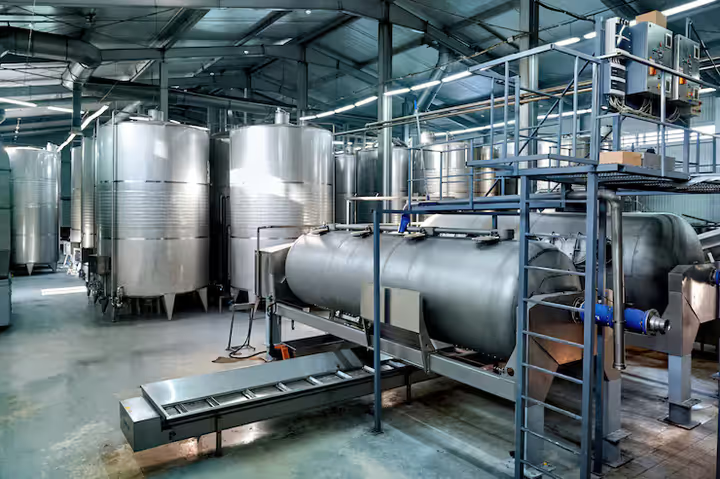
Industrial blending machines are mechanical systems used to combine two or more materials into a consistent mixture. They are used across chemical processing, food production, pharmaceuticals, plastics, cosmetics, agriculture, construction materials, and other manufacturing fields.
Depending on the material and production requirement, an industrial blender may use rotating blades, paddles, ribbons, screws, high-speed impellers, or controlled air movement to create the required mixture.
Context
What Are Industrial Blending Machines?
Industrial blending machines are equipment designed to mix powders, granules, liquids, pastes, or combinations of different materials. The primary purpose is to distribute ingredients throughout a batch or continuous material stream as evenly as the process requires.
Blending technology has developed from simple mechanical mixing toward equipment with controlled speed, programmable operating cycles, sensors, automated material feeding, and digital monitoring. The machine selected for a process depends on material characteristics, batch size, required mixing intensity, temperature, moisture, and production method.
How Industrial Blending Works
The basic blending process involves placing materials inside a mixing chamber and applying mechanical movement. The movement causes particles or liquids to circulate and interact with one another until the required degree of uniformity is reached.
A typical process may involve:
Loading raw materials into the mixing chamber
Measuring or dosing individual ingredients
Starting the mixing mechanism
Controlling speed and mixing duration
Monitoring temperature or other process conditions
Checking mixture consistency
Discharging the completed batch
Some machines operate in batches, while others are designed for continuous production.
Major Types of Industrial Blending Machines
Different blender designs are suited to different materials and process requirements. Common categories include ribbon blenders, paddle blenders, tumble blenders, high-shear mixers, planetary mixers, and conical screw blenders.
Ribbon blenders use helical ribbons mounted on a horizontal shaft. They are commonly used for powders and dry granular materials.
Paddle blenders use paddle-shaped elements to move materials through the mixing chamber. Their movement can be suitable for powders, granules, and materials that require relatively gentle handling.
Tumble blenders rotate the entire vessel or container. This method is often used when gentle movement is preferred.
High-shear mixers use rapidly moving mixing elements to create intensive mechanical action. They can be used for applications involving dispersion, emulsification, or difficult-to-mix materials.
Planetary mixers use rotating tools that move through a vessel while also rotating around their own axes. They are commonly associated with viscous materials and pastes.
Conical screw blenders use screw-shaped elements within a conical vessel and can be used for powders and granular products.
Importance
Consistent Material Distribution
Uniformity is an important consideration in manufacturing. If ingredients are not distributed properly, different portions of a batch may have different compositions or physical characteristics.
Industrial blending machines provide controlled mechanical movement that can help create a consistent mixture. The required level of uniformity depends on the application and material specification.
Supporting Different Industries
Blending equipment is used in many industrial sectors. Food manufacturers may blend dry ingredients, while chemical plants may combine powders or liquids. Pharmaceutical production uses specialized mixing equipment under controlled manufacturing conditions.
Other applications include:
Agricultural formulations
Construction materials
Polymer and plastic compounds
Detergent production
Cosmetic formulations
Mineral processing
Animal nutrition
Ceramic materials
Chemical powders
Specialty materials
Each application requires consideration of material behavior and process conditions.
Handling Different Material Characteristics
Materials behave differently during mixing. Particle size, density, moisture content, viscosity, flow characteristics, temperature, and tendency to form agglomerates can all affect the blending process.
For example, two powders with substantially different densities may separate after mixing if the equipment and process conditions are not appropriate. A viscous paste may require substantially different mechanical action from a dry granular material.
Batch and Continuous Production
Batch blending involves loading a defined quantity into the machine, processing it, and then removing the completed mixture. This arrangement can be useful when formulations or production quantities change between batches.
Continuous blending introduces materials into the equipment at controlled rates and continuously removes the blended material. This approach is commonly associated with production processes that maintain relatively consistent material flows.
| Blender Type | Typical Material | Mixing Characteristic | Common Application |
|---|---|---|---|
| Ribbon blender | Powders and granules | Horizontal mechanical movement | Dry formulations |
| Paddle blender | Powders and granules | Moderate mechanical action | Industrial mixtures |
| Tumble blender | Dry materials | Gentle movement | Sensitive powders |
| High-shear mixer | Powders, liquids, pastes | Intensive mixing | Dispersion and emulsification |
| Planetary mixer | Viscous materials | Multi-directional movement | Pastes and compounds |
| Conical screw blender | Powders and granules | Vertical screw movement | Specialty formulations |
These categories are general. Actual equipment selection depends on material testing, process requirements, vessel geometry, and operating conditions.
Hygiene and Contamination Control
In food, pharmaceutical, and certain chemical applications, preventing contamination between batches is important. Equipment design can therefore include smooth internal surfaces, controlled access points, suitable seals, drainage arrangements, and procedures for cleaning and inspection.
The appropriate cleaning approach depends on the material and regulatory environment. Some processes require specialized equipment designs to reduce material retention in difficult-to-access areas.
Recent Updates
Increased Process Automation
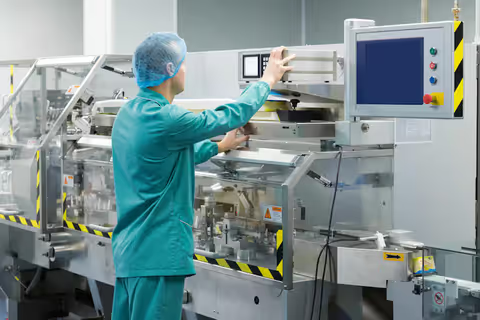
From 2024 through 2026, industrial blending systems have continued incorporating automation technologies. Programmable logic controllers, variable-frequency drives, digital sensors, and human-machine interfaces can allow operators to control mixing parameters more consistently.
Automated recipes can also associate specific ingredients and operating parameters with particular production batches. Appropriate access controls and process validation remain important when automated recipes are used in regulated manufacturing.
Digital Monitoring
Modern blending systems can collect information such as motor load, rotational speed, temperature, mixing duration, and equipment status. These measurements can help operators identify changes in process conditions.
Data logging can also support production records and equipment analysis. The usefulness of the collected data depends on sensor accuracy, system configuration, and how the information is interpreted.
Energy Monitoring
Industrial facilities are paying greater attention to energy consumption associated with motors, pumps, heaters, and other equipment. Blending systems may therefore incorporate motor controls and monitoring functions that allow energy use to be examined during different operating conditions.
Energy performance depends on factors such as batch size, material properties, mixing speed, equipment design, and operating time.
Flexible Manufacturing
Manufacturers increasingly handle multiple formulations and product variants on shared production equipment. This has increased interest in blending systems that can accommodate different recipes, batch quantities, mixing speeds, and processing conditions.
Flexible equipment configurations can also require careful cleaning and changeover procedures when materials must remain separated.
Predictive Equipment Monitoring
Sensors and digital analytics are increasingly being used to monitor mechanical components such as motors, bearings, shafts, and gear systems. Changes in vibration, temperature, or power consumption may indicate a developing mechanical issue.
Predictive monitoring does not eliminate physical inspection. Instead, it can complement established maintenance procedures by providing additional operating information.
Laws or Policies
Industrial Equipment Requirements in India
Industrial blending machines used in India may be subject to workplace safety, electrical safety, environmental, and industry-specific requirements. The exact obligations depend on the machine design, facility, material being processed, and state or central regulatory framework.
The Occupational Safety, Health and Working Conditions Code, 2020 forms part of India's workplace safety framework, subject to its applicability and implementation requirements.
Food and Pharmaceutical Applications
Blending machines used in food manufacturing may need to operate within applicable Food Safety and Standards Authority of India requirements. Equipment that comes into contact with food materials can also require suitable materials, hygienic design, and appropriate cleaning procedures.
Pharmaceutical manufacturing is subject to additional regulatory controls concerning equipment qualification, manufacturing processes, documentation, contamination control, and quality systems.
Environmental Considerations
Facilities processing powders, chemicals, or other industrial materials may need controls for dust, emissions, waste, noise, and material handling. Requirements can involve the Central Pollution Control Board, State Pollution Control Boards, and other applicable authorities.
The exact regulatory requirements depend on the industry, materials, location, and production process.
Machine Safety
Blending machines can contain rotating shafts, paddles, ribbons, gears, motors, and other moving components. Guarding, emergency stopping mechanisms, electrical protection, and appropriate operating procedures are therefore important parts of industrial machine safety.
Safety requirements should be evaluated according to the machine design and applicable standards.
Tools and Resources
Mixing Calculations
Engineers may use calculation tools to examine vessel volume, batch capacity, motor requirements, mixing speed, residence time, and material loading. These calculations should account for the physical characteristics of the materials involved.
Useful information can include:
Bulk density
Particle size
Moisture content
Viscosity
Batch volume
Mixing duration
Operating temperature
Required production rate
Motor rating
Material Testing
Laboratory-scale mixing tests can help determine how a material behaves before industrial-scale equipment is configured. Testing can examine blend uniformity, agglomeration, segregation, heat generation, and discharge behavior.
Industry Standards
ASTM, ISO, IEC, and other technical organizations publish standards relevant to materials, electrical systems, equipment testing, safety, and manufacturing processes. The applicable standard depends on the machine and industry.
Equipment Documentation
Important documentation can include equipment drawings, operating manuals, electrical diagrams, maintenance schedules, material specifications, inspection records, and process parameters.
Digital maintenance systems can help organize these records and associate them with individual machines or production lines.
FAQs
What are Industrial Blending Machines used for?
Industrial blending machines combine powders, granules, liquids, pastes, or other materials into a controlled mixture. They are used across food, chemical, pharmaceutical, agricultural, construction, plastic, and other manufacturing processes.
What are the main types of Industrial Blending Machines?
Common types include ribbon blenders, paddle blenders, tumble blenders, high-shear mixers, planetary mixers, and conical screw blenders. Each design produces a different type of material movement.
How does an Industrial Blending Machine work?
The machine introduces mechanical movement into a mixing chamber. Rotating ribbons, paddles, screws, blades, or other tools move the material until the required degree of mixture uniformity is reached.
What factors affect industrial blending performance?
Material density, particle size, moisture, viscosity, batch size, mixing speed, mixing duration, temperature, and equipment geometry can all influence blending behavior.
Are Industrial Blending Machines automated?
Many modern systems can include PLC controls, sensors, variable-frequency drives, automated recipes, digital monitoring, and data logging. The degree of automation depends on the manufacturing process and equipment configuration.
Conclusion
Industrial blending machines provide controlled mechanical mixing for powders, granules, liquids, pastes, and other industrial materials. Different designs, including ribbon, paddle, tumble, high-shear, planetary, and conical screw systems, address different material and production requirements. Recent developments have emphasized automation, digital monitoring, energy analysis, flexible production, and equipment condition monitoring. Appropriate machine selection and operation depend on material properties, production requirements, safety considerations, and applicable industry regulations.